🎮 HyperChrome Pity Calculator
Estimate Roblox Jailbreak HyperChrome robbery rolls from robbery type, color, current pity, drop chance, crew speed, target level, expected robberies, and cumulative chance.
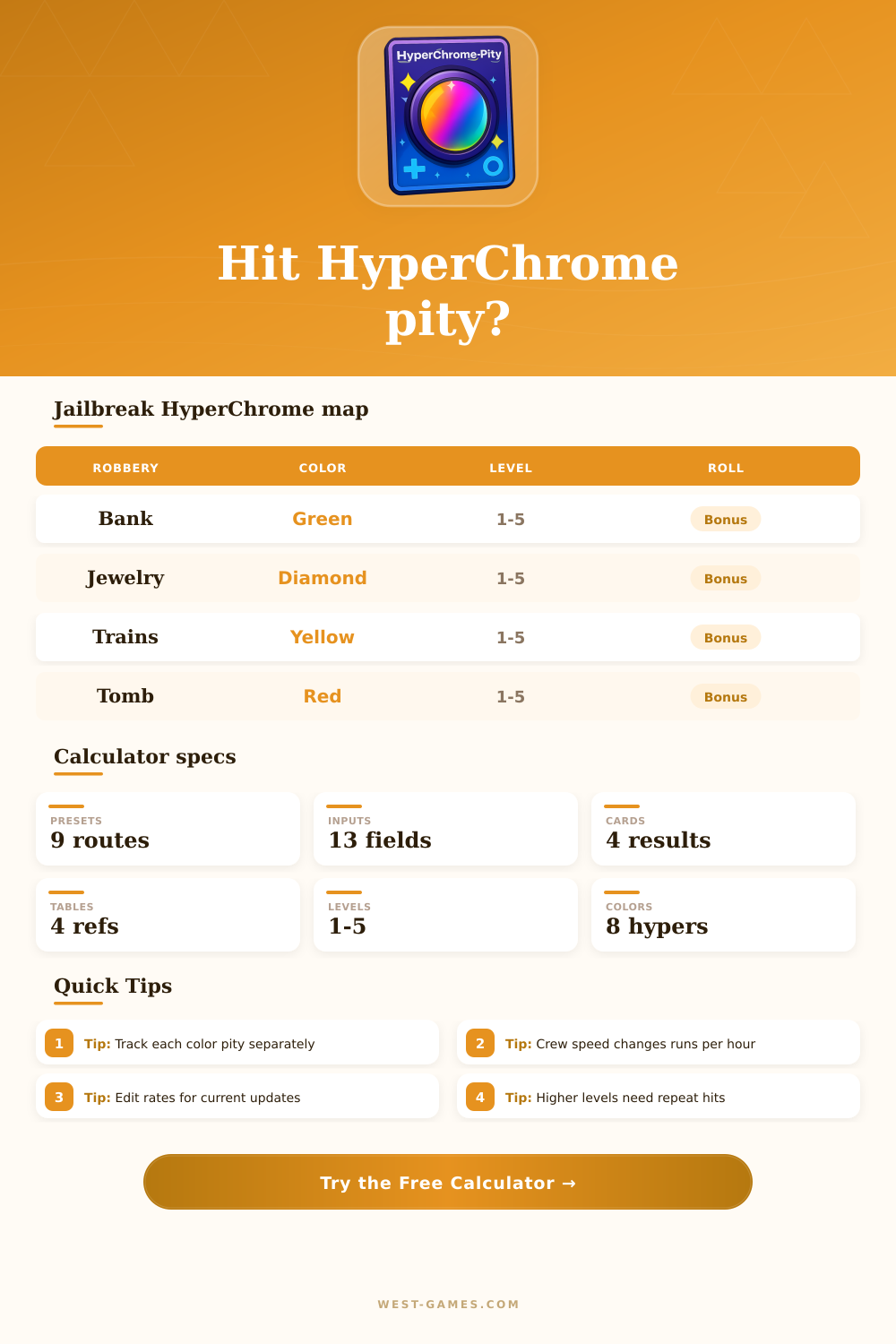
| Robbery route | Modeled color | Route feel | Preset note |
|---|---|---|---|
| Crater or Rising City Bank | HyperGreen | Repeatable city route | Good for steady pity tracking |
| Jewelry Store | HyperDiamond | Short vault route | Strong solo route when open |
| Cargo or Passenger Train | HyperYellow | Spawn-dependent route | Track only eligible completions |
| Museum | HyperOrange | Team pull route | Crew timing changes runs/hour |
| Power Plant | HyperPurple | Speed delivery route | Fast players may raise runs/hour |
| Cargo Plane | HyperBlue | Airport timing route | Good mixed-rotation input |
| Tomb | HyperRed | Group puzzle route | Use lower speed if waiting often |
| Crown Jewel or Casino | HyperPink | Interior route | Enter current version name |
If the game changes a robbery name or reward mapping, use the custom color and rate fields while keeping the math model intact.
| Current level | Target level | Hits needed | Reset logic |
|---|---|---|---|
| No color | Level 1 | 1 hit | Pity resets after hit |
| Level 1 | Level 3 | 2 hits | Each hit starts fresh |
| Level 3 | Level 5 | 2 hits | Current pity helps first hit |
| Level 4 | Level 5 | 1 hit | Short final chase |
The expected robberies card adds one current-pity hit plus fresh-pity hits for the remaining levels.
| Factor | Model value | What it means | Best use |
|---|---|---|---|
| Solo public | 0.90x | Missed cycles | Busy servers |
| Normal crew | 1.00x | Baseline route | General planning |
| Private route | 1.15x | Cleaner loops | Organized grind |
| Custom bonus | User % | Editable correction | Event or tracker data |
Crew factor adjusts modeled odds and route consistency together. Runs per hour still controls the time estimate separately.
| Checkpoint | Target | Robberies needed | Planning read |
|---|---|---|---|
| 50% | HyperGreen | 0 | Calculate to update |
| 75% | HyperGreen | 0 | Calculate to update |
| 90% | HyperGreen | 0 | Calculate to update |
| Expected | HyperGreen | 0 | Average plan |
Checkpoints are estimates, not guarantees. Random drops can land early or run long even with high cumulative chance.
After forty straight Bank robberies in Jailbreak, you might be left feeling frustrated, and empty-handed. You didn’t just get unlucky. That’s because math behind independent events stacks up and ruins your patience. The HyperChrome pity calculator makes that guesswork tangible. Suddenly, it’s less about shooting from the hip, and more about making an informed decision about when to stop grinding and call it quits.
It’s a combination of community-created pity systems and underlying luck of individual rolls. Each robbery roll starts fresh. But when you reach a certain number without success, the game raise your chances. It doesn’t want you twiddling your thumbs forever for one color. The calculator predicts how steep this rise is by asking for things like suspected hard cap and current roll count.
How The Calculator Helps You Win
Because the game combines different types of robberies, keeping tabs on those becomes important. If you’re trying to pity HyperBlue, don’t use Bank hits as part of your pity meter; that just costs time. Instead, the tool break them apart for you, allowing you to get a good read on the momentum of your chosen target different than a mix of everything you do.
The calculator accounts for the complexities introduced by crew dynamics. Things like lag, police interference, and crowded routes all slow down how many robberies a solo player can does in an hour in public sessions. Speed multipliers in the calculator reflect this reality. They acknowledge that a streamlined crew on private server will be able to roll through more in same amount of time. That means total hours invested before reaching a confidence checkpoint are changed.
Sure, maybe there’s a ten percent chance of getting the item during your next session, but slow routes mean doubling the time spent on said session. So it’s difference between an afternoon grind and all-nighter. But that’s not all you need to know: You also have to understand at what level you want to be. For instance, hitting Level 1 only takes one hit… Getting to Level 5 demands five separate successes. And each time you hit your goal, you reset the pity counter. That’s why the calculator represents the cumulative effort. It doesn’t just model chance of the next drop; it calculates how many robberies is expected until you’re fully maxed out on a color.
This helps with planning. Perhaps you’ll want to get to Level 3 before starting the marathon to reach Level 5? It also divides up that mountain into more reasonable hills. The reference table presets let you choose a robbery type to get right base rate. A Bank run using a Museum preset messes up prediction since it assumes different drops based off server load and route design. What you’re after is a model that reflects reality as closely as possible.
Calibration adjusts the tool’s settings to match recent community findings (or your own data). Tweaking the ramp multiplier and pity cap helps you obtain a personalized prediction if you notice drops coming earlier than predicted. And lastly, it replaces generic prediction with specific insight. So all this does is manage expectations for an experience rooted in random number generation.
Nothing is going to guarantee a drop for you. But it flags when you’re nearing something statistically odd or entering into a dry streak that probability tells us should of end shortly. It clears the emotional fog of the grind. Suddenly, rather than guesswork, there’s counting. The calculator does complicated math behind pity ramps and cumulative probabilities. And you get to do what we play games for: gameplay itself.
Just as you tracked empty bank runs when your frustration began, seeing the numbers helps show you the solution. Now, you’re not battling blind against the odds. You’re working with them. You are intimately aware of exactly how much further you have to go before the system tip in your direction.