⚒ Pax Dei Crafting Calculator
Plan Pax Dei crafting batches from gathered raw materials through refined components, station tier, quality chance, expected retries, durability loss, clan project targets, and wall-clock craft time.
| Profession | Common station | Typical material | Planning note |
|---|---|---|---|
| Blacksmithing | Forge / Anvil | Ore to metal | Often feeds weapons, armor, tools, and fittings. |
| Weaponsmithing | Weaponsmith Bench | Blades and shafts | Watch support parts from carpentry or leather. |
| Armorsmithing | Armorer Bench | Plates and straps | Durability planning matters on long gear batches. |
| Carpentry | Carpenter Bench | Logs to planks | Large clan builds can bottleneck on processing time. |
| Tailoring | Loom / Bench | Fiber to cloth | Batch outputs may be stacked components. |
| Recipe tier | Station check | Quality difficulty | Planner action |
|---|---|---|---|
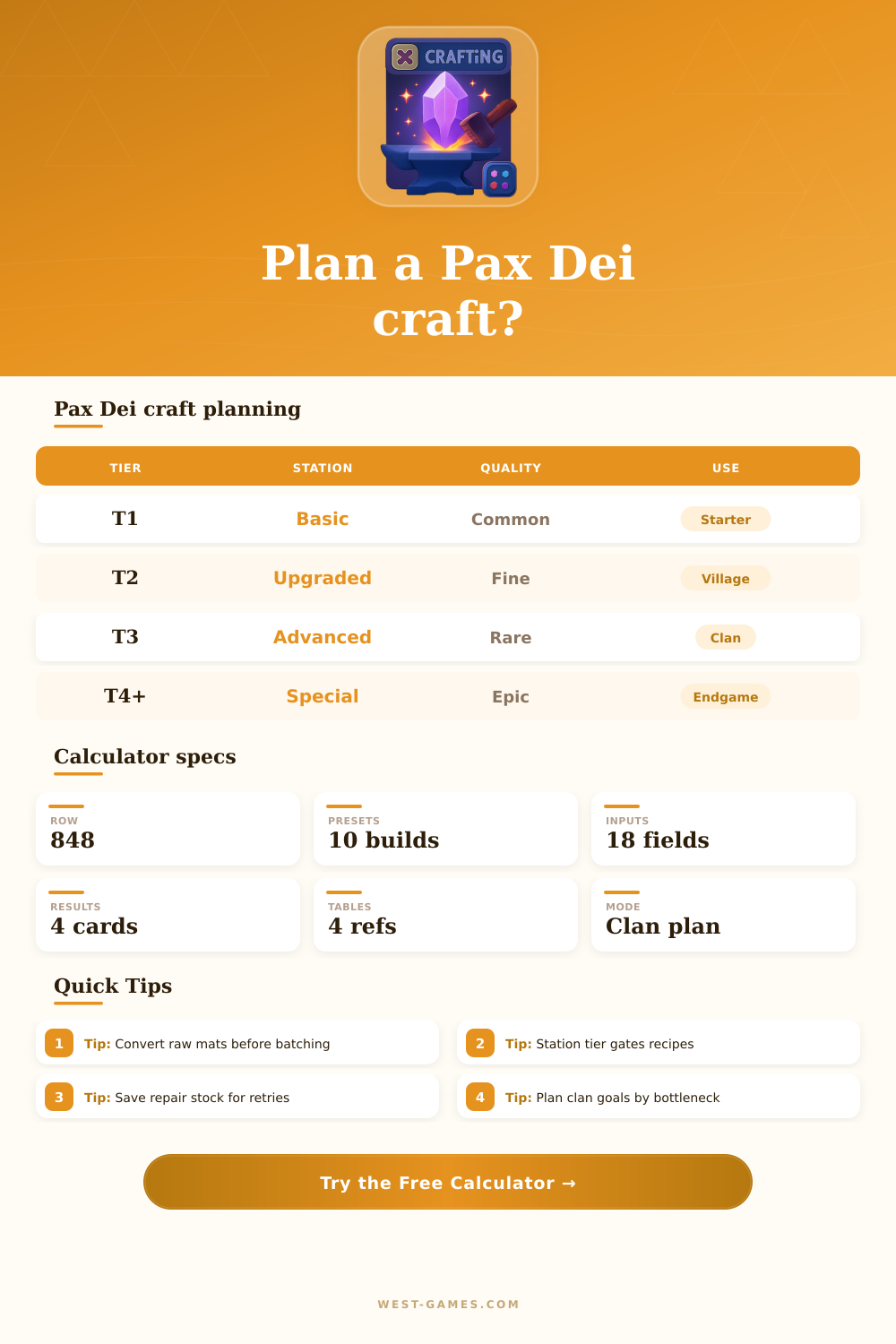
| Tier 1 | Basic station usually enough | Low | Use starter stock and confirm conversion ratios. |
| Tier 2 | Upgraded station preferred | Moderate | Add a small retry and storage reserve. |
| Tier 3 | Advanced station expected | High | Use selected materials for quality pushes. |
| Tier 4 | Specialist station likely | Very high | Plan clan support and repair stock before starting. |
| Tier 5 | Top station required in planner | Extreme | Do a small test batch before committing reserves. |
| Input type | Calculator field | What it answers | Common mistake |
|---|---|---|---|
| Raw primary | Raw primary on hand | How many main refined units can be made? | Counting ore or logs as finished stock. |
| Raw support | Raw support on hand | Can secondary parts keep pace? | Ignoring thread, straps, vials, handles, or trim. |
| Refined stock | Already on hand | What can be crafted without more processing? | Mixing reserved clan stock into spendable stock. |
| Reserve | Storage reserve | What stays untouched after planning? | Leaving no buffer for failed attempts or orders. |
| Factor | Raises chance | Lowers chance | Editable field |
|---|---|---|---|
| Crafter skill | Higher profession skill | Underleveled crafter | Crafter profession skill |
| Materials | Fine or rare inputs | Common stock | Average material quality |
| Station tier | Station above recipe tier | Station below recipe tier | Station tier available |
| Retries | More attempts to hit target | Durability and time loss | Expected retry rate |
| Preset | Profession | Batch style | Best use |
|---|---|---|---|
| Blacksmith Bar Run | Blacksmithing | Processing heavy | Turning ore stock into clan-ready metal parts. |
| Weaponsmith Blades | Weaponsmithing | Low output, high material | Testing quality assumptions before expensive weapons. |
| Armorsmith Plate Set | Armorsmithing | Gear batch | Planning durability and support straps. |
| Carpentry Beam Order | Carpentry | Large stacked output | Village builds and station upgrade material runs. |
| Village Project Push | Mixed clan craft | Target driven | Estimating wall time across multiple crafters. |
Use the preset values as starting assumptions only; overwrite material counts with the exact recipe from your current Pax Dei build.
In Pax Dei, it’s not just button-clicks; it’s a matter of supply chains. When crafting, you try to remember your supplies in your head until you have a chance to write them down. You stand by the forge and wait while animations play out, praying that everything goes right. Clan projects can be derailed by failure and broken station. What happens behind the curtain is what stresses you. You might have wood, but how many planks will remain after processing? Worse yet: if the roll goes badly against your desired quality, so does time.
Until then, this calculator show you up-front how much it’ll cost before you waste any time making bad batches. Potential isn’t currency. Logs aren’t planks. Ore isn’t an ingot. These raw materials needs to be converted before being used in recipes. Players frequentely ignore this conversion process while filling clan order. That’s where the tool comes in. It translates raw stock into refined versions so they can be accurately compared.
Plan Your Crafts Before You Start
Why does that matter? Because you will gather more quicky than you will refine. Gathering is often faster than refining, but refining is the true bottleneck for most early-game player who haven’t specialized their professions yet.
Tiered Stations are a hard gate. At Tier 2 stations, the game blocks Tier 3 crafting even if your character is skilled enough. This check is done automaticly by the calculator. It protects you from discovering late in the game that you never fully upgraded a path.
Quality of Materials also matter. Better quality material goes into a higher quality item. But better quality material cost more. What’s your time worth? Common stock crafts fast, while rare material crafts slowly and yields better result.
Clan coordination require time, which is an increasingly precious resource. Seconds per craft accumulate into hours as you go through dozens of them. Durability loss and retries are accounted for in the planner. They’re frequent sources of project derailment. Repair time and lost progress from broken stations add more time to your project. Including a repair reserve and estimated retry rate give you a more accurate time estimate. No more “best case” scenarios.
Planned for 3 hour session? Or one that takes longer because it can’t clear the queue? Not sure where to start? Use the preset buttons. These load in common recipes for alchemy, carpentry, and blacksmithing. Then you can adjust individual variables rather than having to build everything from ground up.
That lets you compare apples to apples, by converting raw materials into refined equivalents, to see what approach give you more bang for the buck. Want to know whether making ingots from iron stock is better then turning those logs into beams? The comparison grid will tell you. It’ll steers your next gather trip like a missile.
It’s all about the prep. You are preparing for a craft rather than executing one. Having the right skills when you need them most is no good if you miscalculate how much material you’ve got in reserve. The tool supports intuition with data. What used to be a sense of “yeah, I’m good” becomes hard numbers about supply levels.
The worry of creating things fades when you stop guessing and start planning. You know precisely what you possess, what remains missing, and the time required to fill the gap. Provided the plan is solid, you wouldn’t of exhaust your supplies before completing your work.