🐝 BSS Crafting Calculator
Plan Bee Swarm Simulator Blender recipes for enzymes, oil, glitter, glue, waxes, potions, and smoothies with material shortfalls, tickets, honey-equivalent resource value, batch time, boosts, and days to craft.
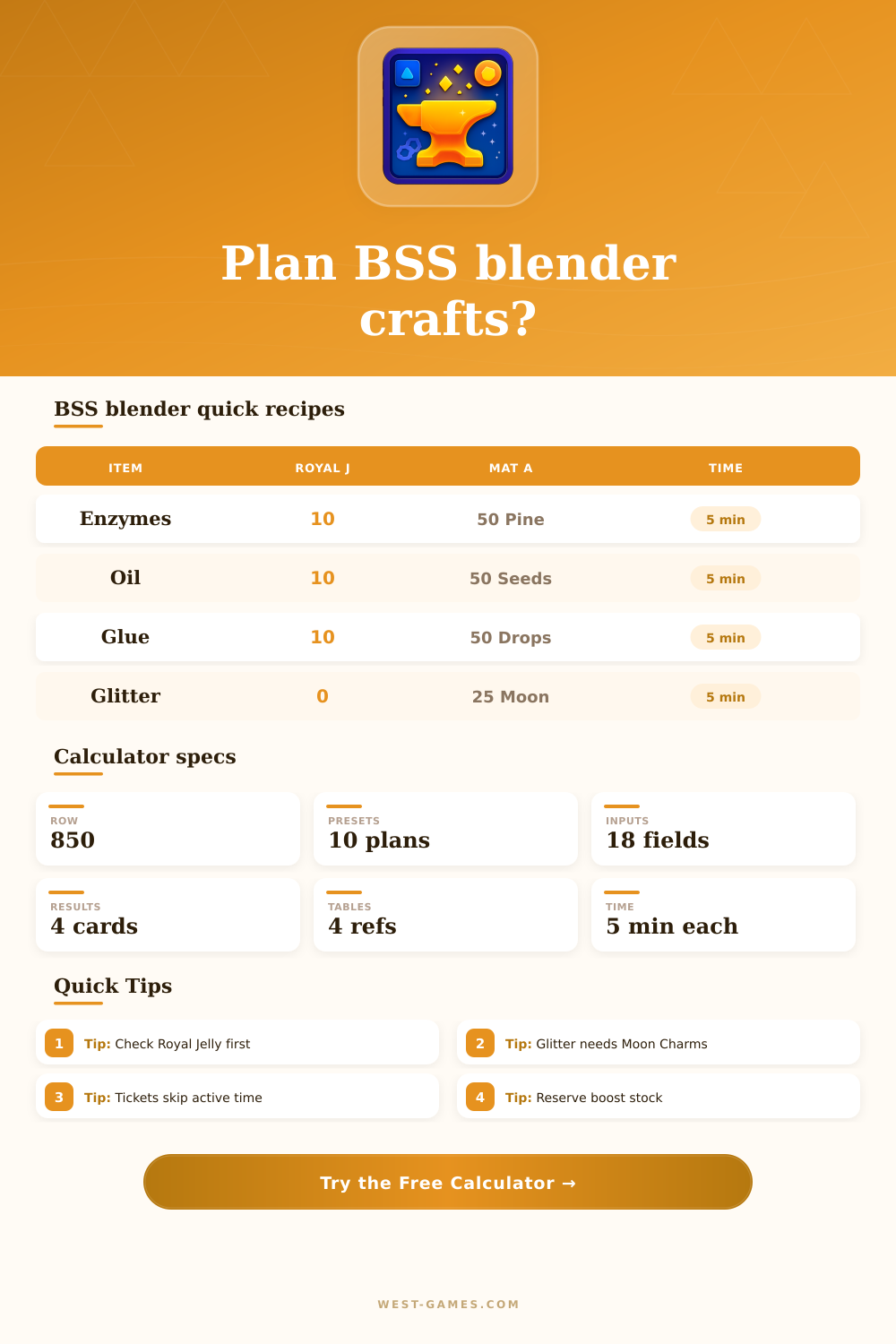
| Recipe | Royal Jelly | Main material | Common use |
|---|---|---|---|
| Enzymes | 10 | 50 Pineapples | Boosts, waxes, gear paths |
| Oil | 10 | 50 Sunflower Seeds | Boosts, drinks, waxes |
| Glue | 10 | 50 Gumdrops | Gummy gear and potions |
| Glitter | 0 | 25 Moon Charms, 1 Magic Bean | Field boosts and Star Jelly |
| Tropical Drink | 0 | 10 Coconuts, 2 Enzymes, 2 Oils | Boosting and late recipes |
| Blender item | Time | Speed-up rule | Planning note |
|---|---|---|---|
| Most crafted items | 5 min each | 1 ticket per item | Use tickets only when time matters |
| Gumdrops | 5 min each | 1 ticket per 10 | Special bulk rule |
| Moon Charms | 5 min each | 1 ticket per 10 | Special bulk rule |
| Offline Voucher | Up to 24h | No ticket change | Model as active hours |
| End Crafting | Partial | Finished items kept | Unfinished materials return |
| Target | Typical drain | Risk | Calculator field |
|---|---|---|---|
| Enzymes | Conversion boost | Pineapple drain | Boost use/day |
| Oil | Speed boost | Sunflower drain | Boost use/day |
| Glue | Gummy planning | Gumdrop drain | Boost reserve days |
| Glitter | Field boost | Magic Bean drain | Target item count |
| Super Smoothie | Major boosts | Nested materials | Material A-D |
| Material | Low plan | Active plan | Best source style |
|---|---|---|---|
| Pineapples | 300/day | 900/day | Field, sprouts, planters |
| Sunflower Seeds | 300/day | 1000/day | Field, windy routes, mobs |
| Gumdrops | 80/day | 250/day | Mobs, dispenser, crafting |
| Moon Charms | 150/day | 600/day | Night, sprouts, memory match |
| Magic Beans | 1/day | 4/day | Sprouts and rewards |
| Recipe | Ingredient A | Ingredient B | Ingredient C / D |
|---|---|---|---|
| Soft Wax | 5 Honeysuckles | 1 Oil | 1 Enzymes, 10 Royal Jellies |
| Hard Wax | 3 Soft Waxes | 3 Enzymes | 33 Bitterberries, 33 Royal Jellies |
| Star Jelly | 3 Glitter | 100 Royal Jellies | None |
| Purple Potion | 3 Neonberries | 3 Red Extracts | 3 Blue Extracts, 3 Glues |
| Super Smoothie | 3 Neonberries | 3 Star Jellies | 3 Purple Potions, 6 Tropical Drinks |
So now you’re standing in front of the Blender. Those damn Star Jellies are what you want. What about gear upgrades? Sure, maybe, but when you look down at your inventory, what you see isn’t prep so much as panic. There is some Pineapples over here. Oh yeah, a few Royal Jellies over there. The rest is… well, hoping the game rules will do you a favor.
That’s when the planning becomes a matter of necessity rather than choice. Crafting in Bee Swarm Simulator isn’t simply a process of clicking buttons while waiting for timer. It’s a sort of logistical puzzle of time management and resource conversion. You has to understand exactly how much pain you’ll need to suffer through for one frigging boost potion.
Why Planning Helps You Craft Better
After plugging in your current stock and desired targets, the calculator above do all the math, sparing you from having to multiply coefficients in your head while fighting off a swarm of bees. It turns abstractions like “crafting vaguely” into concrete actions, tasks you do every day. You start seeing where you’re falling short, and realize it’s not just stuff that separates you from where you want to be.
It’s time. These are your active play hours. This means you face an opportunity cost by spending those hours farming Sunflower Seeds instead than running quests for something else. People’s first bottleneck tends to be Royal Jelly, and also, unfortunatly, their most costly missed opportunity. Only Glitter doesn’t use Royal Jelly, so it’s hidden in the background of all other recipes, slowly bleeding away your supply.
Having a pocket full of Honey makes you feel like you’re rolling in it, while lacking ten thousand Royal Jellies is tantamount to being broke when it comes to Enzyme production. And that’s where the tool steps in: by expressing this deficiency as an amount of Honey, it quantifies your deficit, allowing you to actualy do something about it. Whether to spend money at the market or raise more bees becomes a question of how much each option will cost you. It translates your sense of scarcity into concrete number.
That’s all well and good, but what about time? When you’re waiting five minutes for every item in a batch of 50 Glues, players starts devaluing time as a resource, too. The Blender doesn’t give a damn when you’re logged in or not. If you can afford to feed it Vouchers, it’ll tick its way through whether or not you’re around. You will know exactly how much time it takes to finish your project.
This gives you enough time to spread the process over multiple days, or decide if it’s worth using Tickets for instant gratificaton. The comparison grid on the page spells out the trade-off: burn through your finite stock of speed-up items, or wait patiently. While speeding things up might seem like a great idea from an efficiency standpoint, in practice it typicaly results in you being broke.
Sunflower Seeds and Pineapples grows in abundance, but those things aren’t free. They take some effort to collect. Depending on how well-run your bees are, or how quickly you manage other tasks, your rate of collecting them will change, which means that big old crafting project might take you a week. Or maybe just an afternoon. This is why the calculator wants your rates.
Those rates are the fuel in your tank. It’s not going to give you an estimate of how long anything takes unless you provide at least a rough idea of how much stuff you can collect per day. Be honest! How many minutes do you really play every day?
Then there’s the issue with glitter: it takes Magic Beans, and Moon Charms, both of which is rarer and more difficult to farm reliably than other materials. Now it’s no longer about how much you can farm, but what you’re running out of. Thousands of Pineapples? You have no Magic Beans. This is where the tool comes in, separating out those ingredients so that you know what exactly is limiting your progress.
Turns out sometimes the solution isn’t to farm more. It’s to shift focus to something else altogether. That means chasing after Star Jelly while you don’t have the beans to make Glitter will end up frustrating. You could of saved yourself several hours of pointlessly clicking if you knew that ahead of time.
The worst way to finish a session is empty handed. I sat down to make this one thing, but I was out of an ingredient. I switched to making something else, but then I realized I was short on another item. So, I changed plans again. That’s chaos play.
The antidote is a plan that locks up not just your time but also your resources. With a solid plan you know exactly when to shut down the farm because you’ve reached your number. One more thing: plans turns chaos play into structured progress. Look at your inventory. Choose a target. Plug the numbers in. Have the tool crunch them and tell you what you can really achieve with what you have on hand.
It is often easy to mistake a guess for real knowledge.