⚒ BDO Crafting Calculator
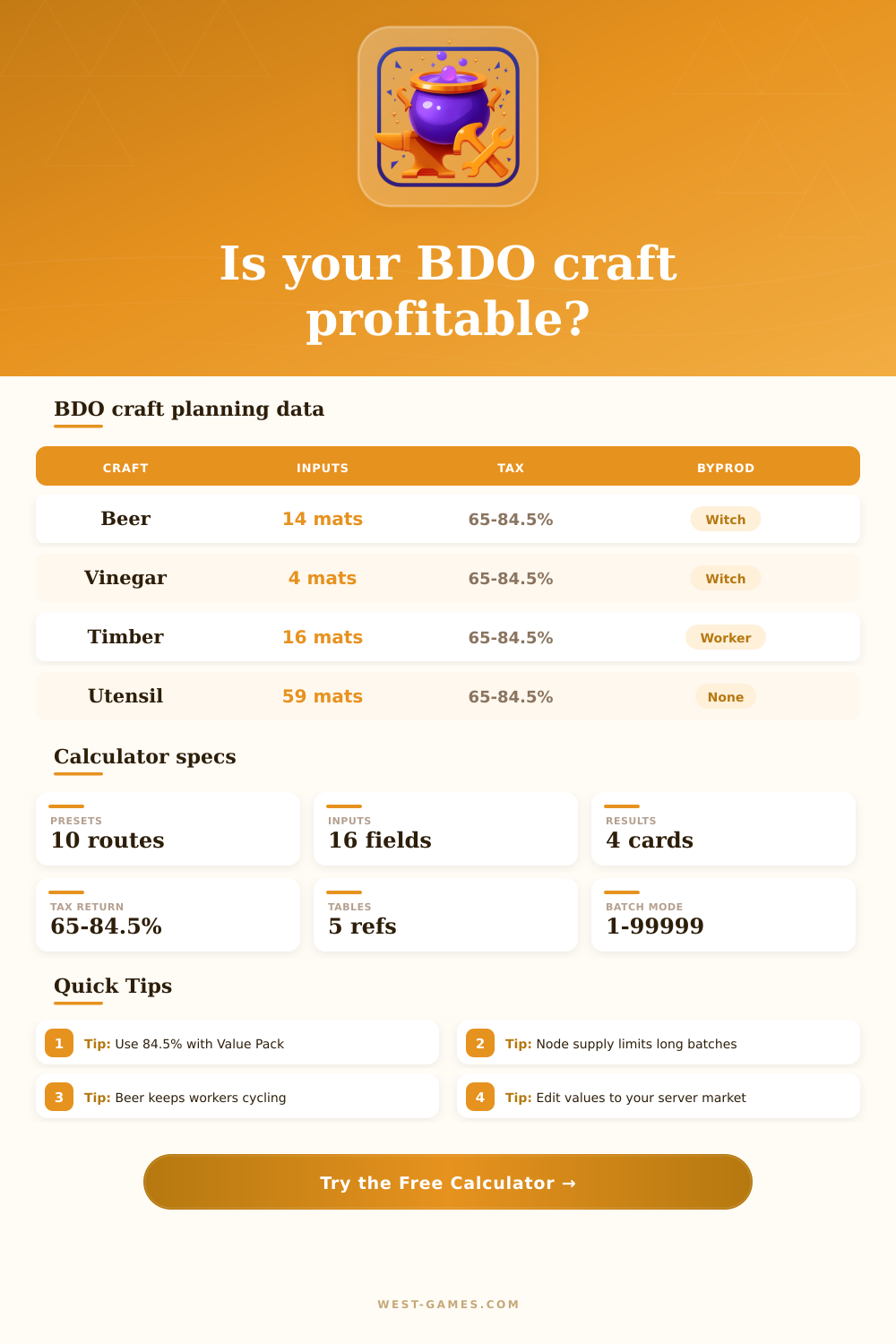
Plan Black Desert Online workshop, cooking, alchemy, and processing batches with worker speed, stamina, mastery, node supply, market tax, byproducts, and craft time.
No Value Pack
0Net silver if the Central Market return is the base 65% collection rate.
Value Pack Active
0Net silver using the 84.5% Value Pack Central Market collection rate.
One More Worker
0hProjected total time if one extra worker or active craft slot is available.
Mastery Push
0Expected net silver if mastery planning value is raised by 300 points.
| Collection state | Tax rule | Silver kept | Calculator use |
|---|---|---|---|
| No Value Pack | 35% market tax | 65% | Use for normal marketplace sales |
| Value Pack active | 65% return x 1.30 | 84.5% | Use when collecting with Value Pack |
| Imperial / self use | No Central Market sale | 100% | Use when valuing boxes or personal stock |
| Custom return | User-entered rate | 1% to 120% | Use for events, buffs, or private valuation |
| Product | Recipe inputs | Craft type | Byproduct path |
|---|---|---|---|
| Beer | 5 grain, 6 water, 1 sugar, 2 leavening agent | Cooking | Witch's Delicacy chance |
| Vinegar | 1 grain, 1 fruit, 1 sugar, 1 leavening agent | Cooking | Witch's Delicacy chance |
| Essence of Liquor | 1 flour, 1 fruit, 1 leavening agent | Cooking | Witch's Delicacy chance |
| Calpheon Timber Crate | 5 cedar plywood, 5 birch plywood, 5 fir plywood, 1 black stone powder | Worker workshop | Worker time and stamina |
| Advanced Cooking Utensil | 20 polished stone, 5 usable scantling, 20 melted iron shard, 14 black stone powder | Tool workshop | Worker time and stamina |
| Processing action | Common input | Common output | Planning note |
|---|---|---|---|
| Heating | 5 ore | Melted shard | Higher skill can improve average output |
| Heating | 10 melted shards | Metal ingot | Used by crates, tools, and gear chains |
| Chopping | 5 logs | Plank | Timber crates need large plywood chains |
| Chopping | 10 planks | Plywood | Primary bottleneck in timber crates |
| Drying | 5 hides | Leather | Weather restrictions can affect drying |
| Worker grade | Typical role | Stamina impact | Calculator field |
|---|---|---|---|
| General | Early node gathering | Low stats, easy replacement | Lower speed, moderate stamina |
| Skilled | Starter workshops | Usable for short queues | Raise speed after promotion |
| Professional | Reliable city worker | Good long-session balance | Common crate baseline |
| Artisan | Best long-term worker | High stats and more skill value | Use actual rolled work speed |
| Giant or Papu | Long AFK stamina loops | More jobs before feeding | Raise stamina points |
| Loop | Rare byproduct | How it appears | How to value it here |
|---|---|---|---|
| Cooking | Witch's Delicacy | Random chance when cooking succeeds | Value CP, milk, beer, or exchange choice |
| Alchemy | Mysterious Catalyst | Random chance when alchemy succeeds | Value exchange rewards or set custom silver |
| Processing | Extra processed output | Skill, mastery, and success change averages | Use processing yield multiplier |
| Worker workshop | No cooking byproduct | Profit comes from time, materials, and tax | Set byproduct chance to zero |
Processing yield, rare byproduct rate, and material value are deliberately editable because BDO tooltips, mastery brackets, event buffs, and regional markets change the practical average.
Eventually, every Black Desert Online player hit a wall where math replaces gut instinct. Sure, you have a fully humming cooking station churning out Witch’s Delicacy and stocking your warehouse full of vinegar. But then you look at your bank of silver and something isn’t adding up. Typically, there is a far larger gap different than what meets the eye between how much you think you’re doing and how much money you’re making.
That’s where this BDO crafting calculator come in. It closes the distance between unclear life skill number and hard currency results. No more guesswork about whether your beer really justifies all that time on a node.
How to Use the BDO Crafting Calculator
So there’s one key thing to grasp at this stage: Materials aren’t just costs; they’re opportunity values. They’re opportunity values. Their materials value per unit is an entry field; the number you put in represent what they would earn on the open market, which will serve as the baseline for comparison. Unless you give them some sort of replacement value (i.e., if you harvest grain from your own nodes), the calculator assume it’s all sunk cost, and that’s important, because materials you provide yourself can hide inefficiencies.
Maybe you’re harvesting grain out of your own nodes and you’re wondering why you’re not making any money? It’s because you didn’t purchase the ingredients, but silver per hour isn’t covering it, so you’re still losing ground. Comparing final sale price after tax with input costs makes you confront that tradeoff by comparing the two.
Another layer of complexity that most players underestimate is market mechanics. There’s the Central Market tax, which is a flat percentage that cut into your margin. Then there’s the Value Pack, which completely shifts the equation. Without a Value Pack, you keep sixty-five percent of your sales. At eighty-four-and-a-half percent with it, you’re keeping almost every single penny. This means the difference can be nearly twenty percent, which is the difference between a hobbyist craft route and a profitable one.
You can instantly toggle this setting on the calculator and see exactly what portion of your profit stem from reducing your tax instead of increasing your raw volume. Small thing, but it matters as you scale up to hundreds of batches.
Worker management introduce its own variables that don’t apply to player-driven life skills. For workshop crafting, there’s a limit to how much each node provides per hour. There is also a limit to the speed at which a person crafts and their stamina. If you assign too many workers to a node without considering its hourly output, you would of hit a bottleneck before you even begin. No matter how many Artisan workers you employ, you can only produce as many Timber Crates from Cedar Logs as those logs exist.
The reference table on the page explain how various grades impact speed and stamina duration. Experimentation is okay with general workers. Consistent long-term output require understanding the stamina drain of higher-grade workers.
The wildcard are byproducts. A few random drops from cooking and alchemy can really increase profits, including things like Mysterious Catalysts or Witch’s Delicacy. Since you recieve these randomly, you can input their value and the expected probability of getting them. Suddenly what was a lucky break becomes a reliable stream of revenue. Not accounting for it make your profit calculations conservative. Overestimating it means you won’t be happy when the RNG doesn’t line up with you. To find the sweet spot, check the current drop rate on your server. Alternatively, use your own information over a large sample size.
Yields also work on that same idea. Five logs will produce more planks when processed by a masterful log pro than they do for a novice. That’s what the yield multiplier field represent… The efficiency of the processing. It is not the success chance. The efficiency are measured by how much you get out of one unit of input. That’s where investing in equipment and skill stones makes sense. You’re purchasing efficiency, and the tool measure that return.
At the end of the day, making things in Black Desert Online is as much a logistics puzzle as it is a loop of gameplay. Market fluctuations, tax implications, worker stamina, and inventory flow are all things you’re juggling simultaneously. Once you input your stat information and local prices, the calculator will do all the math for you, so you don’t have to do any mental arithmetic looking at a spreadsheet. It replaces guesswork with data.
If you want to know if you’re realy moving forward or not, then you need to know what it’s costing you to make something, whether that be crates for silver, or feeding your workers. You go in with materials and come out with silver, but how you get there is where the precision lies.