⚒ Lost Ark Pity Calculator
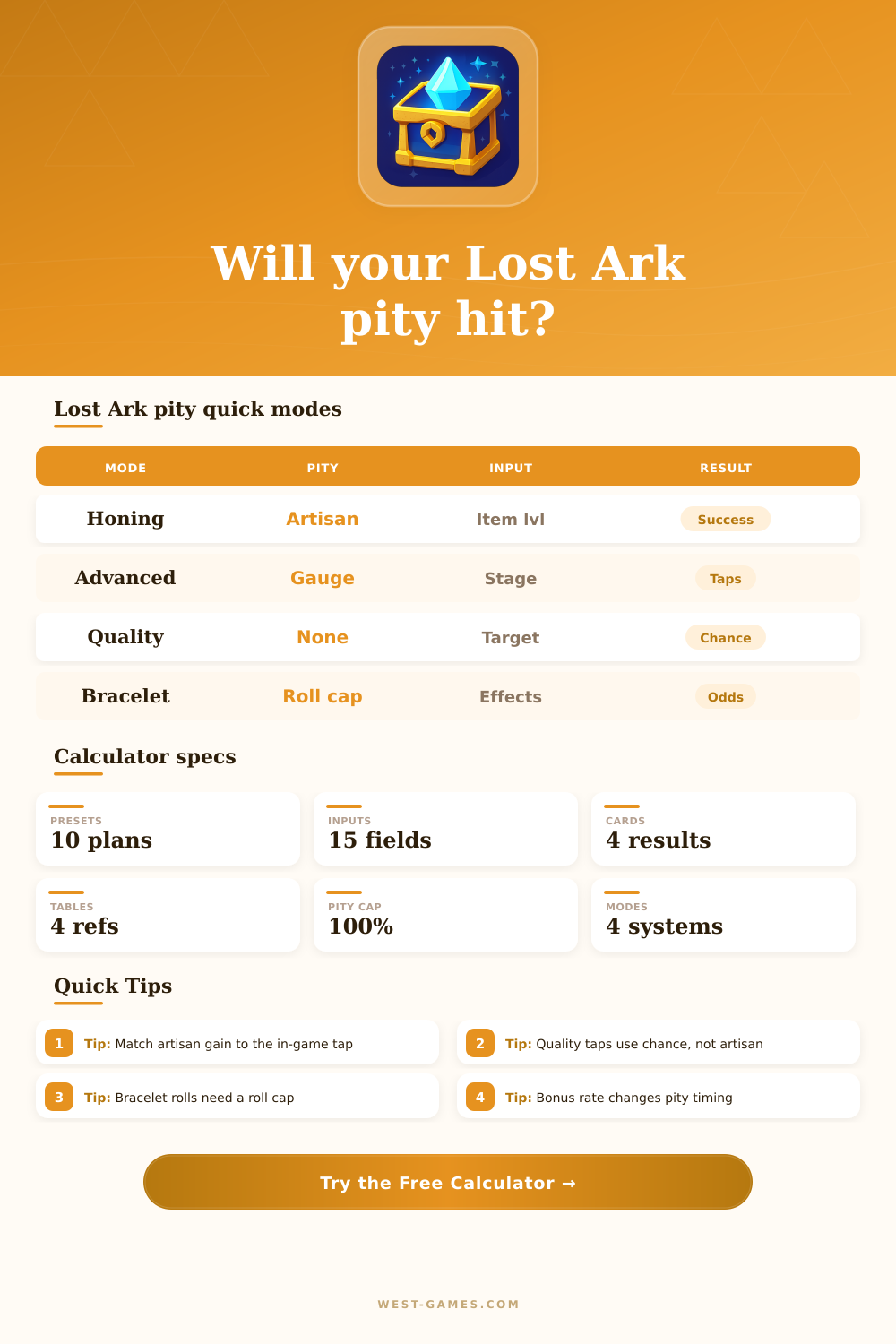
Estimate honing artisan energy, advanced honing style gauges, quality taps, bracelet reroll odds, material attempts, success chance, target item level, expected attempts, and cumulative chance.
| Preset | System | Base chance | Pity behavior |
|---|---|---|---|
| T3 Fresh Honing | Honing | 5.0% | Artisan on fail |
| Akkan Gear Stretch | Honing | 3.0% | Slow artisan |
| Advanced Honing | Gauge plan | 10.0% | Custom gauge |
| Weapon Quality 80+ | Quality | 5.6% | No artisan |
| Bracelet Double Hit | Bracelet | 1.2% | Roll cap only |
Preset rates are planning defaults. Replace them with the rate displayed on your actual upgrade, quality, or bracelet screen.
| Field | Honing meaning | Quality meaning | Bracelet meaning |
|---|---|---|---|
| Current pity | Artisan energy | Usually 0 | Roll progress |
| Fail count | Rate-up count | Attempts made | Rerolls made |
| Gain after fail | Artisan gained | Use 0 | Use 0 or custom |
| 100% pity | Next tap success | Only custom | Only custom |
The calculator only forces a guaranteed attempt when artisan or custom pity reaches 100%.
| Input lane | Honing example | Quality example | Bracelet example |
|---|---|---|---|
| Stones | Destruction stones | Chaos stones | Bracelet base |
| Leap/ticket | Leapstones | Quality stones | Rework tickets |
| Fusion/shard | Oreha fusion | Shard bundle | Locked slots |
| Attempts | Total taps | Total taps | Total rolls |
Use the lanes as counters. They avoid currency assumptions and keep the output focused on taps, rolls, and materials.
| Readout | Good use | Risk note | Action |
|---|---|---|---|
| Cumulative chance | Material push | Variance remains | Compare to cap |
| Expected attempts | Average plan | Not a promise | Budget extra |
| Confidence attempts | Safer target | Can exceed stash | Check gap |
| Worst-case taps | Honing pity | No-pity rolls vary | Use roll cap |
For no-pity quality and bracelet targets, the worst-case card is a modeling horizon rather than a real guaranteed endpoint.
Raid bosses exploding? Not the worst sound in Lost Ark. That empty clicking sound of a failure is up there. It happens when you are down to your last destruction stone for honing something. You’ve been there. I spent weeks grinding away on Chaos Dungeons and Guardian Raids. They gathered leapstones and hoarded shards, all under tight discipline. You stared at a progress bar and watched it refuse to move.
The pity system is supposed to be your safety net, catching you before the fall becomes too steep. But for a lot of people, it’s treated more like magic than math. They ask, “I’m guaranteed one, right?” without even figuring out how close they are to tripping it. That hunch becomes real. It takes you from hoping for the best to planning for the worst.
How to Plan Your Upgrades Better
Since there is no single system, this calculator models four very different systems. Artisan energy is a hidden bank account in gear honing. Each failure builds interest till eventually, you get to a hundred percent guaranteed result. There’s no such protection for upgrading quality or rolling bracelets. They’re pure probability. The calculator separates this out.
If you’re trying to push weapon quality from eighties to nineties, it gets ugly. No mercy here, just the hard numbers of base success rates multiplied by what you’ve got to throw at the problem. Do you have enough to risk churning through ten grand worth of stones? Or is it time to back off while you still has something in reserve?
Finally, inputs matter more than you’d think. I’ve been surprised by how few people bother with the bonus success chance box. Why? Seems too much effort. It’s not. It makes the difference between 55% chance versus 40% of succeeding. Event buffs, solar materials, and books all shift the whole curve. Plug them in and suddenly the expected number of tries drops dramaticly.
Maybe you’ll learn you’re better off holding out for that double-exp weekend after all. Maybe you’ll see that it’s not just a pleasant little perk. It’s strategy. Run the numbers through the calculator and you get a precise sense of how much time you save if you wait for the weekend buff. You’ll see what the material deficit looks like in terms of actual hours played. There are two thousand destruction stones left. That can be a vague idea until you turn it into game time. Then, deciding whether to play tonight in Vern or hold back on resources for next month will seem straightforward.
With its gauge mechanic, advanced honing adds another wrinkle: success rates vary widely depending on where you are in the upgrade window; and they’re not like normal gear upgrades. With that, you have a tool for modelling that variability. What’s the effect of tapping with three-percent when your base is low and your fail count is high? It’ll take time to inch up to that guaranteed hit. It feels tedious but it helps you understand the ramp so you don’t panic sell. If your artisan energy is already at forty percent, sometimes pushing through that three-percent chance tap is worthwhile. The calculator tells me if the gamble eventually pays off, or merely depletes my wallet.
Without a pity system incorporated in the mechanics, bracelet rerolling is akin to gambling. With all due respect to RNG haters, you can spend hours rolling and recieve the exact same common effects. A hard cap on attempts spares you from tilt. Rather than hoping for that legendary hit, you set both your goal and the amount you’re willing to invest. You’ll do a quick calculation: if I have ten tickets, what are my real odds of receiving at least one decent effect? It might not be as high than you’d like to think, but it also prevents you from throwing good money after bad. It forces you to accept variance as a part of the game instead of fighting against it eternally.
Lost Ark is a game about attrition. It is attrition between yourself and the random number generator. That’s what it comes down to: you don’t need to outsmart other people, you’re up against the math. The math doesn’t get worse when you use the tool. If anything, the tool makes the math more apparent. You could keep throwing rocks at the wall, hoping one sticks. Or you could see how far away it is first. Rocks still cost the same either way. All you really have as an advantage is knowing where you stand ahead of time so you can measure the distance.