💰 Tibia Party Loot Calculator
Estimate party hunt profit from vocation roles, damage and healing contribution, rare drop rules, supplies, hunt duration, stamina, prey, and each member share.
| Role | Share basis | Supply burn/hr | Expected net/hr | Session share |
|---|
Member rows are modeled from the selected party profile. Your role row uses your entered damage, healing, and personal supply values.
| Preset | Size | Normal loot/hr | Rare policy |
|---|---|---|---|
| Library 4-vocation | 4 | 4.2M | Sold split |
| Issavi Sphinx Duo | 2 | 2.6M | Sold split |
| Soul War Seal | 4 | 7.8M | Role reserve |
| Ingol Surface Trio | 3 | 5.1M | Contribution |
| Cobra Bastion Duo | 2 | 2.3M | Winner keeps |
| Gnomprona Hazard | 4 | 8.4M | Guild fund |
| Roshamuul Bones | 4 | 3.8M | Equal split |
| Falcon Bastion Duo | 2 | 2.1M | Sold split |
| Asura Mirror Trio | 3 | 3.2M | Contribution |
| Rotten Blood Squad | 4 | 10.5M | Role reserve |
| Role | Main value | Typical damage | Supply risk |
|---|---|---|---|
| Elite Knight | Block, lure, survive | 15-25% | High potions |
| Royal Paladin | Off-tank and steady DPS | 20-32% | Ammo plus pots |
| Master Sorcerer | Burst wave damage | 25-40% | Runes and mana |
| Elder Druid | Healing and control | 18-32% | Runes and mana |
| Support | Bombs, walls, service | 0-15% | Agreed by team |
| Mode | Your rare EV | Use when | Watch out |
|---|---|---|---|
| Sell and split | Rare EV x share | Stable teams | Market tax |
| Winner keeps | Rare EV / party size | Roll or loot-owner rule | Feels swingy |
| Role reserve | All or none by role | Tank/healer upgrades | Agree first |
| Guild bank | 0 personal rare EV | Progression funds | Track ledger |
| Output | Formula idea | Why it matters | Shown as |
|---|---|---|---|
| Adjusted loot | Normal loot x stamina x prey x loss | Models real party pace | gp/hr |
| Contribution share | Damage plus weighted support | Rewards healing and blocking | % share |
| Rare EV | Rare value x hourly probability | Separates spike value | gp/hr |
| Your net | Share minus supplies | Shows personal profit | gp/hr |
The typical scenario goes like this: You all agree casually, only for it to curdle into resentment. You spend two million gold on potions and runes, burn another three hours in the Library, and come out with a chest full of nothing but standard loot. Your sorcerer buddy pulls the rare weapon, which he keep. You split the gold evenly, but something isn’t quite right. If everybody agreed on the math ahead of time, it would feel right; but no one did.
The Tibia party loot calculator aim to solve this very problem, forcing you to define your profit before killing your first monster. The issue is that most hunter view party hunting as an event they share with no defined expectations regarding rewards, which is where people fail. Gross income is not equal to profit. Income minus wasteful expenditure equal profit.
Why You Should Plan Your Loot Before Hunting
Enter your team’s pace, supplies burned through, and your personal split rules into the calculator above, and let it do the rest. You will no longer debate if a healer spends too much on mana potions or not enough on damage. Input how many hours were spent hunting, what average loot per hour was anticipated to be, and how many runes, arrows, and imbuement points the team burn through. Then watch as the calculator spits out your true, actualy hourly net profit.
The difference between personal and team supplies is a far bigger deal than it may appear. A druid spends mana; a potion-sipping, heavy-hit-taking blocker bleeds gold at a rate that make the druid’s expenditure look negligible. Tanking is effectively subsidising dealing damage if you split everything 50/50 without considering cost. You can use the calculator either way, deduct all team supplies (which includes the possibility of sharing potions) first, then personal costs afterwards OR deduct personal costs first and share out the rest. One way is closer to how your group would of actually settle things. Presets help illustrate this in action, without having to enter figures yourself.
The volatility from rare drops is something you won’t see with straightforward averages. They add an element of chance. A single windfall could be worth twenty million gold and completely change a break even session into profit, or it could go missing for weeks at a time only to reappear out of thin air. The expected value incorporates your allocation method, along with the drop chance per hour. Then it takes all those options into account and calculates distribution of wealth. Do you want to put them in the guild fund? Reserve them as a tank upgrade? Sell em and share the money? Let the finder do what they want? Every choice will affect how the wealth is distributed.
The picture is complicated even more by stamina and prey bonuses, which don’t impact raw loot tables but instead scale efficiency. For instance, a fully-stamina player earns higher XP/hour, effectively reducing their time cost on all gold earned. If some players in your party have active prey items or lower stamina levels, this will further move your actual profit rate away from the baseline. The calculator takes these modifiers into account to display your actual accumulation of wealth (faster/slower) relative to a normal hunt.
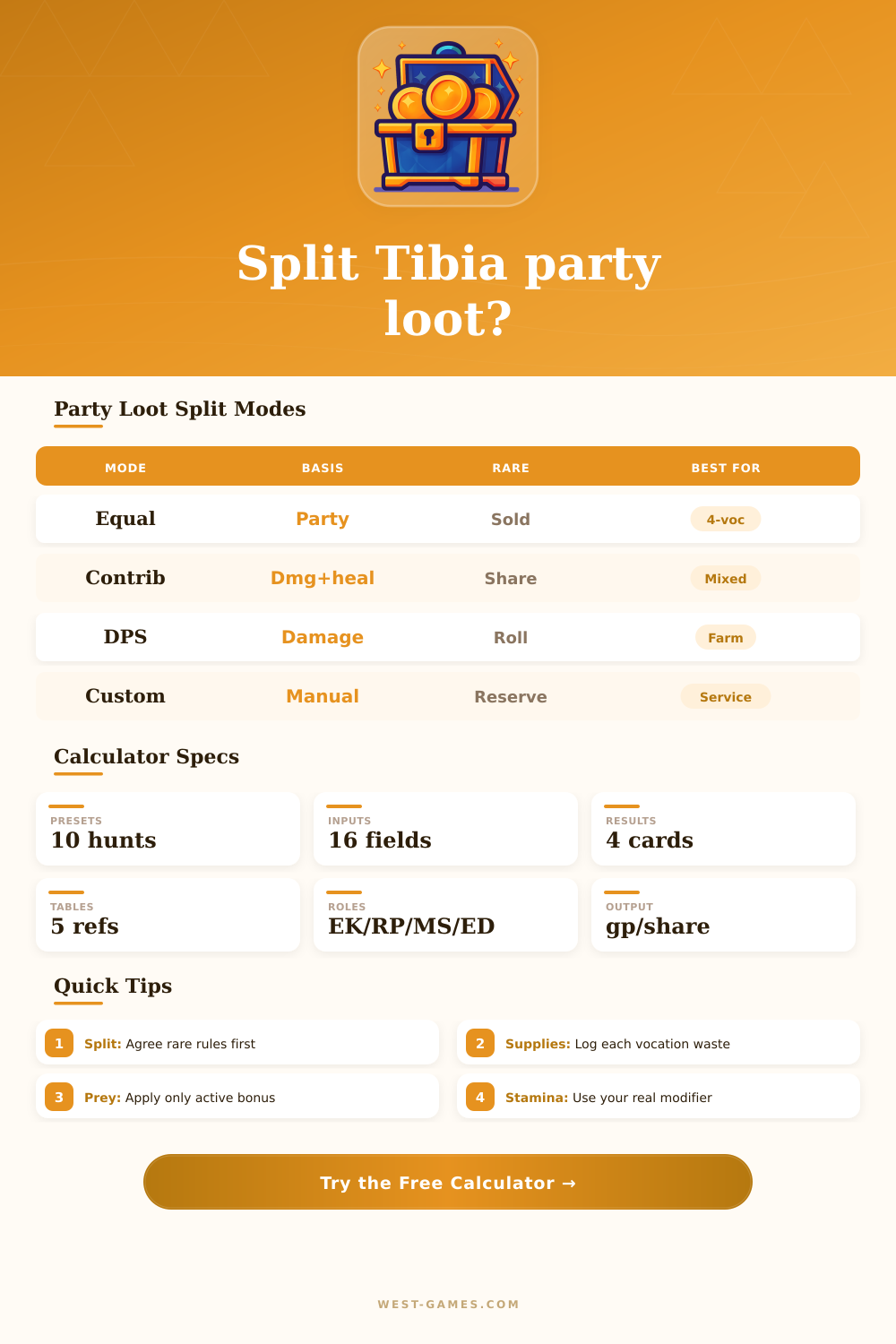
To give some context to these choices, the page includes several reference tables that detail common split modes and vocation weights. This helps explain when an even split is better for long-standing, stable teams. It also shows when a contribution-based split is better for mixed-level teams where one individual shoulder more of the load. It also lets you play around with different scenarios and get a sense for what a tweak in rare policy will do to your bottom line.
But at the end of the day, party hunting isn’t just a battle of skills, it’s a battle of words. Setting some ground rules beforehand will make those post hunt arguments more civil and keep your buddies together. Do you want everyone to contribute all their rares to the guild bank? Or do you want them to save rares for upgrades? Agreeing on the definition of value makes the math easy. And a clean ledger will serve your friendship better then any rare item could.