🍀 New World Loot Luck Calculator
Estimate loot luck from gear, trophies, food, PvP flag, aptitude, zone and activity modifiers, then convert that stack into rare target odds and runs per hour.
| Luck source | Typical entry | Best use | Calculator role |
|---|---|---|---|
| Gear luck | 10% to 25% | Most farms | Main stack |
| Trophies | 1.5% to 4.5% | House bonus | Stable add |
| Luck food | 2% to 5% | Timed routes | Short buff |
| PvP flag | 3% to 10% | Open world | Risk add |
| Luck score | 1000 = 1% | Stat imports | Converted add |
Use the same unit for every source. If a bonus is already included in your raw luck score, do not add it again as a percentage.
| Activity | Added luck | Quality mod | Best read |
|---|---|---|---|
| Standard route | 0% | 1.00x | Baseline |
| Brimstone chests | 2% | 1.05x | Many rolls |
| Mutation focus | 1% | 1.12x | Tiered reward |
| Aptitude cache | 4% | 0.95x | Cache model |
| Event window | 6% | 1.08x | Manual check |
Activity modifiers are planning assumptions. Replace them with custom odds if your target has a known table and no activity scaling.
| Source type | Roll style | Luck weight | Pace warning |
|---|---|---|---|
| Elite chest | Many rolls | High | Daily reset |
| Named mob | Repeat kill | Medium | Competition |
| Expedition boss | Low rolls | Medium | Queue time |
| M3 boss | Tiered roll | Lower | Group speed |
| Raid reward | Lockout roll | Low | Weekly cap |
Runs per hour should include failed pulls, travel, inventory cleanup, chest unlock routes, and any lockout that limits repeat attempts.
| Per-run odds | 50% runs | 90% runs | Farm read |
|---|---|---|---|
| 0.25% | 277 | 920 | Very rare |
| 0.50% | 139 | 460 | Long chase |
| 1.00% | 69 | 230 | Steady farm |
| 2.00% | 35 | 114 | Farmable |
| 5.00% | 14 | 45 | Common chase |
Multiple target copies use a binomial estimate, so the calculator is better than multiplying a one-copy milestone by copy count.
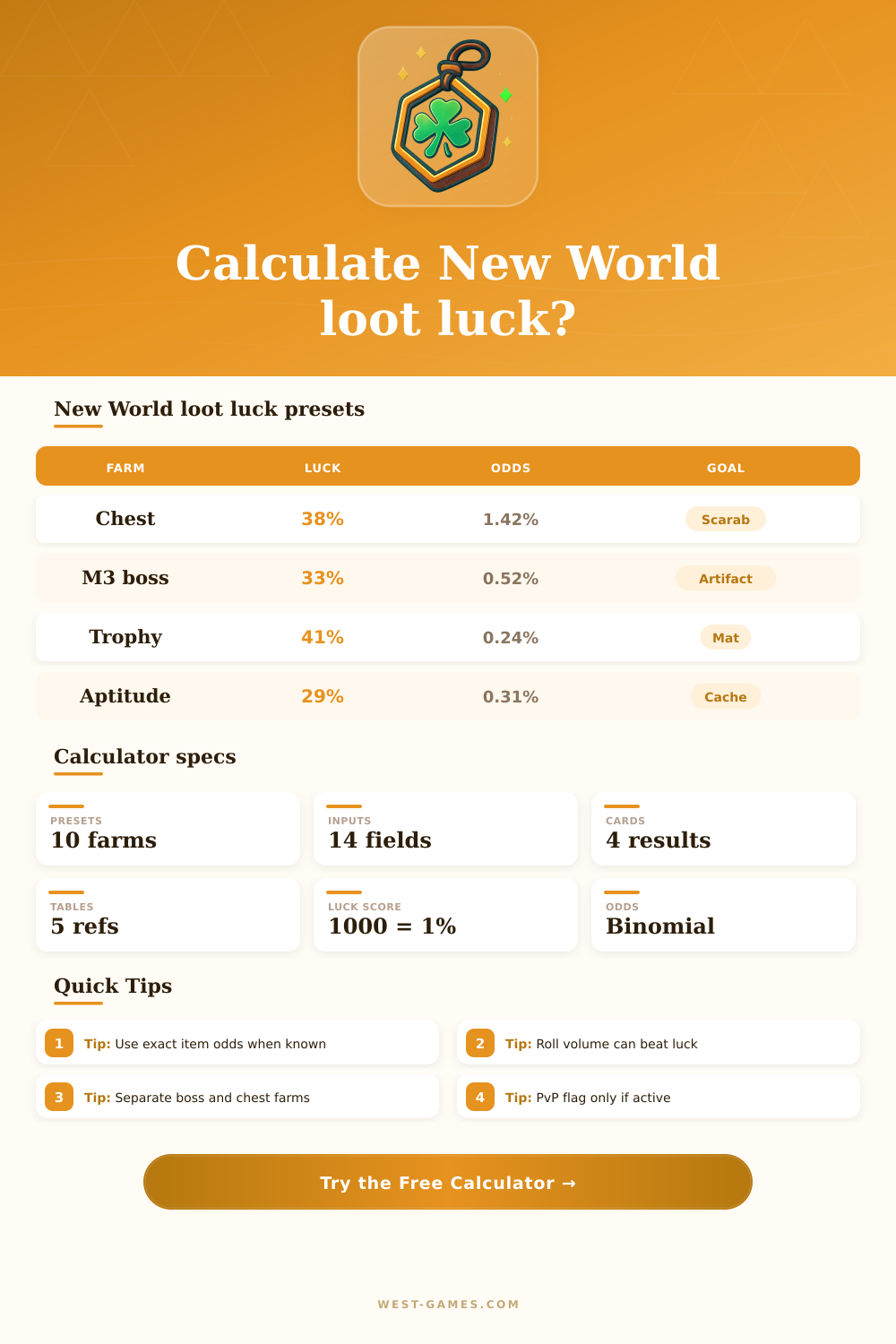
| Preset | Source | Target | Base odds | Rolls/run |
|---|---|---|---|---|
| Brimstone Elite Chest Run | Elite chest | Golden Scarab | 0.18% | 32 |
| Elysian Named Mob Loop | Named mob | Named item | 0.45% | 1 |
| M3 Expedition Boss | Mutation boss | Artifact | 0.35% | 1 |
| Trophy Material Route | Elite chest | Trophy mat | 0.08% | 70 |
| Aptitude Cache Farm | Aptitude cache | Aptitude rare | 0.22% | 6 |
Preset numbers are neutral planning baselines. Use server logs, drop databases, or your own tracking sheet when an exact item rate is known.
Have you ever farmed some high-tier boss for 20 minutes only to get back common grey junk? We all have. To compensate for this, players in New World constantly seeks out lucky gear items.
Most players think of loot luck as a single sliding bar they can just push higher and higher. But it’s not naturaly like that. It has source sensitivity, diminishing returns and raw volume. How these components work together matter more then pushing every percentage point possible into your build.
Why Speed Matters More Than Luck
Put your farming rate into the calculator along with your gear scores. Let it do the math. Avoid the guesswork. Don’t try to convert and calculate coefficients. Before fully trusting the results, you should of know what it’s measuring.
Not all types of content are equally subject to luck. A weekly raid reward, aptitude cache, and brimstone elite chest aren’t mathematically related to your luck score in the same way. To compensate for that, tool includes source modifiers. But you have to choose the proper farm type. Mistaking a boss kill for a chest run might make the numbers look good on paper, but not in practice.
Your score is built on gear luck. Ten to twenty-five percent are typical. That’s the baseline. On top of that, you’ll add food buffs and trophies. These is one-time bonuses; consumables that go away fast. They don’t stack, either. It isn’t about accumulation; it’s about timing. If you spend 10 minutes driving before you begin pulling your food buffs will have already started to decay. It would be best if all your buff were in place right as the route begins.
Because each pull is its own independent roll, every time you get lucky you’ve got a better shot at getting something nice. But if there’s no roll, a high score doesn’t do anything to help that. The volume is a silent killer based off poor planning. You might have ninety percent luck, but if slow running limits you to five attempts an hour, you will fall behind. Someone with only fifty percent luck will pass you if they clear thirty attempts in that same window. This tradeoff is starkly shown by adjusting the runs per hour against your overall luck score on the calculator. It forces you to face up to the tyranny of time.
Do you really want to sacrifice gear slots for greater damage so you can kill faster? Speed mean more eligible rolls, which means more chances, even if those chances are slightly smaller. And often the answer is yes.
The trap of going for max is: you’re going after quantity. Quantity gets you a nice bonus from pvp flags, provided you’re spending time doing PvP and don’t die over and over again. That bonus vanishes if you’re running back to safety or dead, half the time.
The page has some handy reference tables to see the pace levers in action between various kinds of farm, boss ones use kill frequency; chest ones depend on unlock efficiency. Each one has its own ceiling, too, you can’t optimize what isn’t measured.
The other thing to note about aptitude caches and gathering crates is that they behaves differently than world bosses. For example, how much they react to luck can be less. In other words, each point of score added don’t give you a proportionally better chance. By default, the tool takes account of this and reduces its modifier accordingly depending on what you’ve chosen for your source. That way you’re not wasting your time and resources getting all buffed out for something that won’t reward you for it.
Just like starting, it’s also good to know when enough is enough. And finally, there’s the goal. If you’re farming common trophy materials, you’ll farm different from if you’re chasing a named artifact. Unique items have such a low base chance that it takes more than good luck to close that gap. Staying at it and doing it a lot will be required.
That’s where the calculator comes in: It provides an estimate of your cumulative odds over time, helping you gain a clearer idea of what your chances are; i.e., it transforms vague hope into projected probability. Perhaps you’ll realize that spending six hours on one boss is mathematically unwise, but spreading that time among three different routes would yield better results.
Loot luck isn’t magic. It’s math pretending to be RNG. Players with the most points aren’t necessarily the best players. They know exactly how their items interacts with a specific mechanic for the type of farm they’ve chosen. Stop worrying about arbitrary percentages. Optimize for efficient routes instead. This change of mindset makes all the difference.