🛠 OSRS Construction XP Calculator
Estimate planks, contracts, butler trips, sawmill fees, XP per hour, and GP per XP for oak larders, mahogany tables, mounted mythical capes, and Mahogany Homes.
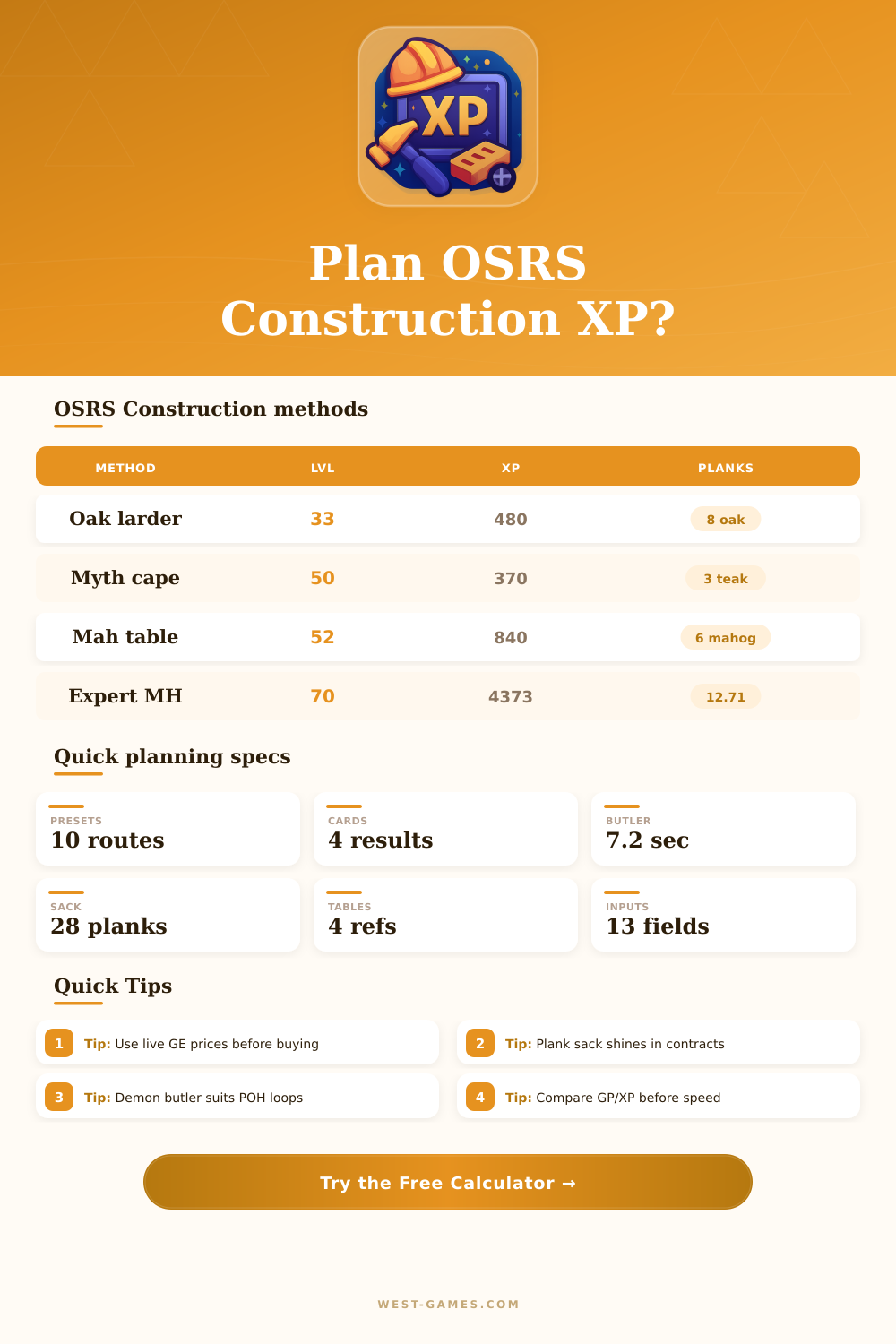
| Method | Level | Materials | XP each | XP/hour |
|---|---|---|---|---|
| Oak larder | 33 | 8 oak planks | 480 | Up to 480k |
| Mounted mythical cape | 50 | 3 teak planks and reusable cape | 370 | Up to 430k |
| Mahogany table | 52 | 6 mahogany planks | 840 | Up to 900k |
| Teak garden bench | 66 | 6 teak planks | 540 | 500k-700k |
| Oak dungeon door | 74 | 10 oak planks | 600 | Up to 550k |
| Gnome bench | 77 | 6 mahogany planks | 840 | Up to 1.1m |
POH methods assume a saw, hammer, build/remove rhythm, and servant handling where applicable.
| Tier | Level | Planks | Bars | Avg XP | Points |
|---|---|---|---|---|---|
| Beginner | 1 | 9.7 regular | 0.5 | 865.01 | 2 |
| Novice | 20 | 9.84 oak | 0.5 | 1,887.44 | 3 |
| Adept | 50 | 11.5 teak | 0.5 | 3,275.58 | 4 |
| Expert | 70 | 12.71 mahogany | 0.5 | 4,373.37 | 5 |
Average XP includes contract furniture and completion XP; full Carpenter's outfit can add 2.5%.
| Plank route | Typical XP/plank | Sawmill fee | Default price |
|---|---|---|---|
| Regular planks | Varies by item | 100 gp | 136 gp |
| Oak planks | 60 XP | 250 gp | 465 gp |
| Teak planks | 90 XP | 500 gp | 771 gp |
| Mounted myth teak | 123.33 XP | 500 gp | 771 gp |
| Mahogany planks | 140 XP | 1,500 gp | 1,888 gp |
Default prices are editable inputs; check live GE values before buying large plank stacks.
| Tool | Capacity | Timing | Planning use |
|---|---|---|---|
| Demon butler | 26 items | 7.2 sec bank trip | Best for fast POH build/remove loops. |
| Demon butler wage | 8 services | 10,000 gp payment | Adds 1,250 gp per service. |
| Plank sack | 28 planks | Used directly | Strong for Mahogany Homes and fewer banks. |
| Sawmill vouchers | Voucher based | Fee discount model | Use discount field for voucher coverage. |
| NPC Contact | Contract flow | Route saver | Raises Mahogany Homes XP/hour. |
Servants do not fill the plank sack from bank trips, so sack mode is modeled separately from POH butler loops.
| Route | Default target | Actions | Planks | When to use |
|---|---|---|---|---|
| Oak larders 33-52 | 123,660 XP | 220 larders | 1,760 oak | Early Construction before mahogany furniture. |
| Mounted myth capes 50-99 | 13,034,431 XP | 34,955 capes | 104,865 teak | Teak efficiency after Dragon Slayer II. |
| Mahogany tables 52-99 | 13,034,431 XP | 15,370 tables | 92,220 mahogany | Fast traditional route with demon butler. |
| Oak dungeon doors 74-99 | 13,034,431 XP | 19,897 doors | 198,970 oak | High XP/hour with oak plank pricing. |
| Expert Mahogany Homes | Custom target | Contracts | 12.71 avg each | Cheaper, calmer route with rewards. |
The calculator recomputes actions from your current XP and target XP, so these checkpoints are references rather than fixed requirements.
In Old School RuneScape, most players think of Construction as a chore, one you scurry past so you can get to the shiny thing. Pick up a few planks, construct a larder until it’s gone, rinse and repeat while monitoring your inventory cooldown time with mild anxiety. It’s seen as an exercise in tedious repetition, yet that’s to forget the complex economic layer beneath clicking.
No, Construction isn’t merely about XP per hour. It’s about knowing when to send servants out and what they’ll bring back. It is also about understanding if you are better off saving money now or spending time later based on your current account state.
How to Train Construction Smartly
Once you input your efficiency rating and the cost of your planks, the calculator above spits out math for you… No need for guesswork when wondering how long your next trip to level ninety-nine will realy last. Your first choice is whether to go for Mahogany Homes contracts or do it the old-fashioned way… Building Player Owned Houses. And while both paths has their own cost structure and rhythm, choose which suits your play style best.
For lower levels, oak larders are the traditional entry point. They offer straightforward gains that scale well with your growing Construction skill. Click, wait, repeat. The art lies more in figuring out the rates and knowing exactly what you’re measuring. People throw out huge XP per hour figures based off ideal circumstances: no errors, instant planks delivered, no need to bank up, etc. Doesn’t happen very often in real life. That’s where your own efficiency rate comes into play.
Your true rate will be much lower if you’re multi-tasking with an additional monitor, or if you tend to lose track of time. To account for this, you can edit the percentage to more accurately represent what happens in real life instead of what might be possible in theory. On paper, you may have a training regimen that nets you a thousand XP per hour, but in practice, maybe it takes twice as long because you’re constantly getting up and walking back from bank. By accounting for this delay, you avoid the disappointment of falling short of your weekly training goals. It also helps you decide if spending the time to switch to a faster method is worth it if your current system feels too slow.
Flipping the model on its head, Mahogany Homes doesn’t even bother with repeated building animations; instead, it’s all about contract completion. Collect raw material, submit it, and earn points toward rewards. The XP rate tends to be slightly lower compared to best POH loops, though you don’t have to stare at each individual build bar ticking down, which reduces the mental load quite a bit. If you prefer a slower pace with long-term progress instead of lots of clicks, this is a pleasant happy medium. It also tends to cost less XP per dollar (particularly if you can score some bulk plank deals or have access to sawmill vouchers).
Whether or not your training session is an uninterrupted glide through supply stations or a series of pauses will depend on the supply setup. Having a demon butler service is pricey but saves precious seconds that accumulate with prolonged sessions. Even a seven-second jog to the bank doesn’t seem like a big deal, until you perform it hundreds of times per hour. The other benefit of the plank sack is that you can load it up in bulk instead of repeatedly diving into your menus. Your inventory configuration and your preference for intermittent hands-on activity versus uninterrupted flow will decide which one reigns supreme.
In this game, the Grand Exchange will make or break you: Your profit margin depends heavily on price fluctuation of lumber. Oak costs far less than mahogany planks, which means you’ll save thousands of gold throughout an entire training arc with just a tiny drop in prices. Before you splurge on a big plank order, be sure to consult live market values.
You may think that a 10% decrease in plank price isn’t a big deal. However, it adds up fast when doing hundreds of action. It can also cover gear upgrades and other skills.
In summary, Construction leveling is partly clicking a lot and partly planning. While the raw rate of XP doesn’t dictate how quickly (or cheaply) or tired you’ll get, it does offer choices in how fast you level and how mentally taxing it will be. You should of planned ahead to avoid extra costs. Consult the reference table, take note of what’s possible, and tweak based on your resources and play style. It’s about getting to the number, sure, but also doing so at pace and with joy. Once you’re able to see planks as things you can work with rather than something in the way, this formerly hard grind becomes an exercise in strategic pacing.