WPM to APM Calculator
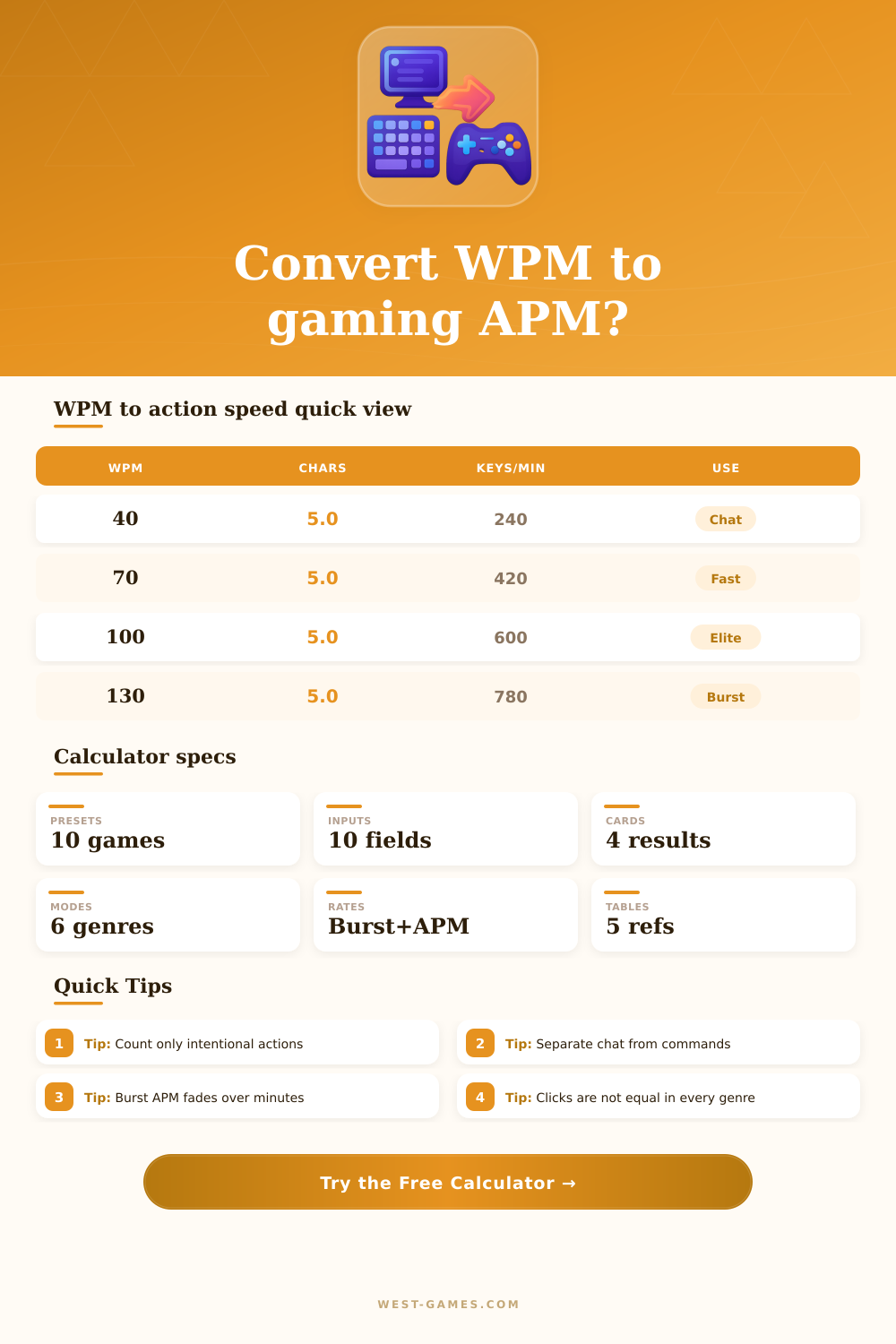
Convert typed words per minute into keyboard actions, add hotkeys and clicks, then compare raw, effective, burst, and sustained APM for different game genres.
RTS favors hotkeys, camera jumps, selection changes, and intentional command cycles.
Tactical games often value lower noise more than very high raw input counts.
Rotations reward stable sustained pacing, cooldown timing, and clean targeting.
Building games can turn clicks and hotkeys into very high burst command load.
| Typed WPM | Avg chars/word | Keyboard actions/min | Gaming interpretation |
|---|---|---|---|
| 35 WPM | 5.0 plus space | 210 keys/min | Comfortable chat or light command entry. |
| 60 WPM | 5.0 plus space | 360 keys/min | Fast enough that typed commands can matter. |
| 90 WPM | 5.0 plus space | 540 keys/min | High keyboard throughput when accuracy holds. |
| 120 WPM | 5.0 plus space | 720 keys/min | Short bursts can exceed many mouse-heavy APM profiles. |
| APM band | Raw APM range | Typical source | What to check |
|---|---|---|---|
| Light | Under 80 | Exploration, menus, turn setup | Look for idle time, not speed limits. |
| Moderate | 80 to 180 | Most combat, RPG, and casual RTS play | Clean binds matter more than spam. |
| High | 180 to 320 | RTS, MOBA fights, build games | Separate repeated clicks from useful commands. |
| Extreme | 320 or more | Elite RTS, rhythm, burst building | Measure accuracy and fatigue, not only speed. |
| Genre profile | Typing value | Hotkey value | Click value |
|---|---|---|---|
| RTS / strategy | Medium for control input | Very high for groups and camera | High when commands are intentional. |
| MOBA / action RPG | Low unless chat-call driven | High for skills and items | Medium for movement and targeting. |
| Tactical FPS | Low during rounds | Medium for utility and weapon binds | Lower count, higher consequence. |
| MMO / raid | Low to medium | High for rotation and target swaps | Medium for camera and targeting. |
| Builder / sandbox | Medium for commands and search | High for slots and edits | Very high during placement bursts. |
| Rhythm / key lane | Very high if keys are the game | High lane value | Usually low unless mouse mode. |
| Grouping mode | Effective factor | Use when | Practical meaning |
|---|---|---|---|
| Direct actions | 1.00x | Each input is its own command | Best for clean RTS, rhythm, or precise ability use. |
| Two-step pairs | 0.88x | Select plus act, aim plus confirm | Two inputs often become one useful game decision. |
| Three-input chains | 0.76x | Combo setup, edit-confirm-release | Fast chains are valuable but not all separate decisions. |
| Rotation bundle | 0.66x | Macro cycles, opener sequences | The rate is meaningful mostly as execution load. |
| Spam filtered | 0.54x | Repeated clicks or panic tapping | Large raw counts are heavily discounted. |
| Burst window | Likely multiplier | Sustain risk | Example situation |
|---|---|---|---|
| 5 to 15 seconds | 1.4x to 2.2x | High hand and accuracy drop | Build fight, opener, emergency micro. |
| 30 to 60 seconds | 1.2x to 1.6x | Moderate focus cost | Teamfight, boss burst, base defense. |
| 5 to 20 minutes | 0.9x to 1.1x | Depends on rhythm and breaks | Ladder game, dungeon, ranked match. |
| 60 minutes or more | 0.75x to 0.95x | Fatigue and consistency dominate | Scrim block, raid night, long grind. |
In the video, it appears mechanical with quick hands. And that’s what APM is (Action Per Minute). APM are the standard measure of gaming speed.
In reality it can mislead since raw numbers don’t separate meaningful input from frantic noise. Half your clicks could be a flurry of tapping on one button in a moment of panic and you’d still have high APM but low impact. The WPM to APM calculator approximates how fast you’re playing games based off your hotkeys, clicking, bursts, grouping, pace, type of game, and sustained play fatigue. It helps you figure out where real skill ends and accidental spammage begins.
Why High APM Is Not Always Good
This is the most dangerous misconception about input. Most people think more is always better. In certain games, such as real-time strategy games (Age of Empires IV, StarCraft II), they’re right. Every time you move camera or make a selection change, it all adds up. However, in turn-based games and tactical shooters, higher numbers of inputs tend to result from wasting energy doing redundant things. The calculator takes into account what game genre you play so it can runs the math for you.
Why? Because not all inputs are created equal. For example, keyboard binds in your MMO rotation have a different value than mouse clicks in your first-person shooter. So the tool accounts for this by assigning different weights to your inputs based on game type.
The second factor that creeps into this a lot more then most think is typing speed. A lot of gamers type stuff out in chat during games. They’ll use their keyboards for inventory and macro commands. At 70 words per minute (with five characters per word), that’s about forty-two keyboard actions per minute. Depending on what those action are, they can counts toward APM. On the one hand, they could be purposeful commands. On the other, they could just be chatting with friends. In that case, it doesn’t realy add anything to gameplay, but it will still clutter up your stats. So should your typing get counted? Or is it just background noise? Is it a part of the play loop? The calculator allows you to choose how much typing actualy counts towards command input. That becomes important when you’re looking at your own numbers compared to someone else’s, which may have different habits.
Another layer most people ignore is command grouping. You can have two inputs with one decision when you choose a unit and move it. Complex builds or ability chaining will create bundles of inputs that combine as single strategic moves. The calculator lets you pick between direct actions, pairs, chains, and spam filtering. Pick the correct model and you’ll see your effective APM.
It is not your raw count but the number that shows how fast you’re making decisions, not just how many times your fingers press keys. It’s a lot less clicky, a lot less repeated presses, and a lot more honest about what you’re controlling. That effective rate is almost always much lower then the raw rate, but also so much more honest about how well you’re doing.
There are two types of APM, as your stamina has two sides: burst and sustain. Burst APM tracks those rapid flashes when adrenaline pushes your reactions into overdrive (an opener combo, a build battle). Those peaks can gets really sky-high. Problem? You could of sustained that indefinitely. Sustained APM accounts for fatigue during long play sessions. It incorporates a gentle decay factor, illustrating how quickly you slow down after playing for twenty minutes. Knowing the difference lets you balance your energy levels. Are you spiking but crashing? Maybe you’re burning out before your time. Pro players may not reach as high peak numbers as amateur players who spike and crash, but they keeps a steady level.
This page lays it out through the reference tables that show typical bands for extreme, high, moddern, moderate and light play. Where does your input fit in relation to these? You can see from there.
Don’t get hung up on being as fast as possible at all costs. Clean slow beats messy fast every day of the week. If you’re finding yourself screwing things up because you’re trying to max out APM then you’re losing. Efficiency is what we are going for here. It’s about doing the right thing at the right time with no wasted motion.
Understanding how your inputs translate to actual commands allows you to train smarter. It’s about reducing noise more than simply adding more volume. That mindset switch makes a difference in how you practice and leads to better results quicker then any raw speed drill will. Fast hands mean nothing if your mind isn’t clear.