🗡 New World Experience Calculator
Estimate character XP, trade skill ranks, weapon mastery sessions, route uptime, and XP efficiency before your next Aeternum grind.
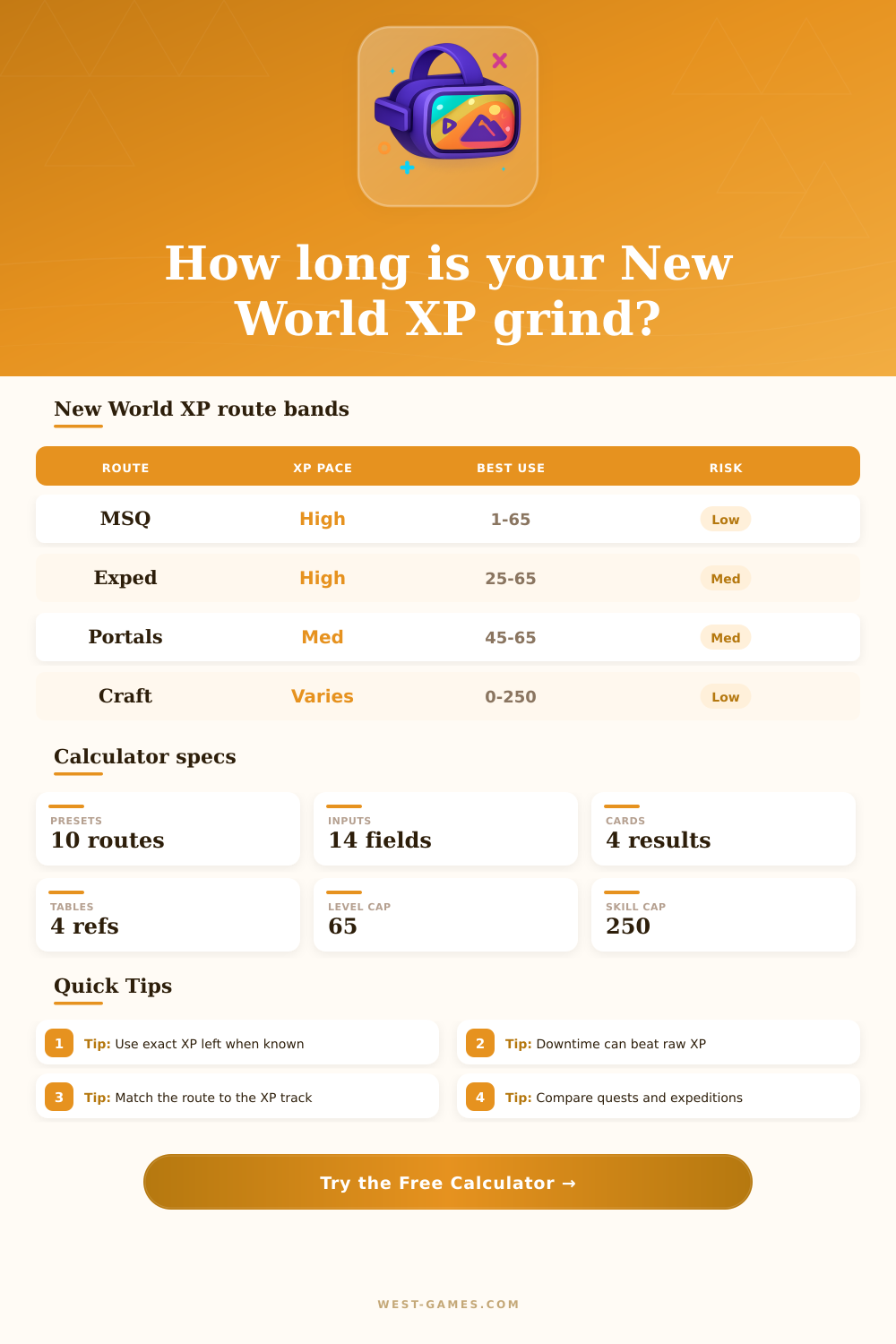
Main Story
Best for character level when turn-ins are close and travel stays controlled.
Expeditions
Strong completion XP when queues, wipes, and repair downtime stay low.
Elite Zones
Good weapon mastery only when tagging and pack density are reliable.
Crafting
Trade skill XP depends on batch size, station access, and material prep.
| Track | Cap | Curve | Best Data Entry |
|---|---|---|---|
| Character level | 65 | Quest weighted | XP to next level |
| Weapon mastery | 20 | Short ramp | Elite farm XP/hour |
| Trade skill | 250 | Long ramp | Batch craft XP |
| Faction rep | 5 tiers | Mission chunks | Mission XP |
| PvP track | Open-ended | Rank chunks | Match XP |
Use the exact override whenever the in-game panel shows a precise XP remaining value.
| Activity | XP Each | Per Hour | Downtime |
|---|---|---|---|
| Main story quest | 9,500 | 6 | 18% |
| Side quest loop | 4,200 | 9 | 14% |
| Expedition | 22,000 | 2.4 | 22% |
| Corrupted breach | 3,400 | 14 | 12% |
| Faction mission | 5,800 | 8 | 16% |
| Elite weapon farm | 260 | 95 | 10% |
| Bulk crafting | 1,150 | 70 | 9% |
| Outpost or arena | 12,500 | 2.8 | 20% |
| Route | Character | Weapon | Trade | PvP |
|---|---|---|---|---|
| Main story | 1.20x | 0.45x | 0.10x | 0.20x |
| Expedition | 1.05x | 0.85x | 0.15x | 0.25x |
| Portals | 0.88x | 0.75x | 0.10x | 0.25x |
| Elite farm | 0.48x | 1.25x | 0.10x | 0.15x |
| Crafting | 0.20x | 0.05x | 1.30x | 0.05x |
| PvP match | 0.55x | 0.35x | 0.05x | 1.25x |
Fit multipliers keep the calculator from treating every XP source as equally useful for every progression track.
| Input | Typical Range | Use When | Watch Out |
|---|---|---|---|
| XP bonus | 0% to 50% | Events or rested | Do not double count |
| Contribution | 60% to 100% | Shared open-world farm | Tagging matters |
| Downtime | 8% to 30% | Travel and queues | Town loops add up |
| Fail minutes | 0 to 15/hr | Wipes or PvP losses | Lowers net pace |
| Formula Card | Calculation | Purpose | Pressure Point |
|---|---|---|---|
| Net XP/hour | XP each x completions x fit x bonus x uptime | Shows practical farming speed | Downtime over 25% |
| Time to target | Remaining XP divided by net XP/hour | Converts the grind into hours | Low completions/hour |
| Ranks gained | Session XP applied through track curve | Shows visible progress | Late-rank curve ramp |
| Efficiency score | Fit, contribution, uptime, and failure blend | Rates route quality | Wrong track or weak tagging |
These are planning formulas for route comparison. Exact in-game XP tables can change, so override remaining XP when precision matters.
When planning a progression session in New World, it is first important to understand how long it will take to complete the specific goal that you desire to accomplish. There are several different variable that will impact the length of time that is required to complete these goals, and each of those variables will impact the total time that is required for your progression session. Many players believe that they understands how long it will take to complete certain task, but they dont account for variables like travel time, repair time, and the potential for failed runs on certain activities.
Whether your goal is to increase your character level or to complete a specific weapon track, it is possible that the time it will take to complete those tasks will be different than you might expect. If you do not account for such variables in your planning, you may find that you spend many hours completing these goals yet you did not account for the time that will be required to complete your progression session. Another of the main factor to consider in creating a progression session is the amount of experience point that will be earned with each completion of the session, as well as how that relationship relate to your goals for progression.
How to Plan a Progression Session in New World
For instance, although a portal farm is fast in providing experience point, it may not be efficient if your character levels are high enough that each clear of an area provide low experience points. Similarly, although crafting may take a while to complete a number of items, it may be the best way to increase your trade skill if you already have all of the material for crafting. The experience point calculator allows you to enter your rank, your goal for your rank, and the activity that you will perform in your progression session; the calculator can then provide you with the mathematical calculation that will help you to understand the time and experience point projections for your progression session.
Each of the variables that you enter will impact the final result of the projection. Downtime is one of the variables that may reduce the efficiency of your created progression session. The time that you take to recall to a town, to sort your inventory, or to wait for a group can all reduce the number of experience points that you accrue in comparison to the projection that you have made for your session.
The efficiency of your game session can be lost to downtime, as well as to failed runs for your specific activity. These loss to your time spent playing the game should be accounted for when creating your projections and goals for your progression session. Another variable that you should consider is your track fit.
Your track fit will determine how many experience points you earn for each specific goal that you create for yourself in New World. For instance, main story quest provide a great deal of experience points for character level, but they contribute very little experience to weapon mastery. Elite farming, however, provide a much higher amount of experience points towards weapon mastery.
Experience point calculators allow you to use a multiplier for your experience point total; the game uses this value to account for the varying experience point multipliers for each game activity and goal. Rested experience and first-clear bonus are also finite; there are a limited number of experience points provided to you in these case. As such, you should only allocate rested experience and first-clear bonuses to activities that have high uptime and low failure rate; allocating such a bonus to an activity that takes long travel time or wipes will waste those bonuses.
The experience point calculators allow you to enter these bonuses as a one-time addition to the experience point calculations; the calculators do not calculate or determine experience point value after rested experience or first-clear bonus application. Contribution share is another variable that you should consider for players that are working as a group. For instance, if three player attack a single elite game, the experience points for each player will be a fraction of the total experience points of the game.
The contribution share value should be entered as a lower percentage then the total number of players in your group. This prevents mistakes in thinking that each kill of an enemy in a shared area belong to the player alone. Session length is one of the more flexible of all variable.
Session length can change based off the success of your game sessions. For instance, a session that is planned to take two hour may take three hours if you travel long distance or if there is a daily game reset. The experience point calculators allow you to set your session length; they will calculate the number of rank you can earn within that length of time, as well as the experience points that you will have earned by the end of your session.
This can help you to decide when to end your play session. Overall, you should use these experience point calculators to determine how a variety of variable create experience points. By accounting for downtime, contribution share, and track fit, you can determine which activities will take the required experience points yet allow for you to allocate your time efficient; you can compare certain progression sessions to others to determine which will provide you with the best value of experience for your time invested.