⚒ PF2e Crafting Calculator
Model Pathfinder 2e item level DCs, formula setup, crafter proficiency, downtime progress, Earn Income value, check outcome, critical success, critical failure, and batch item counts.
| Item level | Base DC | Typical use | Note |
|---|---|---|---|
| 0 | 14 | Simple gear | Level-less items |
| 4 | 19 | Early rune | Striking example |
| 8 | 24 | Mid gear | Expert often ok |
| 12 | 30 | Advanced item | Master tier soon |
| 16 | 35 | High gear | Master required |
| 20 | 40 | Top item | Legendary tier |
Apply GM difficulty adjustments for rarity, workshop quality, special materials, and campaign variants.
| Crafter level | Trained | Expert | Master |
|---|---|---|---|
| 3 | 0.5 gp | 0.5 gp | 0.5 gp |
| 5 | 0.9 gp | 1 gp | 1 gp |
| 9 | 3 gp | 4 gp | 4 gp |
| 13 | 7 gp | 10 gp | 15 gp |
| 17 | 15 gp | 30 gp | 45 gp |
| 20 | 40 gp | 75 gp | 150 gp |
Critical success uses one level higher; at level 20, use the special critical success row.
| Degree | What happens | Extra days | Material impact |
|---|---|---|---|
| Critical success | Craft succeeds | Level +1 income | At least half spent |
| Success | Craft succeeds | Level income | At least half spent |
| Failure | Start over | No progress | Supplies salvaged |
| Critical failure | Start over | No progress | 10% supplies ruined |
A natural 20 improves the degree by one step; a natural 1 worsens it by one step.
| Case | Setup | Batch count | Requirement |
|---|---|---|---|
| Formula owned | 1 day | By item | Access covered |
| Common no formula | 2 days | By item | GM allows common |
| Consumable | 1-2 days | Up to 4 | Pay all materials |
| Ammunition | 1-2 days | Listed lot | Often 10 pieces |
| Missing access | Blocked | None | Find formula first |
The calculator flags common gating rules, but your GM has the final call on access and facilities.
This tool is good for planning crafts in Pathfinder Second Edition. In Pathfinder, there’s a cost of both downtime days and gold when crafting something. There’s also time cost vs. Materials. You want to find the balance between the time your skills take to reduce costs and the cost of materials. It’s about improving resource management and finding time for everything else too.
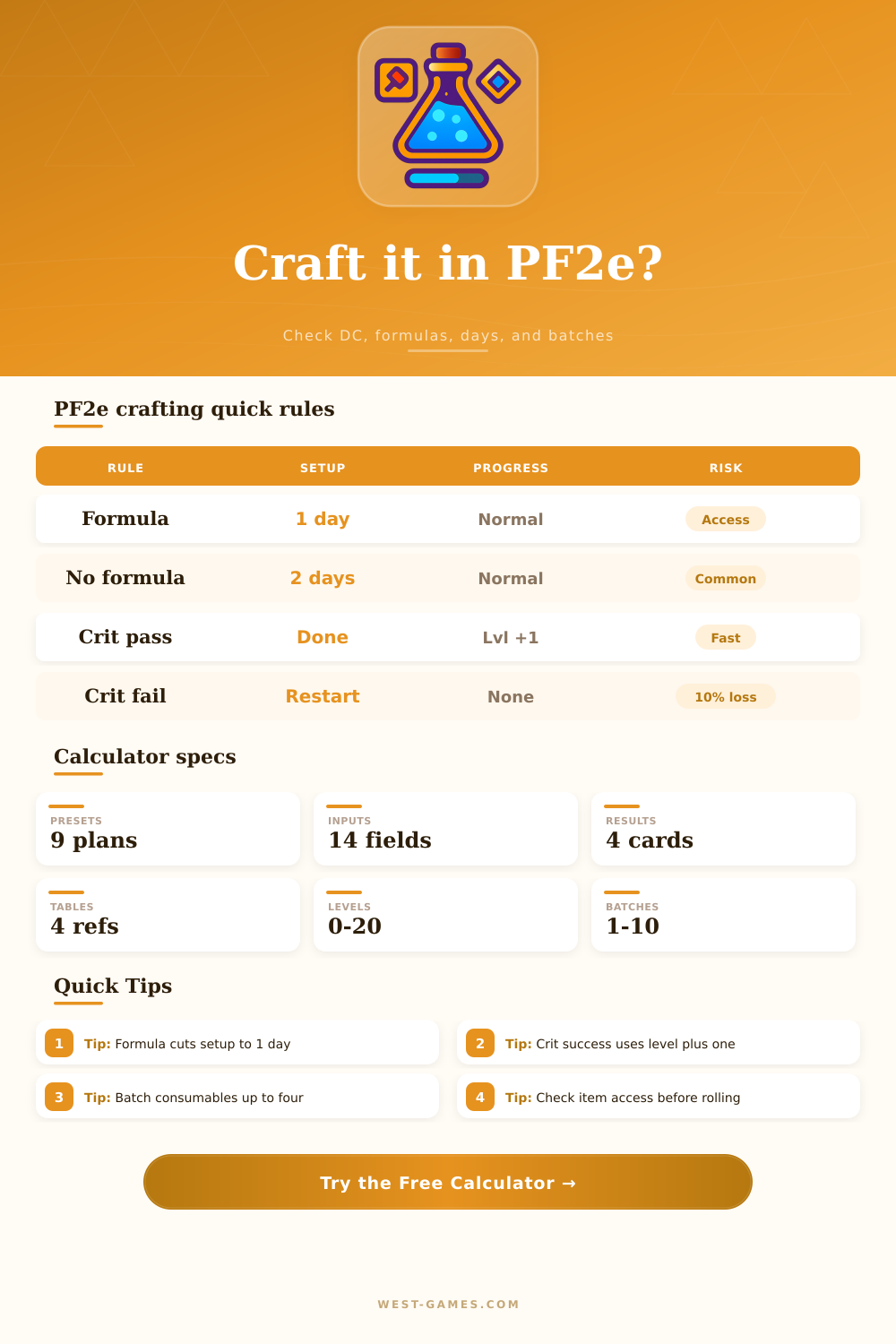
Knowing the formulas. Without knowing the recipe, you can’t make the item. Having the physical recipe slashes your set-up time from two days down to one which makes a big difference when you’re juggling several projects. If you don’t have the formula, then you has to reverse-engineer the item. It will take longer and it might prevent you from making rare or uncommon gear. Before you even go looking for the item, the calculator shows that you are falling behind due to a lack of formula.
How to Plan Your Crafting
After that, it’s a matter of comparing price-to-income. Your income is how much you can make from selling materials during downtime days. The more proficient you are and the higher your level, the higher your income per day. For example, a level 9 crafter who trained as a master will get paid more then a level 5 one who trained as an expert. The gap grows larger as you level up. The daily rates appears in the tool’s reference tables which explains why crafting things becomes too expensive if you fall behind in terms of crafting skill (not just initially in cash).
Higher criticals make you more efficient. With each critical success, you may use one level higher for your Earn Income calculation. Accumulate this gain over several days or weeks on the job. It’s the difference between finishing early or dragging out a project. A failure means restarting from scratch (and salvaging any materials). A critical failure destroys some of those materals. The modifier must be high enough that you avoid bad rolls. One point better than the DC? Then you’ll be at the mercy of nature with natural ones and twos.
This also gives you an advantage with consumable items. With potions and alchemist fires, you can batch craft up to four at a time. Roll the same check for the whole batch and save those setup days. It costs more gold but no additional time. Think of this as a volume discount. If your game permits it, batching should of been your default choice. You maximize your return on downtime days spent making gear. All that’s required is amount of liquid gold needed to pay upfront before you start making money back.
You may also find that the rarity of an item will impact your chances. Rare and uncommon items often carry a DC penalty, such as a +2. This seems minor but makes you more reliant on high die roll vs. Your flat modifier. Before jumping in, talk to your game master regarding any such penalty they apply. You’ll be able to turn these off/on via the calculator which shows the end cost as well as how much it affects your odds.
Being a crafter takes time. It costs resources. And it pays off if you are prepared for it. To master crafting you have to know when to pay full price for quick results or take the time to scrimp and save. Every crafting loop is different. Some require more skill than others do. What works well on one game table might not be the same solution for another. Use the time you have available and plan accordingly. Check your modifiers, craft wisely, and enjoy the reward.