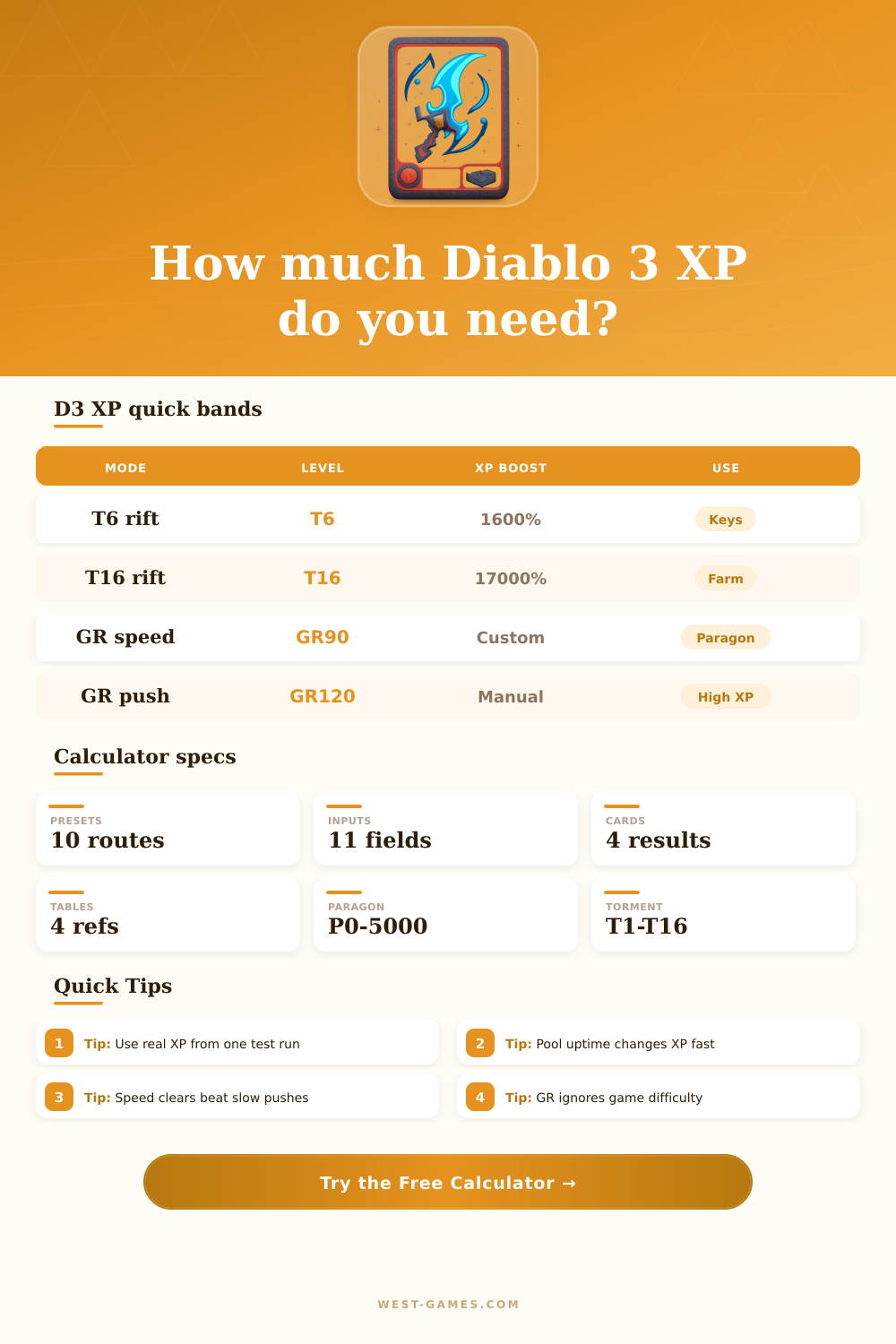
🎮 Diablo 3 Experience Calculator
Estimate paragon XP needed, effective XP per run, Greater Rift pace, Torment bonus impact, Pool of Reflection value, and time to your next target.
| Difficulty | Extra XP | Use case |
|---|---|---|
| Torment I | 300% | Fresh 70 farming |
| Torment VI | 1,600% | Season start keys |
| Torment X | 4,000% | Early speed farm |
| Torment XIII | 8,200% | Pre-T16 farming |
| Torment XVI | 17,000% | Max Torment routes |
| Paragon | XP for next level | Planning note |
|---|---|---|
| 100 | 0.166B | Early gearing |
| 400 | 1.136B | Set farm stage |
| 800 | 23.272B | Core cap reached |
| 1000 | 47.752B | Season target |
| 1500 | 108.952B | Group grind |
| 2000 | 170.152B | Long push |
| Route | Typical entry | XP model |
|---|---|---|
| T16 Nephalem Rift | Fast keys | Low XP, fast cycle |
| GR70 Solo | Gem unlock | Starter paragon |
| GR90 Speed | 3 min farm | Efficient solo XP |
| GR110 Group | Meta speeds | High XP/hour |
| GR120 Pool Chain | Organized group | Pool boosted XP |
| Bonus | Calculator input | Practical effect |
|---|---|---|
| 2 players | 10% | Small party gain |
| 3 players | 20% | Better XP stack |
| 4 players | 30% | Max party bonus |
| Pool active | Uptime % | Doubles while active |
| Shrine/event | Bonus % | Optional multiplier |
In Diablo 3, when you reach teh level cap for your character, you will need to start earning paragon levels for your character. While the number of paragon levels that you can earn for your character is seemingly unlimited, each subsequent paragon level require more experience to earn than the previous level. Consequently, in order to earn paragon levels for your character as quickly as possible, you has to farm experience for your character efficienty.
An experience calculator can help you to determine how much experience you will need to farm in order to reach your target paragon level for your character. Rather than forming a farm route for your character based off the hope that it will provide you with the best experience per run for your character, you can use the experience calculator to enter the amount of experience that you have earned per run while testing your character on a route that you are considering using to farm for paragon levels. In addition to experience per run, you will also need to enter the size of your party and your uptime of your Pool of Reflection into the experience calculator.
How to Use the Diablo 3 Paragon Experience Calculator
Additionally, you can also enter any experience that you can earn from shrines or events into the experience calculator. The experience calculator will provide you with a projection of how long it will take for you to earn the amount of experience that you require to reach your target paragon level for your character. The experience calculator will require you to enter a number of different values to ensure that the information that it calculates is accurate.
For instance, you will be asked to enter your current paragon level and your target paragon level. You can enter your current level in order to determine how much experience you have already earned. The amount of experience that you earn with every run of your selected run route can be entered into the experience calculator.
Additionally, the length of time that it takes for you to complete your route, and the length of time that you must spend in the towns to restart your character can be entered. The experience calculator uses these two values to calculate the amount of experience that you will earn in relation to your total amount of minutes. Finally, you can enter your uptime for your Pool of Reflection, as this will double the amount of experience that you earn while you are using the Pool of Reflection.
There are different types of content that can be played within Diablo 3, each of which provides experience to the players in different ways. For instance, if you are playing Greater Rifts, the difficulty level of the Rifts will not have any impact upon the amount of experience that you earn. If, however, you are playing Nephalem Rifts or completing Bounties, the level of Torment that you choose will impact the amount of experience that you earn.
Each of the tables that are provided within the experience calculator indicate the type of bonus that each Rift will provide to your experience as the Torment level increases from I to XVI. The experience calculator automatically applies these values if you choose the content that you would like to play. While it may be tempting to believe that every farming route for Diablo 3 is the same in terms of the amount of experience that it will provide to the players, this isnt true.
It is possible that a route in which you and your friends spend more time farming will be slower at earning experience than another route that is considered to be fast. The route comparison grid allows you to compare the time that it will take to reach your target experience for each of the routes that you consider to be potential candidates for your game sessions. This grid will allow you to avoid spending hours playing a route that is slower than another route.
While the experience calculator provides players with valuable data regarding their characters, it does not provide data regarding how the player feels while they are playing. For example, some players may feel best while playing speed farming routes, while other players may feel best playing higher levels of Greater Rifts. It may be better to use a route that takes longer to reach the target experience but which the player feels that they can maintain for long periods of time, as opposed to an “optimal” route for earning experience that can be abandoned after only a few hours of play sessions.
Within the experience calculator are multipliers that will account for the different ways that you may choose to farm for experience. For instance, the experience calculation will factor in the bonus to experience provided by having a full party, as will the effect of dying within your party. The experience from the Pool of Reflection can also be factored into the calculation.
These multipliers will be reflected within the results of the experience calculator. With the understanding of how many runs it will take for you to earn enough experience to reach your target paragon levels, you can better decide how to use your time in the game. For instance, if you have decided on a target number of runs that you can complete, you can decide whether you would like to focus on leveling up your gems or whether you would like to focus on gathering the materials that you require for crafting your items.
In this way, the experience calculator will allow you to make informed decisions about your game sessions and what type of route you will take during those sessions. You should of used this tool alot more often.