🎯 FEH Summon Calculator
Estimate Fire Emblem Heroes orb budget, banner rates, pity bonus, color sniping, focus charge, spark count, target copies, expected summons, and chance before summoning.
| Stones taken | Orb cost | Average | Planning note |
|---|---|---|---|
| 1 stone | 5 orbs | 5.00 | Strict snipe |
| 2 stones | 9 orbs | 4.50 | Good when two colors appear |
| 3 stones | 13 orbs | 4.33 | Mixed sniping |
| 4 stones | 17 orbs | 4.25 | Almost full circle |
| 5 stones | 20 orbs | 4.00 | Full circle discount |
The calculator estimates expected orb cost from target-color frequency and the FEH 5, 4, 4, 4, 3 circle discount pattern.
| Banner type | Base focus | Regular 5-star | Default focus pool |
|---|---|---|---|
| New Heroes | 3% | 3% | 4 heroes |
| Special Heroes | 3% | 3% | 4 heroes |
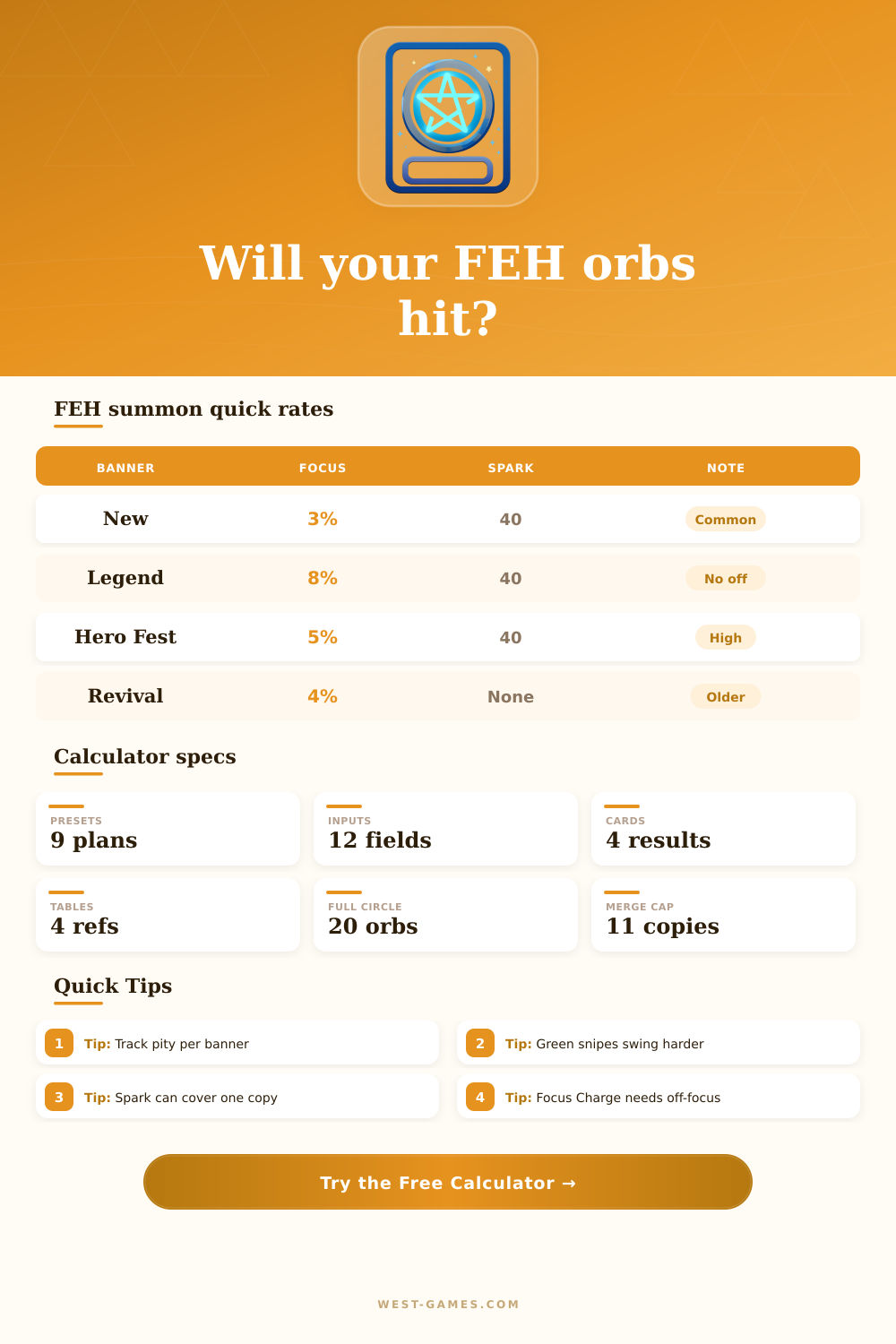
| Legendary / Mythic | 8% | 0% | 12 heroes |
| Hero Fest | 5% | 3% | 4 heroes |
| Weekly Revival | 4% | 2% | 3 heroes |
Always check the in-game Appearance Rates page because FEH event rules and subscription spark access can vary by banner.
| Color plan | Stone share | Orb pressure | When useful |
|---|---|---|---|
| Red only | 29% | Medium | Sword, red tome, red beast |
| Blue only | 25% | Medium | Lance, blue tome, dragon |
| Green only | 19% | High variance | Axe, green tome, green bow |
| Colorless only | 27% | Medium | Staff, dagger, bow |
| Full circles | 100% | Lowest per pull | Spark rush or broad targets |
Color shares are planning approximations. The exact stone color mix depends on the banner's summonable pool.
| Mechanic | Counter | Effect | Calculator input |
|---|---|---|---|
| Pity increase | Every 5 no 5-star | Raises 5-star rates | Summons since last 5-star |
| 120 safety | 120 no 5-star | Next circle at 100% | Included as high pity |
| Spark | Usually 40 summons | Choose a focus copy | Spark count and rule |
| Focus Charge | 3 off-focus 5-stars | Next 5-star is focus | Charge state |
| Target merges | Up to 11 copies | Plus 10 project | Owned and goal copies |
Spark copies and random summon copies are both counted toward the target-copy goal in this model.
Your orbs aren’t looking great. The new banner comes out. A fresh banner spawns, and there it is: that sweet, sweet unit is calling to you. But base rate is only 30%… Too risky! It’s gacha time, and gacha mechanics are random: either analyze spreadsheets too hard, or pull blind and hope for the best. Neither extreme is the truth. Probabilities stacks against you, and you need to learn what they mean.
To put it simply: After inputting your circumstance into the calculator (above), it crunches the numbers for you. You won’t have to guess about pity thresholds and coefficients anymore. Not all banners are created equal. While a normal new heroes banner use one mathematical curve, a legendary event applies another. The focus rate may appear the same, but pool size makes all the difference. Twelve units with an eight percent chance of focusing each other drastically diminishes your chances on any one target. Choosing the right type of banner is your starting point.
Stop Guessing. Use Data to Save Orbs.
That’s where the tool’s underlying math comes into play, adjusting based off the banner event’s dilution. A Remix banner isn’t the same as a standard four-hero focus; use the wrong one and you’ll overspend while failing to achieve results.
Strategy comes into play here, which I’m sure you’ve seen debated, do you skip orbs to save up for color you want? Again, it’s a matter of patience and what you’re looking for. Skipping saves you some money on orbs per summon. Sounds good! Except then you run into a banner that didn’t distribute well. Maybe they ran out of green and now you skipped three circles to get one usable spot. That’s stressful variance.
The tool takes that into account, and estimates how much an orb will cost on average if you use its sniping suggestions. It doesn’t give you the best case, but something more realistic.
And then there’s pity. It rises gradually with every unsuccessful summon until your chances suddenly spike after some number of summons. It might be forty, but I am not sure. I’m not sure how long). By one hundred and twenty, if you haven’t pulled a five-star yet, you’re practically guaranteed results. Since most people don’t bother counting their own pity meter, most players thinks the game keeps an internal tally of it. It doesn’t. Nobody tells you what your pity number is. You need to keep tabs on it yourself.
That internal sense of momentum represents the unseen boost from all the pulls you’ve made since your last lucky draw. If you are deep in a pity cycle, your odds are actualy better than the base rate suggests. That’s value being squandered when you overlook that upward trend.
The additional wrinkle is in spark mechanics. Sure, forty summons means you get a guaranteed copy, but it lulls you into bad budgeting habits. “One unit is covered by spark”. That’s not true if you’re pursuing a plus ten merge. Then spark is only the beginning. Now you want ten additional copies on top of that. The calculator isolates the random part of your summon prediction and subtracts out the spark component. It tells you precisely how many units remain beyond the guaranteed hit. No more false confidence.
How far do we have to go? People get caught up thinking that focus charge is a safety net. It’s not. It’s a way to give a time penalty if you haven’t hit three off-focus five-stars. This can bail you out in a focus drought. But it also means you’ll potentially burn through some charges on banners where you don’t really care about the off-focuses. Do you turn it on? That’s dependent on your current charge amount, and what random pulls is worth more then others to you.
On the page they also have some reference tables that list out their standard rates for easy comparison. So if you’re considering two events happening at once you can check it quickly. Sometimes math says to pick one banner, and other times it says to pick another, but sometimes your roster needs require a different choice. And that’s where the human element comes in. No tool can replace that.
The calculator provides the floor and ceiling of your choices. It tells you whether your budget is realistic or not. Then you get to decide if you want the units today more than the orbs needed next week. The art, though, is managing what you expect. The entire point of gacha games is to make you think hope and near-miss is everything. Go in to summon with data, not hope. Open up your eyes, pull it out. Don’t guess. Plan. Think with the numbers. That way, you don’t lose any of that important orb count.