⚒️ PoE2 Crafting Calculator
Plan a Path of Exile 2 craft by base item, item level, route, mod tier target, in-game currency spend, prefix/suffix pressure, expected attempts, and value risk.
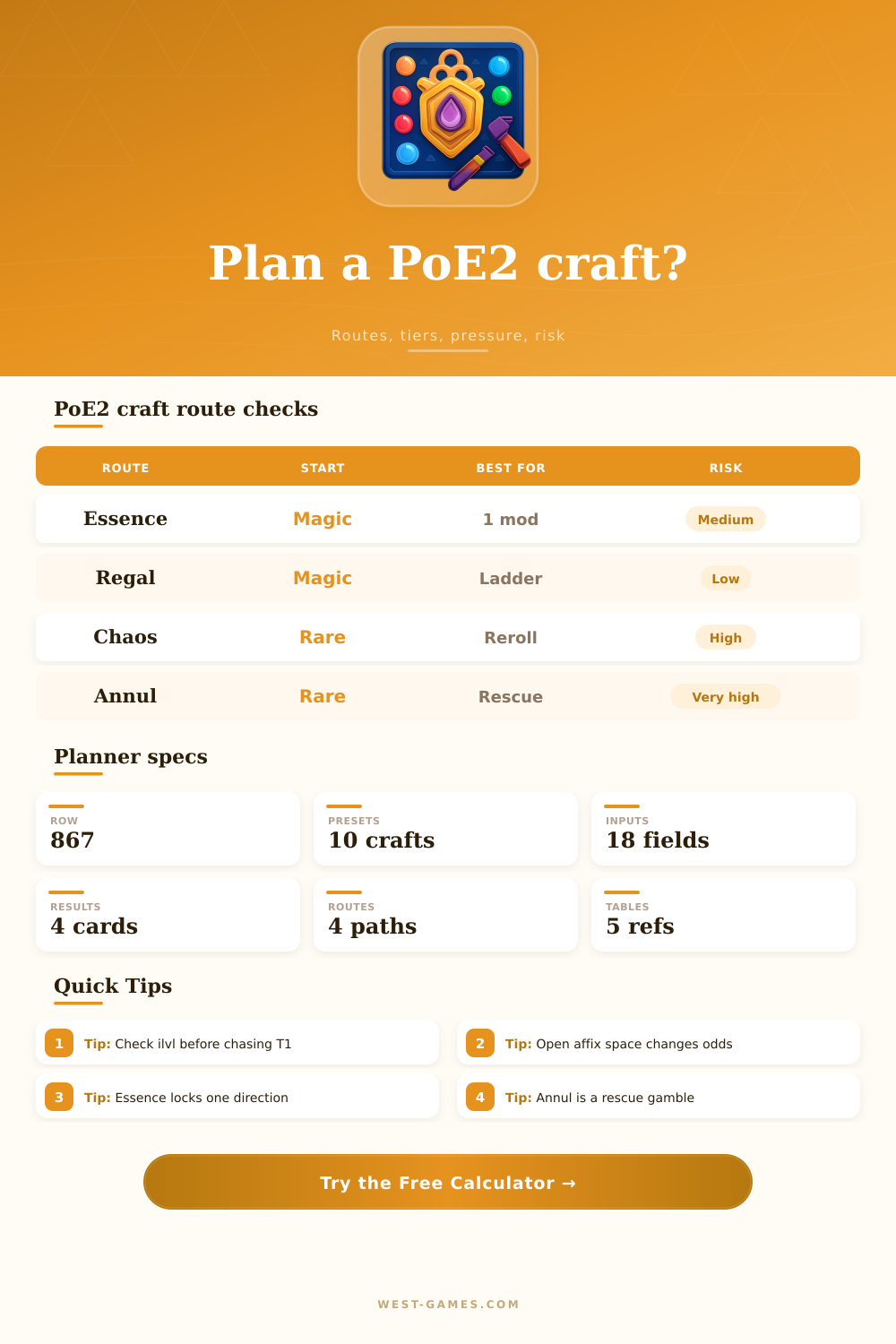
| Route | Main currency | Modeled action | Pressure note |
|---|---|---|---|
| Essence foundation | Essence, Regal, Exalt | Force a themed start, then promote and add | Strong when focus matches target |
| Regal ladder | Regal, Exalt | Keep a magic hit, then build rare slowly | Stops before heavy loss |
| Chaos rebuild | Chaos | Reroll rare modifiers for a fresh spread | Good only on replaceable bases |
| Annul rescue | Annul, Exalt | Remove one random mod, then refill space | High keeper-loss risk |
| Target | Use case | Hit multiplier | Planner meaning |
|---|---|---|---|
| T5+ functional | Campaign or early maps | 1.40x | Any useful band is acceptable |
| T4+ mapping | Stable atlas progress | 1.00x | Baseline practical target |
| T3+ strong | Endgame upgrade | 0.65x | Noticeably stricter roll |
| T2+ premium | Trade-quality item | 0.35x | Expensive chase zone |
| T1 chase | Mirror-tier direction | 0.18x | Extreme attempt count |
| Base | Main side | Typical target | Pressure pattern |
|---|---|---|---|
| Expert War Staff | Prefix | Gem level or spell damage | Prefixes crowd quickly |
| Bombard Crossbow | Prefix | Physical damage stack | Needs open damage slots |
| Spirit Focus | Suffix | Minion or spirit scaling | Suffixes compete with utility |
| Evasion Boots | Suffix | Movement speed | Resist suffixes may block target |
| Jewellery | Mixed | Attributes, gem, resist, cast | Both sides can matter |
| Occupied side | Open space | Craft read | Suggested route |
|---|---|---|---|
| 0 of 3 | Wide open | Low pressure, many adds possible | Regal ladder or essence |
| 1 of 3 | Comfortable | Can pursue one focused target | Essence or Exalt finish |
| 2 of 3 | Tight | One miss can cap the side | Stop rules matter |
| 3 of 3 | Blocked | Cannot naturally add that side | Chaos or annul only |
| Material | Planner role | Best moment | Risk control |
|---|---|---|---|
| Essence | Starts with a themed modifier direction | When one target family matters most | Use only on bases worth finishing |
| Regal Orb | Promotes a magic item into a rare item | After one or two keepers are present | Stop if the regal lands dead weight |
| Exalted Orb | Adds a random modifier to a rare item | When the correct affix side is open | Avoid full-side pressure |
| Chaos Orb | Rebuilds the rare modifier spread | When no keeper is worth protecting | Reserve for cheap or replaceable bases |
| Orb of Annulment | Removes one random modifier | When a single bad mod blocks a valuable item | Only if keeper-loss odds are acceptable |
The calculator models mod weights and currency values as editable planning assumptions because league economy and exact mod desirability can change.
Item modifiers are another area where Path of Exile 2 tutorial doesn’t explain how it works. In simple terms, it’s just concerned with what ends up on your item. And craft calculator is meant to close that gap.
In practice, most players see crafting as binary: either do this or don’t, but crafting are much more detailed than even that simple split can account for. At the heart of any viable craft is your base item archetype and item level. They is limiting your access to higher tier modifiers before you spend currency. Target a T1 mod on an item level 82 staff? Regardless of how many Orbs you save up, the math is against you.
How to Use the Craft Calculator
The calculator crunches these probabilities for you. It will adjust the hit rate based on tiers and weights you choose for each pool. Then it will show you just how steep that climb is so you don’t commit resources to a futile chase. Do you think you’re chasing a mirror-tier trade piece? Or do you think you’re chasing a functional map clear item? Those requires different budgeting strategies, and you need to know them.
Most players don’t realize that they’re losing value by bleeding out into currency pressure. Every rare item has three prefix slots and three suffix slots. Each of those has 3 slots. So once they’re full, you can no longer slap any additional modifiers onto that side without removing one. The calculator specifically accounts for this kind of pressure. It tells you if you are naturaly getting in your own way.
Want an extra offensive roll? But you already have 3 prefixes taken up, so now standard Orbs can’t touch that slot. Now you need to spend an Orb of Annulment, or a Chaos Orb. Which exposes you to a different set of risks, you stand a chance of dropping the one nice mod you were coddling. And that’s the mistake people make when they think more currency = better outcome. Spending more money simply means you’ve got more ways to screw over what you’ve got in-hand.
Even more important than choosing your target mod is choosing how you get there. If you’ve got an Essence foundation, then you’re forced to go down one particular theme. That’s great if you have a plan in mind; otherwise, it sucks if what you rolled doesn’t fit into your build.
If you’re using the Regal ladder, you’re taking fewer risks, and you’ll still have time to pause before bricking something good. With chaos rebuilds, you get low-cost variety at the expense of replaceable base items. With annul rescue ops, you’re making a high-stakes gamble with items whose best modifiers aren’t being used yet. You then try to pull them out of the fire if they are only missing a single bad modifier that keeps them from being great.
Different methods has different failure modes; knowing those failures will let you decide how much you should of care if the dice don’t come up the way you’d like. The page has some reference tables laying all of this out. You can look at the pressure associated with each method side by side before opening your inventory to see what you’re going to do.
Keep in mind as well that all of these currencies have different values on the real market at each stage of your league. End-game currency costs are wildly different than early season ones. You can tweak it so that the tool shows how the exalt-equivalent cost of Chaos Orbs and Essences changes with the price. When Chaos Orbs is inexpensive, it makes sense to blow them up and rebuild a rarer base instead of hoping against hope you might salvage some half-baked craft that’s gone south. Instead of a fatal error, it just becomes another expense to manage.
Over time, that is what distinguishes informed probability management from blind gambling. In the end, creating in Path of Exile 2 is far more about avoiding regrets after a thousand tries than it is about being lucky. Yes, you’ll waste Orbs. And yes, you’ll brick items. Sometimes, however, you’ll get just what you wanted with very first click.
But to consistently succeed, you have to know the numbers going into any attempt. Before clicking anything, you should understand the chances of making something good versus bad. Instead of buying things out of impulse or hype, treat each craft as an investment, only make them if you think they have a decent chance of turning a profit. That’s why this calculator does all the hard work for you; now you can play the game without spending hours looking at spreadsheets in your downtime.
If you’re having a bad roll, know when to cut your losses and walk away before it eats into your wallet too much. Don’t get greedy. Stay within your limit. Keep your base stuff clean. Make sure the math decides your wallet, not your dreams. When you find yourself staring at a pile of money and tempted to bet it all, just think about what numbers you should be checking first, because the smartest choice might be knowing when not to bet.