⚒ BitCraft Crafting Calculator
Plan BitCraft settlement crafting with station tier gates, skill tier, material chains, gathering and refining time, batch size, quality assumptions, cooperative projects, hauling trips, and crew labor split.
| Tier | Working area | Typical craft | Model speed |
|---|---|---|---|
| 1 | Camp bench | Rations, cord, rough parts | 1.00x time |
| 2 | Improved bench | Planks, cloth, copper tools | 0.92x time |
| 3 | Specialist shop | Furniture, carts, stonework | 0.84x time |
| 4 | Advanced workshop | Iron fittings, upgrades | 0.76x time |
| 5 | Guild workshop | Large cooperative stages | 0.68x time |
| Refined unit | Raw input | Raw ratio | Refine load |
|---|---|---|---|
| Plank | Logs or timber | 3 raw | Wood station |
| Cloth or cord | Plants or fiber | 2 raw | Loom station |
| Ingot or rivet | Ore | 4 raw | Smelter station |
| Mortar or block | Stone or clay | 2 raw | Kiln station |
| Special fitting | Mixed materials | 1 token | Final bench |
| Target | Material factor | Time factor | Use case |
|---|---|---|---|
| Common | 1.00x | 1.00x | Usable settlement stock |
| Sturdy | 1.08x | 1.05x | Durability buffer |
| Fine | 1.18x | 1.12x | Preferred equipment |
| Exceptional | 1.32x | 1.22x | Rare roll planning |
| Masterwork | 1.50x | 1.38x | Showcase project |
| Role | Formula use | Bottleneck sign | Adjustment |
|---|---|---|---|
| Gatherer | Raw units per hour | Gather time is highest | Add tool quality or workers |
| Refiner | Refined units per hour | Queues fill before craft | Add station feeders |
| Crafter | Attempts x craft time | Final station is slow | Raise skill or station tier |
| Hauler | Trips x route minutes | Materials wait in storage | Raise capacity or haulers |
| Preset | Tier | Chain | Per craft focus |
|---|---|---|---|
| Trail Rations Stockpile | 1 | Raw | Food, herbs, light bindings |
| Forager Linen Pack | 2 | Textile | Fiber into cloth and packs |
| Pine Plank Wall Segment | 2 | Wood | Logs into planks for walls |
| Copper Tool Repair Run | 2 | Metal | Ore, ingots, handles, fittings |
| Stone Hearth Foundation | 3 | Construction | Stone, mortar, timber braces |
| Iron Rivet Construction Batch | 3 | Metal | Ore into rivets for projects |
| Explorer Cart Parts | 3 | Wood | Planks, ingots, hide bindings |
| Guild Storage Chest | 4 | Wood | Planks, cloth lining, fittings |
| Settlement Loom Upgrade | 4 | Textile | Cloth, planks, metal fittings |
| Cooperative Watchtower Stage | 5 | Construction | Stone blocks, planks, fittings |
So you want to build a fortified hall? Or maybe a bustling settlement. What you envision is that completed structure sitting on the horizon. What you don’t see is the mountain of stone, ore, and raw logs needed to construct it. It’s this gap between inventory and desire where most crafting plans falter.
Plug in your crew size and station tier into the calculator. It does the math for you so you don’t have to guess if you have enough to get job done. Flow management is key to BitCraft crafting, it’s less “click click click” than “whoops, I’m out of wood again.”
How to Plan Your Craft
Each project has its own pipeline. You must get resources, turn those resources into craftable parts and then combine those parts into something useful. Wherever you’re lagging are often the bottleneck. Got lots of log hauler but your refiners is snarled? Look upstream. You won’t find relief by hiring another log hauler or two; try rearranging your entire pipeline before you log on.
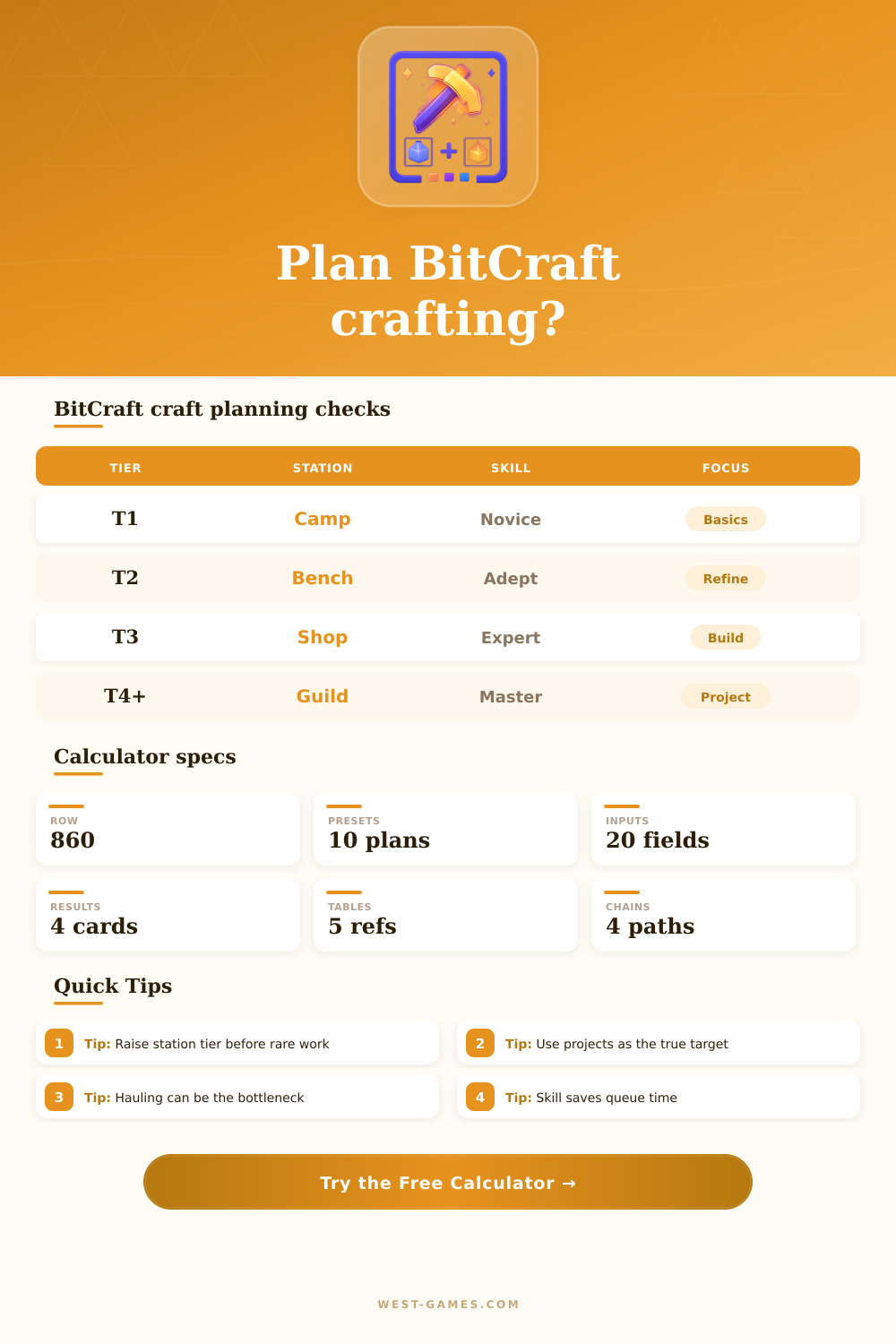
It’s made like this for a purpose. Before you do anything, the tool let you reassign workers between all three step in each project. Don’t underestimate the value of stations early on. Early on, any tier one bench will do if you’re making trail rations. What about advanced workshops? Ouch, those benches is painfully slow. This is clearly laid out on page with the reference table. It shows just how much the time penalty stack up when recipes start getting complex. You want to make some iron rivets at home on a basic bench? You might as well work against the numbers. Upgrade your station to cut your queue time down by a lot. It’s a small investment that pays off in hours saved over weeks of play.
It is similar but different: skill. Items aren’t simply improved by skill. They’re produced faster with it. Novices take twice as long to complete a batch compared to a master crafter. A master can free up that slot at their crafting station and let another player use it. This leads to a virtuous cycle for co-op groups. The stronger your specialists are, the more flexible the whole team is, and you’re able to put less skilled players on hauling/gathering without sacrificing progress.
Hauling is the silent killer of efficiency. Many players focus on craft time and don’t realize that the walk from resource nodes to their crafting station eats up minutes. A haul route that’s 20 minutes round trip means one player may be spending as much or more time walking than they do working. By considering capacity limits and trip counts, the calculator will show whether your logistics makes sense. It is not glamorous work but it is necessary work.
The other wrinkle is quality chasing. If you’re looking to make a weapon with a certain level of quality (exceptional/masterwork), you’ll need to plan for extra materials because not every roll will meet the standard required for that item. To match this, the tool ups the number of needed materials depending on the quality desired. Going after perfectly balanced stats can be fun, but it takes both time and resources so do you really want to wait for that stat upgrade? It depends on what you are trying to accomplish with that build.
When it comes to cooperative projects, things take on a different level of importance. This isn’t something you’re creating solely for yourself, you’re building up the stock for this common settlement phase. By breaking out individual batch goals versus project goals in the calculator, you’ll be able to visualize where your contribution fits into the overall scheme and avoid over- or under-production different than what is truly needed by the collective.
The whole point of planning, though, is saving time because you can’t make what’s not in your inventory; likewise, you can’t refine something without gathering its components first. Planning out the process ahead of time makes it a smooth operation rather than a chaotic scramble, bringing that distant picture of the finished structure to Earth, one ingot and one log at a time. You should of planed ahead for better results. It’s actualy more luxurios when everything is ready.