🎯 FACEIT Elo Calculator
Estimate FACEIT level, Elo movement, win or loss impact, streak pressure, match confidence, level progress, and games needed for the next level.
| Level | Elo range | Next threshold | Planning note |
|---|---|---|---|
| Level 1 | 1–800 | 801 | Early account volatility |
| Level 2 | 801–950 | 951 | First climb band |
| Level 3 | 951–1100 | 1101 | Common solo queue range |
| Level 4 | 1101–1250 | 1251 | Approaching mid ladder |
| Level 5 | 1251–1400 | 1401 | Mid ladder baseline |
| Level 6 | 1401–1550 | 1551 | Consistency starts to matter |
| Level 7 | 1551–1700 | 1701 | Strong mechanics band |
| Level 8 | 1701–1850 | 1851 | Promotion discipline band |
| Level 9 | 1851–2000 | 2001 | Level 10 doorstep |
| Level 10 | 2001+ | Open | Ranked by ongoing Elo |
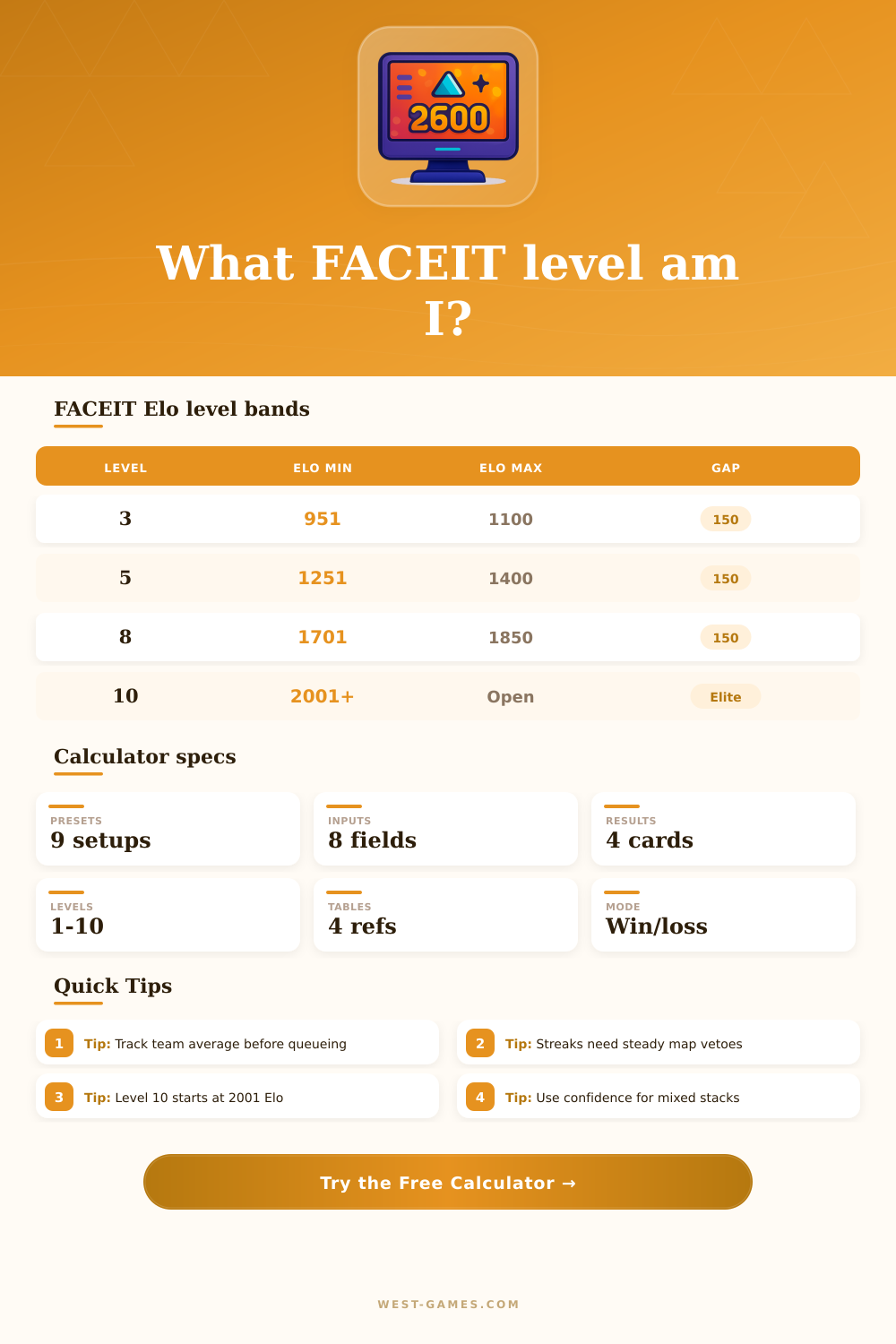
These are the commonly used FACEIT level thresholds. Level 10 starts at 2001 Elo and has no fixed upper cap.
| Situation | Win | Loss | Why it moves |
|---|---|---|---|
| Even lobby | +25 | -25 | Balanced team averages |
| Underdog | +27 to +32 | -18 to -23 | Opponent average is higher |
| Favorite | +18 to +23 | -27 to -32 | Your team average is higher |
| High Elo | +18 to +25 | -18 to -25 | Tighter lobby matching |
| Calibration | +26 to +35 | -26 to -35 | More volatile early data |
The calculator uses these bands as a practical estimate rather than a promise of the exact post-match Elo.
| Input | Low | Medium | High |
|---|---|---|---|
| Confidence range | Wide | Normal | Narrow |
| Elo uncertainty | 8 Elo | 5 Elo | 3 Elo |
| Positive streak | Mind risk | Small boost | Steady plan |
| Negative streak | Pause check | Map review | Reset roles |
| Locked data | Exact lobby | Best range | Smallest gap |
Streaks do not override Elo math in this model; they adjust practical expectation and games-needed planning.
| Scenario | Starting Elo | Goal | Match planning focus |
|---|---|---|---|
| Fresh account | 900–1100 | Stable level 4 | Confidence range matters most |
| Mid ladder duo | 1250–1550 | Level 6 or 7 | Team average and veto discipline |
| Level 8 climb | 1701–1850 | Level 9 | Avoid favorite-side losses |
| Level 10 push | 1851–2000 | 2001 Elo | Queue only when stack roles are clear |
| High Elo sustain | 2001+ | Net positive block | Measure session swing, not one game |
Use the projected Elo and games-needed result together when deciding whether to keep playing after a streak.
Until you attempt to climb, FACEIT Elo is easy. You go into a match, win, and think it’s all good, I just got ranked up! But then the next match where you lose erases twice as much than.
Because the levels are always fixed, the swing of one game depend on how the averages line up, what sort of stack and lobby you get in, and your Elo. This is what most players fail to account for, and why they jump back into queue without looking at anything. All these variables are precisely modeled by the inputs in that calculator up top.
How to Use the Calculator to Win More Games
The baseline is your current Elo and target level. If you’re the underdog/over-matched, that’s reflected in team average and opponent average (this impact both loss and win). Full teams runs more steadily than solo runs, which shows in the queue profile. Confidence rating and streak value reflect the fact that a strong win streak narrows practical range, whereas a mixed lobby expand it; a win streak can hide problems while a loss might not be indicative of anything serious.
Players assume all games carry equal weight… But they don’t. Once you start to see how the swing shifts based off lobby balance, that’s where things fall apart. If you’re on the winning side of an extreme favorite/underdog matchup, it won’t boost your elo as much while also hurting losing team more. Conversely, if you’re on the losing side, the opposite happen.
The calculator provides that data in advance (before you even queue), allowing you to determine whether you want to continue for a few more results, or just call it quits. The page shows how these swings work in common situations and which band levels they match. So for example: Level 9 caps at 2000 Elo and Level 10 starts at 2001 without a defined cap.
What’s important about that is everything in-between are just a ramp up, though the cost per bad loss increases dramatically the further down the road you go. And then there’s streak pressure. It increase the potential of your expected swing up or down a little bit, depending on whether it’s a positive or negative streak. It also increases the odds that you’ll continue to play longer once you lose focus.
The streak doesn’t replace the Elo math for determining actual points; instead, it adjust the final result with a modifier, which is closer to reality in lobbies. If you’ve been on a losing streak, it means something about your recent form, but it doesn’t replace the Elo math.
Running the numbers won’t just produce one number. Its real value is that it teaches you to look ahead at the gap to the next threshold and see how many more games you will likely need before starting your next block. This prevents the common tendency to grind along until you reach the loss streak where you have no choice but to take a break, which could of helped.
You’ll queue up with a target in mind and adjust length of your session based on the swing following each game. That’s a style of play that has seen players rise more consistently. Those players don’t get caught up in trying to chase down that one last win, as they know it’s not worth it based on the risk-versus-reward the lobby average represent. Instead, the calculator just shows them that outcome ahead of time instead of after those points have gone away.
It’s a more moddern approach for livig with the math.