🎯 CSGO Elo Calculator
Estimate classic Competitive hidden Elo movement from current rank, team average, opponent average, match result, round margin, MVP impact, and rank-up pressure.
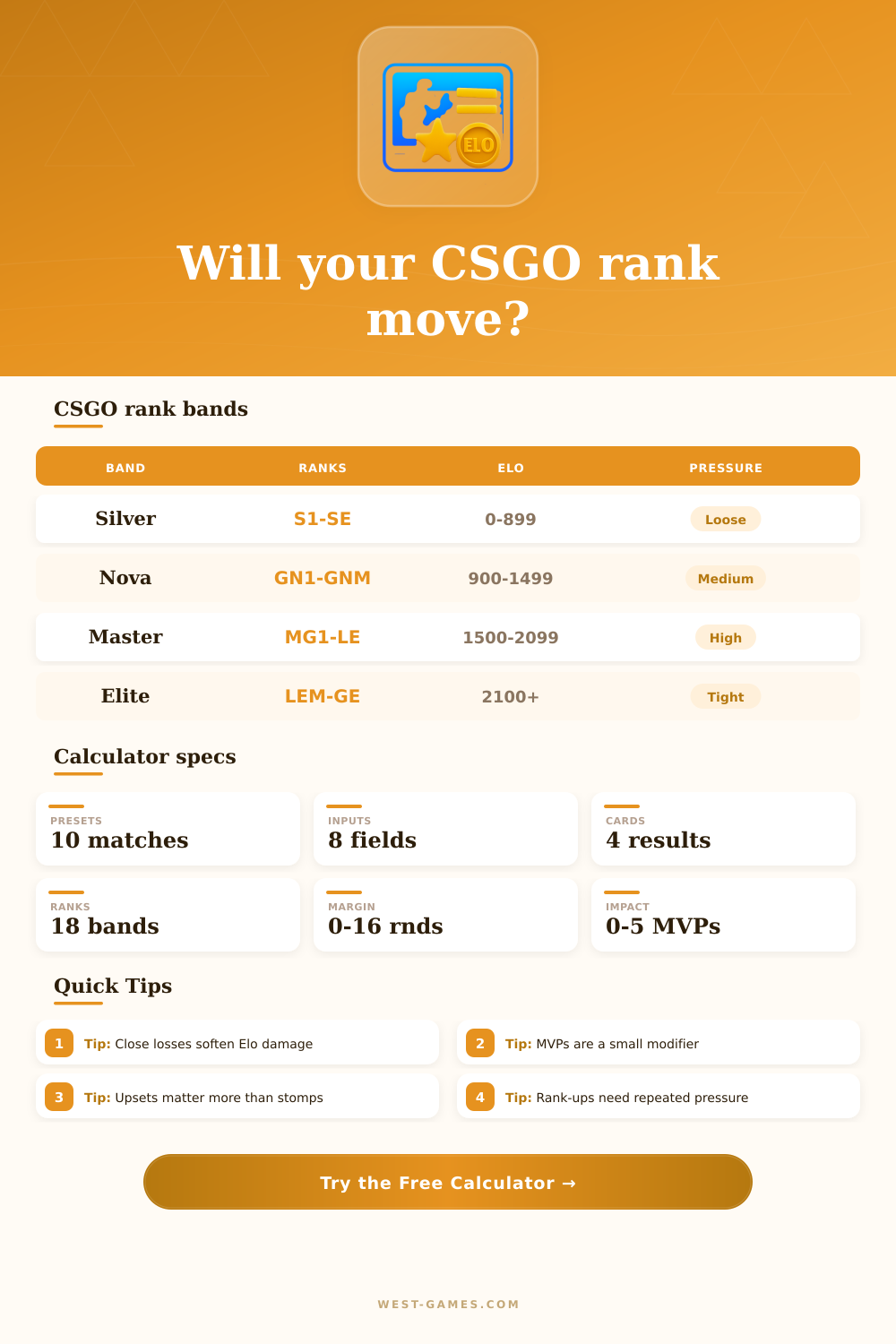
| Rank group | Approx hidden Elo | Rank pressure note |
|---|---|---|
| Silver I to Silver Elite Master | 0 to 899 | Large skill spread; streaks can feel swingy. |
| Gold Nova I to Gold Nova Master | 900 to 1499 | Utility basics and trade spacing start to separate wins. |
| Master Guardian I to Legendary Eagle | 1500 to 2099 | Opponent average and close losses matter more. |
| LEM to Global Elite | 2100 to 2700 | Small gaps and repeated quality wins decide movement. |
| Result | Actual score | How the calculator treats it |
|---|---|---|
| Win | 1.00 | Positive Elo change after expectation and margin. |
| Tie | 0.50 | Small change based on whether your team was favored. |
| Loss | 0.00 | Negative Elo change, softened against stronger teams. |
| Upset | Gap-based | Higher opponent average increases the reward. |
Expected win chance comes from team average rank gap, not from individual scoreboard stats.
| Impact level | Multiplier | Best used for |
|---|---|---|
| Low impact | 0.92 | Few conversions or a rough individual map. |
| Average impact | 1.00 | Normal scoreboard share for your role. |
| Good impact | 1.05 | Two or three MVPs with useful trades. |
| High impact | 1.09 | Four MVPs, clutch wins, and high KAST. |
| Carry impact | 1.13 | Five or more MVPs plus opening pressure. |
| Score type | Margin | Interpretation |
|---|---|---|
| Draw or overtime-like close | 0 to 1 | Very little confirmation beyond the result. |
| Close regulation | 2 to 4 | Normal CSGO match, modest adjustment. |
| Controlled map | 5 to 8 | Clearer confirmation of the expected outcome. |
| One-sided map | 9 to 13 | Large pressure but still capped by the model. |
| Full stomp | 14 to 16 | Maximum margin signal for classic MR15. |
| Preset | Current rank | Match setup | Why it matters |
|---|---|---|---|
| Silver Close Win | Silver IV | 16-13 versus similar Silvers | Shows small but positive movement in a loose early band. |
| Silver Loss Streak Save | SEM | 16-14 recovery after losses | Tests whether one close win stops derank pressure. |
| Gold Nova Solo Upset | GN2 | 16-11 against higher Novas | Rewards beating a stronger lobby with solid impact. |
| GNM Rank-Up Push | GNM | 16-10 near Master Guardian | Models a promotion gate from Nova into MG ranks. |
| MG Even Win | MG1 | 16-12 with equal teams | Baseline classic rank movement for stable accounts. |
| MGE Blowout Win | MGE | 16-5 with strong MVP share | Shows margin confirmation without unlimited inflation. |
| DMG Favorite Loss | DMG | 11-16 versus lower average | Highlights why favorite losses are painful. |
| LE Impact Tie | LE | 15-15 versus higher average | Draw can still help slightly when your team was weaker. |
| LEM Supreme Gate | LEM | 16-14 promotion pressure | Estimates the tight climb into Supreme. |
| Global Elite Hold | Global | 16-13 versus elite average | Shows smaller deltas at the top classic rank. |
Valve never released the specifics of their CSGO ranking system, which always left that feeling that they were a bit of a mystery. Match wins, match losses, you’d see your rank shift up or down with no rhyme or reason. And thus, despite removal of the official ranks, the need for people to turn to an Elo style calculator lingers. People try to guess at the likely algorithm in the background and play “what-if” games with how things might change based off the outcome of the next several matches.
All the inputs represent distinct parts of the game. The first input is your current ranking which tell us where in the band you’re starting out. If you’re close to a promotion or demotion gate then that’s an input for adjusting the hidden Elo estimate. Next, average of your team and your opponent determines how much weight we give the result. Beating a stronger lobby will weigh more heavily than defeating a weaker one. That goes into the calculator and it shrink (or widens) the expected outcome range accordingly.
How the Calculator Works
Finally, round margin is another factor because a 16-5 victory isn’t the same as a 16-12 victory. Even though they both register as wins. On top of that, you have MVP which is a smaller modifier but if there’s something like five MVPs and everything else is close then it can nudge things over. And lastly we’ve got the pressure setting which take into account how far away you are from your next badge. So if you are very close to moving to the next rank, you feel the win more than somebody who is in the middle of the band.
People often make this error when considering rank movement: they only consider whether their match was a win/loss. However, they don’t realize how lobby strength affect the magnitude of that result. An underdog win help you more then an expected win, just as a favorite loss hurts you more. You can use the calculator to run these comparisons fast and understand why you got moved up or down one night of matches versus being stuck where you were.
Then there are the reference tables on the page that help put it all into perspective. These show the various impact levels and margins, and how they’re banded within the classic ranks. A quick look will tell you why blowouts get capped, how lobby strength change the size of a result, or why a close defeat feels worse in MG compared to Silver.
It’s about taking the guesswork out of it, while avoiding an obsessive pursuit of accurasy. But in that form it’s not a magic number at all. It’s a tool for planning: How many good games do I likely need? What does a decent recovery win even look like after a poor run? And it remains an approximation. But its reasoning matches the actual reward/punishment of the old system.
This is why so many people misunderstand it: They apply one result to all match, which is not how the game worked.