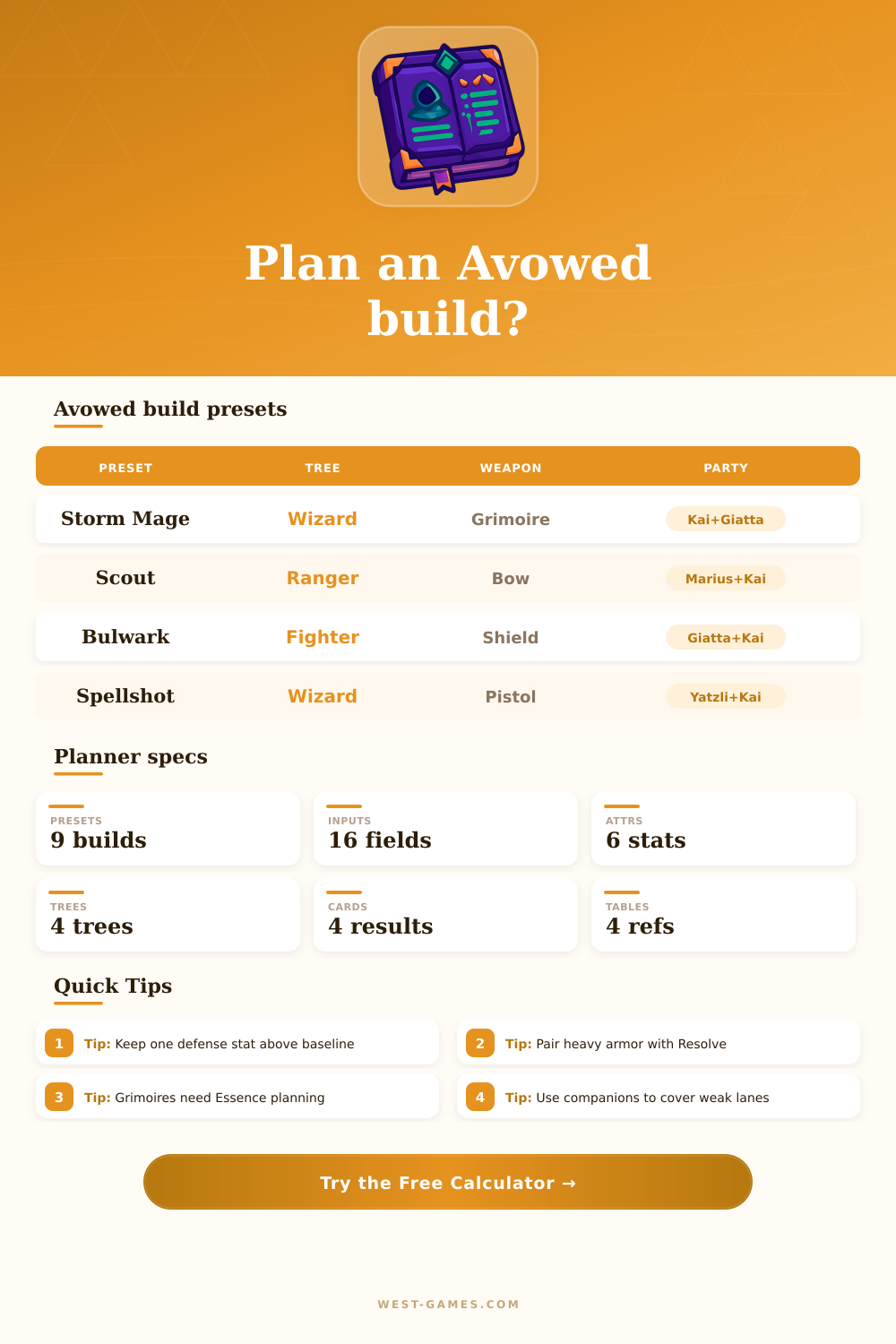
⚔ Avowed Character Planner
Plan background, attributes, ability trees, weapon style, grimoire focus, armor load, companion synergy, survivability, and resource flow before committing your Living Lands build.
| Attribute | Main value | Build use | Planner weight |
|---|---|---|---|
| Might | Damage | All offense and carry comfort | High for strikers |
| Constitution | Health | Frontline error room | High for tanks |
| Dexterity | Speed | Weapon flow and dodging | High for Ranger |
| Perception | Accuracy | Ranged hits and dialogue checks | High for precision |
| Intellect | Essence | Grimoire sustain and spell value | High for Wizard |
| Resolve | Stamina | Recovery, resistance, long fights | High for heavy load |
Backgrounds shape the starting lean and dialogue flavor, while later points and gear carry the final build.
| Style | Stat pair | Resource | Companion help |
|---|---|---|---|
| Shield melee | Might + Con | Stamina | Giatta sustain |
| Two-handed | Might + Res | Stamina | Kai space |
| Bow | Dex + Per | Stamina | Marius scout |
| Pistol | Per + Dex | Mixed | Yatzli burst |
| Grimoire | Int + Res | Essence | Kai or Giatta |
| Spellblade | Might + Int | Mixed | Kai support |
Mixed builds score well when they still keep one clear main damage stat above the rest.
| Pair | Strength | Best player role | Coverage note |
|---|---|---|---|
| Kai + Giatta | Safety | Caster or duelist | Frontline plus sustain |
| Kai + Marius | Scouting | Ranged striker | Space and tracking |
| Kai + Yatzli | Burst | Weapon hybrid | Tank room and spells |
| Marius + Giatta | Balance | Heavy fighter | Utility and healing |
| Marius + Yatzli | Control | Frontline tank | Roots and spell pressure |
| Giatta + Yatzli | Magic value | Ranger or skirmisher | Support and burst |
The planner gives bonus points when companions cover the role your character is not already solving.
| Load | Survival | Tempo | Best fit |
|---|---|---|---|
| Clothing | Low | Fast | Backline Wizard |
| Light | Medium | Fast | Ranger and duelist |
| Medium | High | Stable | Spellblade hybrid |
| Heavy | Very high | Slow | Fighter bulwark |
If heavy armor lowers tempo too much, increase Resolve or shift companion support toward Giatta.
When you build your character in Avowed, you will have to make choices about how your character will function in combat. The background of your character is one of the first choices you must make, as your characters background will determine your starting attributes and dialogue option. For example, if you choose the Court Augur background, you will start with higher levels of Perception and Resolve attribute, which are beneficial if you wish to observe the situation before you act.
Alternatively, if you select the War Hero background, you will receive higher Might and Constitution attributes, which are beneficial for those who wish to stand in the middle of the fight and take damage. Beyond your characters background, you will have to assign attributes to your character. Your attributes will determine how your character perform in the game, as well as how your character reacts to changes in combat situation.
How to Build Your Avowed Character
For instance, higher levels of Might will allow your character to do more damage and to carry more weight, but will not increase survival from enemies. Higher levels of Constitution will increase your survival in combat, but will not increase your Might attribute. Attributes like Dexterity and Perception will increase your effectiveness with ranged attacks, while attributes like Intellect and Resolve will determine the amount of magic that you can cast in combat.
The attribute points you allocate will determine how long you can continuously cast spells before becoming out of resources (magic); thus, these are important for spellcasting characters. Using a planner within the game will allow you to test the combination of attributes to find the best suited to your play style. Beyond your attributes, you will have choices to make regarding the weapon styles for your character.
Weapon styles will determine how your character utilize resources. For instance, if you choose the two-handed weapon style, you will use stamina very quick, so you will need high levels of Resolve attribute to be able to replenish your stamina between attacks. Bows allow you to remain at a distance from enemy combatants for your safety, but should any of those enemies reach you, your safety is lost.
Finally, grimoires will change how you utilize resources within combat. For instance, if you select elemental burst grimoires, you will need steady supplies of Essence attribute to fuel the attacks, requiring investments in both Intellect and Resolve attributes. Utility grimoires focus upon providing control and sustain abilities rather than burst damage.
Using a planner within the game will allow you to calculate the resource costs for each of these attributes, allowing you to determine if your attribute point investments will provide adequate resources prior to investing in a specific skill tree. Beyond resource costs, you will have a choice in the armor type that you equip to your character. Armor choices will create different types of tensions within the game for your character.
For instance, heavy armor will make you more likely to survive damage in combat, but will limit your recovery from damage and increase the amount of stamina you will expend during combat. Light armor and robes will allow you to maintain your tempo in combat; however, you will have less opportunity to make mistakes in combat with this type of armor. Your armor choice will have to be weighed against the difficulty of the game; you may find that your character requires certain armor choices to play well on Normal difficulty, but that those same choices will not be balanced if playing on the Path of the Damned difficulty.
Following your character build are your companion selections. Each of the companions will fill the gaps that your character does not fill. For instance, Kai can fill in the gaps for your character in melee combat, while Marius allows for scouting and tracking of enemies.
Giatta provides sustain for your character, allowing fragile spellcasters to remain in combat longer. Finally, Yatzli provides burst magic abilities for your character that work well in conjunction with characters that use physical attacks. The proper selection of your two companions will provide the flexibility needed with your character plan.
A planner will calculate a score that reflects the synergy between your companions, allowing you to ensure that they fill in the gaps of your character. When planning your character, you should avoid even spacing out your attribute points. Spreading your attribute point investments too evenly will result in a character that is more mediocre at every task.
Investing in a character in a focused manner in two attributes will result in a smoother play experience than if you distribute your attribute points equally among every category. The planner will calculate scores that reflect the fit of your character for the game, survivability of your character in the worst case scenarios, and the resource buffer that you will have available for your characters actions. While these numbers cannot replace your judgment in building your game character, they can remove the guesswork that you may have to make in determining what is the best attribute spread for the difficulty settings that you would like to play.
The final decision you must make in game planning is the type of character that you would like to play. Some player may desire to play a character that is focused upon burst damage and spellcasting, requiring positioning skills and companions to succeed. Others may desire to play a character that functions as a shield for the party.
The planner makes visible the cost of each of these play styles prior to investing attribute points into your character. Once you are familiar with each of the numbers and how each contributes to your play experience, you can make informed decisions about which type of character you would like to play.