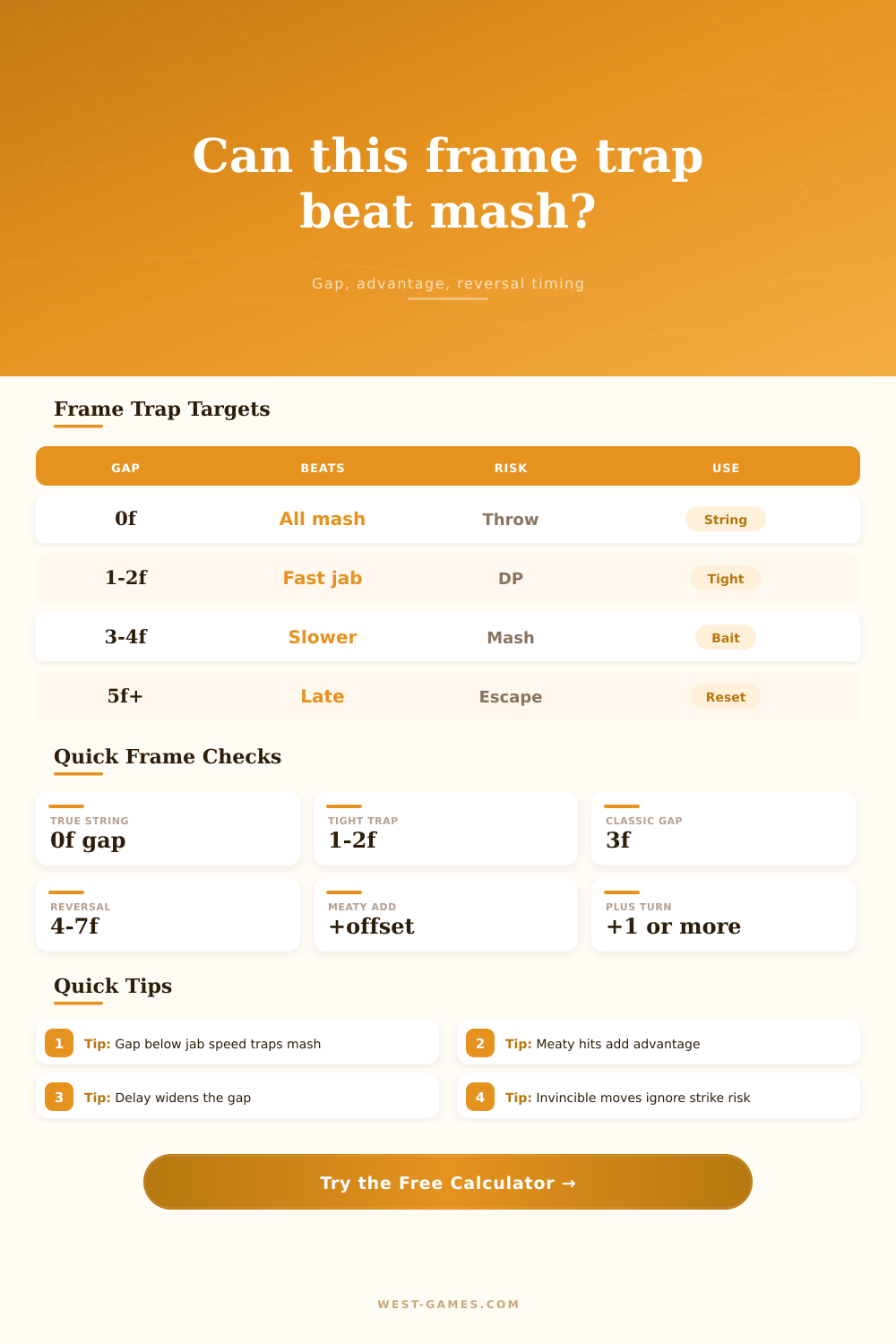
Frame Trap Calculator
Test startup, active frames, recovery, blockstun, hitstun, advantage, gap size, reversal startup, and meaty offset for fighting-game pressure.
| Calculated block gap | Pressure type | What defender can do | Use in matches |
|---|---|---|---|
| 0f or less | True blockstring | No normal action before the next hit | Keep them blocking; watch pushback and throw gaps |
| 1f to 2f | Tight trap | Only very fast invincible or special options matter | Strong against jab, crouch tech, and delayed buttons |
| 3f to 4f | Classic frame trap | Fast mash may trade or lose depending on startup | Good counter-hit bait when your follow-up reaches |
| 5f to 7f | Loose stagger | Many fast normals and reversals can challenge | Use when conditioning block or baiting panic |
| 8f or more | Reset pressure | Defender can jump, backdash, mash, or reversal | Needs reads, spacing, or plus-frame threat |
| Reference point | Typical frames | Calculator input | Practical meaning |
|---|---|---|---|
| Fast jab or light kick | 3f to 5f startup | Defender reversal startup | Main mash benchmark for tight traps |
| Medium strike follow-up | 5f to 8f startup | Second attack startup | Common counter-hit trap button |
| Heavy plus-frame normal | 7f to 12f startup | Second attack startup | Needs more advantage or a bigger read |
| Invincible DP or super | 1f to 7f startup | Defender response type | Can beat real gaps even when mash loses |
| Meaty active contact | +1f per later active frame | Meaty offset | Turns marginal pressure into plus pressure |
| Preset | Advantage source | Follow-up | Defender check |
|---|---|---|---|
| SF jab to medium | Listed +2 | 5f medium, no delay | 4f normal mash |
| Drive-rush plus | Listed +6 | 7f heavy, no delay | 4f invincible reversal |
| Guilty Gear c.S | Listed +3 | 6f close strike, 1f delay | 5f normal mash |
| Tekken df1 check | Listed -1 | 10f jab, no delay | 10f jab response |
| MK stagger poke | Listed +1 | 7f mid, 1f delay | 6f poke |
| KOF close normal | Calculated stun | 5f close normal | 4f light |
| Meaty okizeme | Calculated stun | 6f meaty follow-up | 5f reversal |
| Safe-jump jab trap | Listed +4 | 5f jab, 1f delay | 5f invincible reversal |
| Minus bait check | Listed -2 | 8f whiff punish bait | 5f mash |
| Custom tight trap | Listed +5 | 6f strike, no delay | 4f jab |
He jabs, you block it and push him back. But he strike quickly and you’re out. It is math, not magic. Frame traps rely on mathematics. When you set up a trap, you force your opponent into making one of two poor decisions. The difference between a solid trap and a punishable miss are often just three frames.
What separates an effective trap from a fatal error? The tool above do that work while you focus on strategy. It’s a hard skill to master, yet the idea behind it is easy to understand. Give enough time so your opponent has the opportunity to counter attack, but not enough time for them to do just that. Too many frames and they’ll either mash out of it, jump over it or backdash out of it. One or two frames is usually pretty close to the sweet spot; It’ll beat a quick jab but isn’t quite enough of a window for proper blockstring.
How to Use Frame Data
The startup and active frames for each of your first moves becomes the baselines when you put your data into calculator. What happens after that are the blockstun and recovery calculations. Does your first move cause the defender to remain blocked for more time than it takes you to recover? If it take you fifteen frames to recover and they’re stuck in blockstun for twelve, then you’ve left yourself open. The calculator will display the numbers relative to one another to demonstrate how much of an advantage you have on block. How much of an advantage tells you whether you can get away with being conservative or if you’ll has to take some chances.
This is where frames of advantage come into play. One might think it’s insignificant to hit your opponent on the first or last active frame, but it makes all the difference in a long match. If a meaty hit turn a minus four move into a plus one attack, it shifts the posture from defensive to offensive. It means a minus four on block becomes a plus one when combined with meaty hit. These small timing changes will turn the tide of an exchange as seen in reference table.
That doesn’t mean you should of ignore the defender’s options, however. While a normal mash may beat a gap, it could still lose out to a throw or an invincible reversal. You can use the calculator to factor in defense type and reversal startup to make your plans more realisticly. Rather than simply mashing buttons, opponents at the high level is looking for openings. Will they wait for a five-frame gap? Or will they panic if there’s only a one-frame gap? Knowing this about your opponent let you know when to tighten your trap. It also tells you when to expand it to bait a reaction.
A frame chart isn’t a rule book. It’s a guide. A frame chart informs you of possibilities; it can never anticipate psychological pressure, habit or spacing. Maybe you’re aware of your opponent’s love of jumping in, so you’ll create more space on purpose. Perhaps he tend to whiff on punish attempts, so you’ll close it up. The math will set limits as to where your characters pressure game works best. Then train until those limits are tested. See how those frames line up and the rest is muscle memory. When you know the number, you believe the timing and the trap work. Confidence makes the space feel tighter. Round winners comes from confidence. Learn the math, trust the timing, let the trap do the work.