⏱ Idle Game Prestige Timing Calculator
Compare keeping your current idle run against prestiging now with current production, prestige multiplier, reset downtime, rebuild ramp, payback time, break-even point, and long-run gain per hour.
| Step | Formula | What it means | Idle prestige use |
|---|---|---|---|
| Multiplier ratio | new multiplier / current multiplier | How much faster the new run becomes after prestige. | Higher ratios shorten payback and rebuild time. |
| Rebuild time | base rebuild / ratio, if enabled | Estimate for reaching the same progress point after reset. | Matches common prestige loops where old walls are cleared faster. |
| Ramp average | post-reset rate / (exponent + 1) | Average production during a power-curve rebuild. | Slow ramps reduce early prestige value. |
| Keep path | bank + integral(current rate growth) | Resources if you keep the current run. | Baseline for break-even comparison. |
| Reset path | ramp integral + boosted production | Resources after downtime, rebuild, and boosted rate. | Prestige is good when this catches up soon. |
| Profile | Exponent | Ramp feel | Average during rebuild | Use when |
|---|---|---|---|---|
| Fast early ramp | 0.60 | Early production returns quickly | About 62.5% of post-reset rate | Autobuyers or strong first milestones carry the run. |
| Linear ramp | 1.00 | Steady unlocks | About 50.0% of post-reset rate | The run climbs evenly from reset to current point. |
| Smooth curve | 1.45 | Moderate early slowdown | About 40.8% of post-reset rate | Normal idle prestige with several upgrade gates. |
| Slow early ramp | 2.20 | Late production dominates | About 31.3% of post-reset rate | Early reset feels weak until a late multiplier unlock. |
| Calculator signal | Payback time | Long-run gain/hour | Break-even meaning | Typical action |
|---|---|---|---|---|
| Reset now | Less than 25% of horizon | Strong positive | Reset path catches keep path quickly. | Prestige is likely efficient. |
| Good but not urgent | 25% to 60% of horizon | Positive | Reset wins, but the catch-up wait is noticeable. | Reset after claiming a nearby milestone. |
| Borderline | 60% to 100% of horizon | Small positive or flat | Most of the horizon is spent recovering. | Wait unless your next unlock is far away. |
| Delay prestige | Not reached in horizon | Negative | Keep-running path remains ahead. | Farm more prestige currency first. |
| Preset | Common idle pattern | Reset pressure | Best field to tune | Practical check |
|---|---|---|---|---|
| First Soft Reset | Small early multiplier | Low to medium | Current resources lost | Prestige too early can waste a growing run. |
| Hero Souls Push | Meaningful permanent gain | Medium | Base rebuild time | Use if old zones return much faster. |
| Angel Investor Reset | Large economy acceleration | High | Multiplier after prestige | Reset when payback beats the next milestone wait. |
| Antimatter Crunch | Short repeat prestige | High | Reset downtime | Automation makes tiny payback windows viable. |
| Overnight Idle Run | Long offline horizon | Horizon dependent | Long-run comparison horizon | Long sessions make multiplier gains easier to justify. |
Prestiging often feels like a gamble in an idle game. You look at your bank of resources and then consider pressing the reset button which will erase everything. In exchange, you’ll receive a multiplier permanently increasing your rate of growth. Prestige pits your potential against your security.
How do most people decide? Gut feeling. But their methods don’t account for the unique friction of your playing session.
How the Prestige Calculator Works
Enter: the calculator. It’s the real math made easy for you. It converts vague multipliers into concrete time costs. This changes the question from “should I prestige?” to “is this a good use of my time right now?”
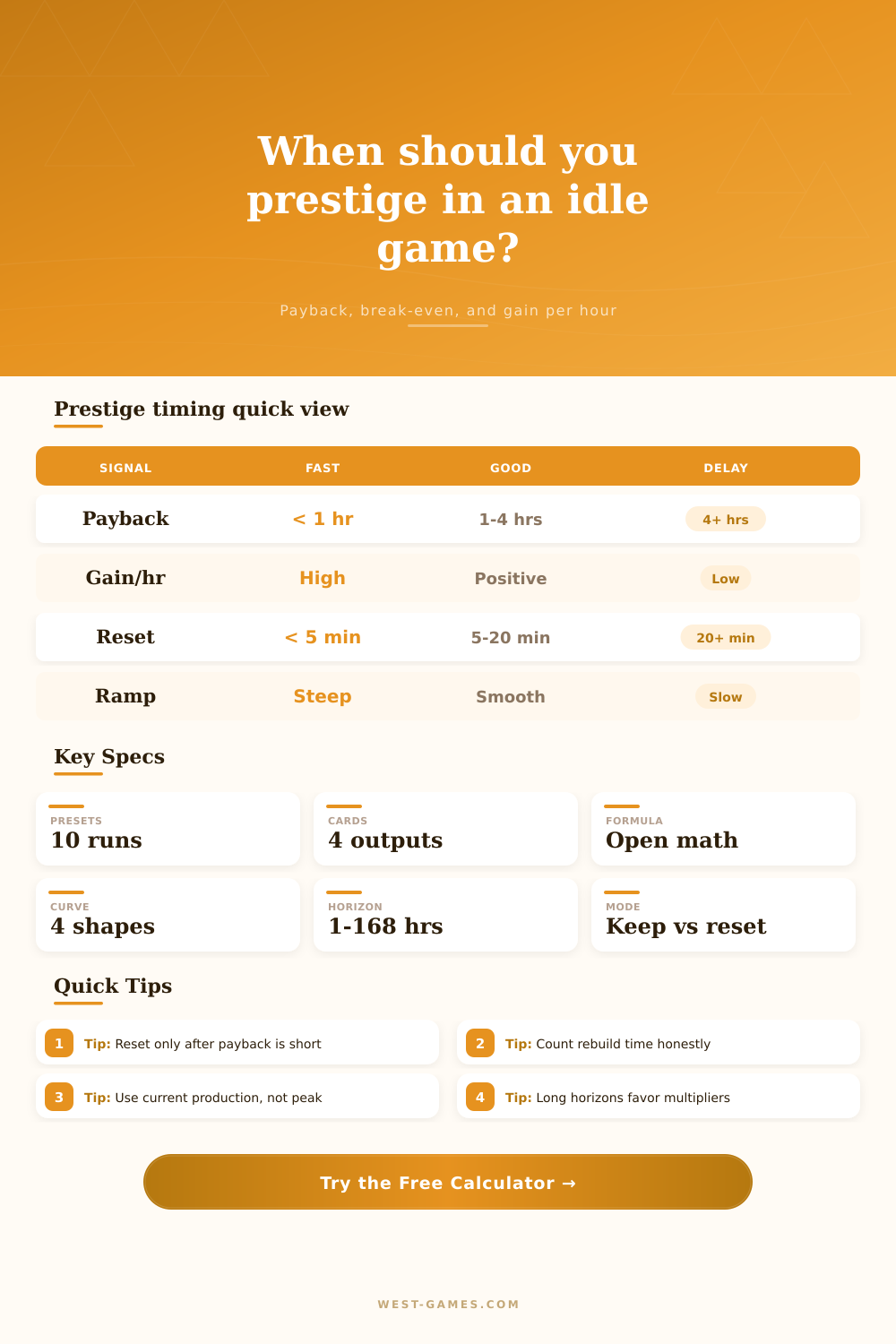
The most important number in any reset analysis is the payback time. Payback time is how much time will elapse before your increased production catch up to what you could have had without resetting. Shorter payback times mean you’re probably better off doing the reset. Longer payback times mean that you’ll be paying high interest rates on your hard-won progress, you’re not catching up quickly enough.
The tool lays this out clearly: It draws a line from where you are now to what you would of gotten if you hadn’t reset. It takes into account the time lost and resources given up. It takes the guess work out of how much you paid for that vacant bank.
These are some inputs that need an ounce of honesty. The first is the rate at which you’re producing right now. This isn’t the peak amount produced in a short burst of productivity. If you use peak numbers, then the perceived benefit of maintaining the run will be inflated. You’ll end up making a poor timing decision.
Next is reset downtime. How long does it take to get through the menu system? How long do you wait for the challenges to load? Most people overlook this friction; they think that as soon as they press confirm, the boost kicks in. This error hides true expense of resetting.
Growth curves are more important then they seem. Your production doesn’t immediately spike from 0 to whatever after a reset, that happens gradually as you unlock tier upgrades and buy them back. You can tweak how long it takes for production to grow (the ramp profile) in the calculator to fit your game’s system. If your ramp starts slowly, you’ll spend ages churning out next-to-nothing while regrowing. That lowers average efficiency of the reset. A steeper ramp with solid early milestones will make the prestige look far more appealing, you’ll get most of your losses back in no time. Getting the right profile for the ramp ensures the payback calculation isn’t optimistic but realistic.
These are all powered by multiplier ratios. If you take a long time to rebuild, a minor boost probably isn’t worth the headache of resetting. The calculator will show you how much more you’ll get per hour in the long run. It will also show your potential loss from downtime and the ramp up time after. That’s great for when you’re going on an extended idle session or overnight run.
The calculator can help you see that catching up might work for now, but there is a bigger picture to consider. You need to decide if it is worth it given actual time you have.
Then there’s the break-even point: that’s the resource amount where the reset path surpasses the keep-running path. Knowing that number is useful as a milestone. When you’re just shy of an important milestone or major unlock, you may want to wait for that before resetting. You can use the tool to calculate how much more benefit that gives you versus how much longer you have to wait. It transforms the fuzzy feeling of “I should really do this soon” into a measurable choice.
Incremental games is about timing. If you rush through a reset without having built up a good multiplier, then you’ve thrown away some of what you could have gained. But if you wait too long then you’re not taking advantage of whatever you’re producing, you’re letting money fall onto the floor.
The calculator makes all that clear and illustrates which variables matter most to the result. It will push you towards being more thoughtful with how you advance. You’ll think “I unlocked this, but is it actualy efficient to reset now?” rather than responding impulsively to anything shiny.
At its core, prestige timing is more a matter of managing time than managing numbers. What it tells you is that there’s a point where the added speed you gain from a reset is no longer worth the effort to do so. It takes into account all those other messy aspects of manual setup and different growth rates. It allows you to ground your decisions in data instead of impulsive whims.
And as you make steady, predictable progress, you stop gambling with your bank and start making wise investments of your time. Even if your gut lies, the math never will.