⏳ Idle Game Upgrade Payback Time Calculator
Compare an idle upgrade cost against current production, production increase, compounding, purchase delay, opportunity cost, break-even time, and horizon ROI.
per hour now
per hour after buy
new production/hr
based on horizon ROI
| Hour from now | Active after purchase | Extra earned | Opportunity drag | Net after cost | ROI |
|---|
Rows include any time needed to afford the upgrade before the active payback clock starts.
| Signal | Payback vs horizon | Horizon ROI | Opportunity cost | Typical action |
|---|---|---|---|---|
| Buy now | Under 25% | High positive | Small | The upgrade repays quickly and keeps scaling. |
| Good upgrade | 25% to 60% | Positive | Manageable | Buy unless a very close milestone beats it. |
| Borderline | 60% to 100% | Low positive | Noticeable | Wait if the next upgrade is close. |
| Delay | Past horizon | Flat or negative | High | Farm more currency or choose a faster upgrade. |
| Compounding setting | What it means | Best for | Payback effect | Watch out for |
|---|---|---|---|---|
| 0% per hour | Linear upgrade gain | Simple generators | Payback equals cost divided by delta. | Ignores future unlock acceleration. |
| 0.5% to 2% | Slow follow-on buys | Normal idle loops | Later hours improve ROI. | Short horizons may still look weak. |
| 2% to 8% | Strong scaling chain | Research, prestige shop, autobuyers | Break-even can arrive much faster. | Do not enter temporary buffs as permanent. |
| Negative | Decaying burst or offline cap | Timed buffs, capped idle storage | ROI fades over longer horizons. | Use efficiency to model downtime too. |
| Preset | Upgrade style | Main risk | Best input to tune | Practical check |
|---|---|---|---|---|
| Early Clicker | Small flat gain | Overpaying too soon | Upgrade cost | Buy only if it repays inside the active session. |
| Cookie Farm | Percent farm boost | Delayed buy | Saved currency | Waiting to afford can make a good upgrade feel slow. |
| Research Lab | Compound unlock | Bad horizon | Compounding rate | Longer horizons reward unlock chains. |
| Offline Vault | Offline efficiency | Capped storage | Efficiency | Lower efficiency if offline caps waste production. |
| Late Multiplier | Expensive percent gain | Opportunity cost | Alternative gain | Compare it against the next cheaper milestone. |
An idle game is basically a time management math problem that’s masquerading as a cozy simulation. It’s about managing resources, and ultimately, what you give up by using those resources over time. Its central mechanic is timing. Your bank account is filled with lots of resource. A cheap upgrade will give you a little boost to production. An expensive overhaul will dramatically increase your output by a percentage, but it will take three days to afford. Do you buy now? Or do you wait? Both options are likely incorrect.
The calculator does the hard work, but knowing what it’s tracking will help avoid costly blunders. When an upgrade occurs, most players only look at the production number at face value. That is where people goes wrong. What matters isn’t the raw production number, but rather how fast this upgrade pays for itself. What do I have to give up by making this purchase? This is called break-even time. This is the pulse of efficient progression.
Why You Should Use Math to Win
If an upgrade costs me ten hours but my typical play sessions are just half an hour long, then this upgrade is working for only a tiny fraction of its life span. You feel like you’re progressing, but in reality you’re dragging down your average yield per hour. Because idle games use different kinds of mathematical engines, inputs do matter. Some upgrades multiply all your output by a percentage; others simply add a flat number to it. Depending where you are in the game, that can scale very differently. Early on, a ten percent boost isn’t going to make much difference at all. Late in the game, it’s worth more then any flat addition. So the tool has toggles so you’re not comparing apples to oranges.
You’ll also have to factor in delay. You could save up and wait four hours before making a purchase. Those four hours of lower production count against the upgrade. The calculator automatically takes into account that opportunity cost. It shows you the net gain, not the gross gain.
There’s also compounding. Players can buy an upgrade that speeds up how fast they can buy more upgrades or unlocks more upgrade. That leads to a snowball effect where the return on investment multiplies with time. The greater your current upgrade… If it reduces the cost of the next one or accelerates its arrival. The higher the compounding ROI. We reflect this in the tool by setting a compounding rate, because the upgrade isn’t simply a one-off payment. It’s an investment into future speed. Otherwise, you may underestimate a costly purchase that triggers a strong chain reaction down the line.
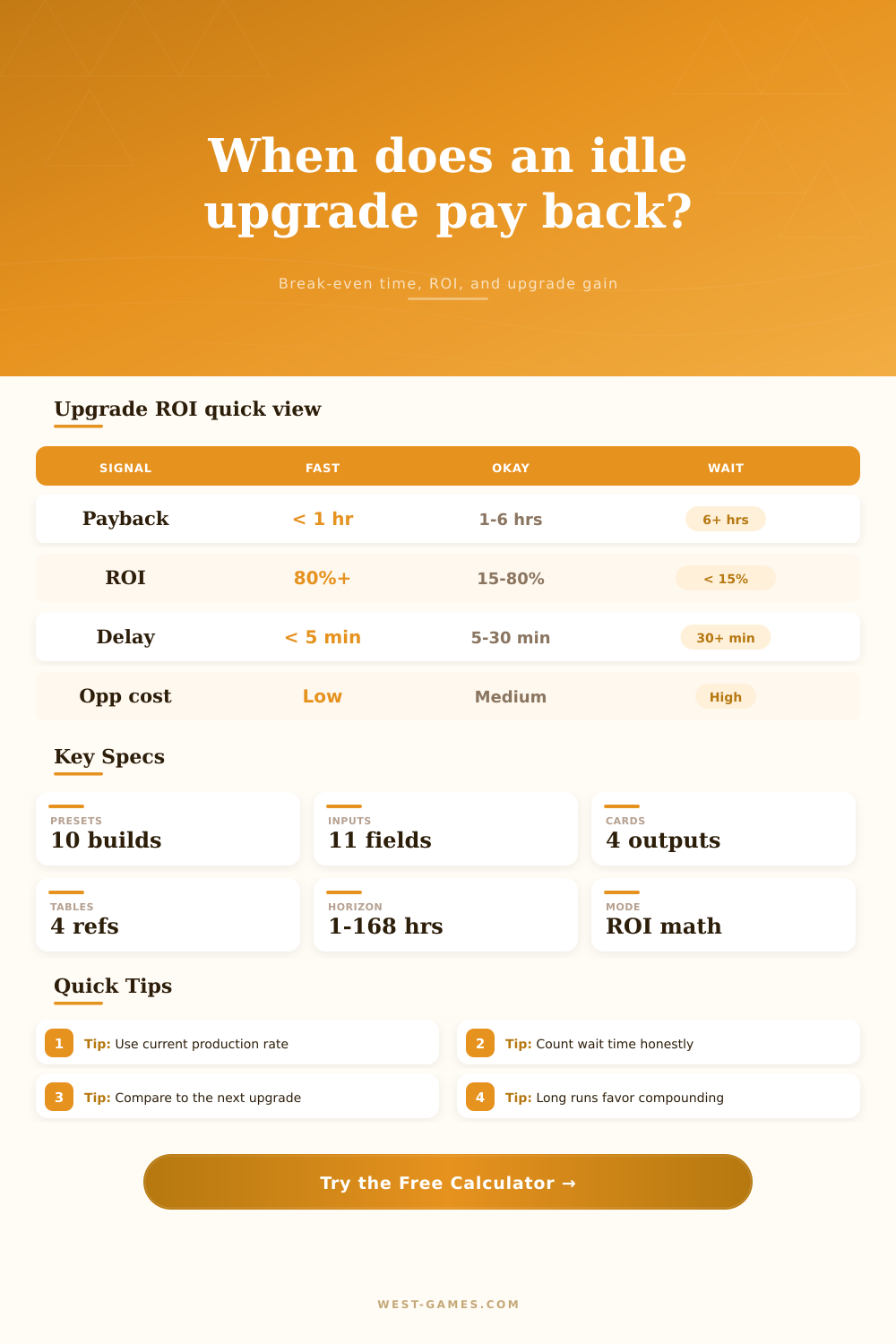
The other part is that psychological trap of the horizon. How much time do you want to play? Is it a quick break? Then you care about fast payback. Is it a weekend away from home? Are you leaving the game on? Then you care about long term compounding. The tool breaks this out into different signals. Buy now (fast payback, low opportunity cost). Wait (long payback, high opportunity cost). It’s not that the upgrade itself is good or bad. It’s whether it’s good compared to what else you can be doing with your time, given your specific time window.
This is where the options available to the calculator show off its variety. A late-game prestige multiplier isn’t the same thing as an early clicker upgrade. One scales large, the other turns over quickly. You can’t judge one by the same standards as the other. Efficiency percentage also serves a role here. If you’re someone who knows they only play an hour per day, set it lower than 100% and reflect what you actualy use. That way, the calculator doesn’t assume you’re playing in an idealized “always on” situation, which isn’t how you will actualy play the game.
Optimization is what idle games are all about. Squeeze the maximum output out of each unit of resource and time. Ignore the distracting flash of the icons; look at the numbers and they don’t lie. Focus on the break-even point instead of the immediate gratification of a shiny new purchase and you go from playing a passive game to making it an active strategy. Go from guesswork to calculation. Calculation makes a game feel less random when you start doing it. It is less like a random collection of purchases and more like a stream of clear, logical decisions. These decisions pull you along with exact intent. Resources saved here wait for the proper moment. Let that be the moment the math says it should of been.