⏱ Defuse Timing Calculator
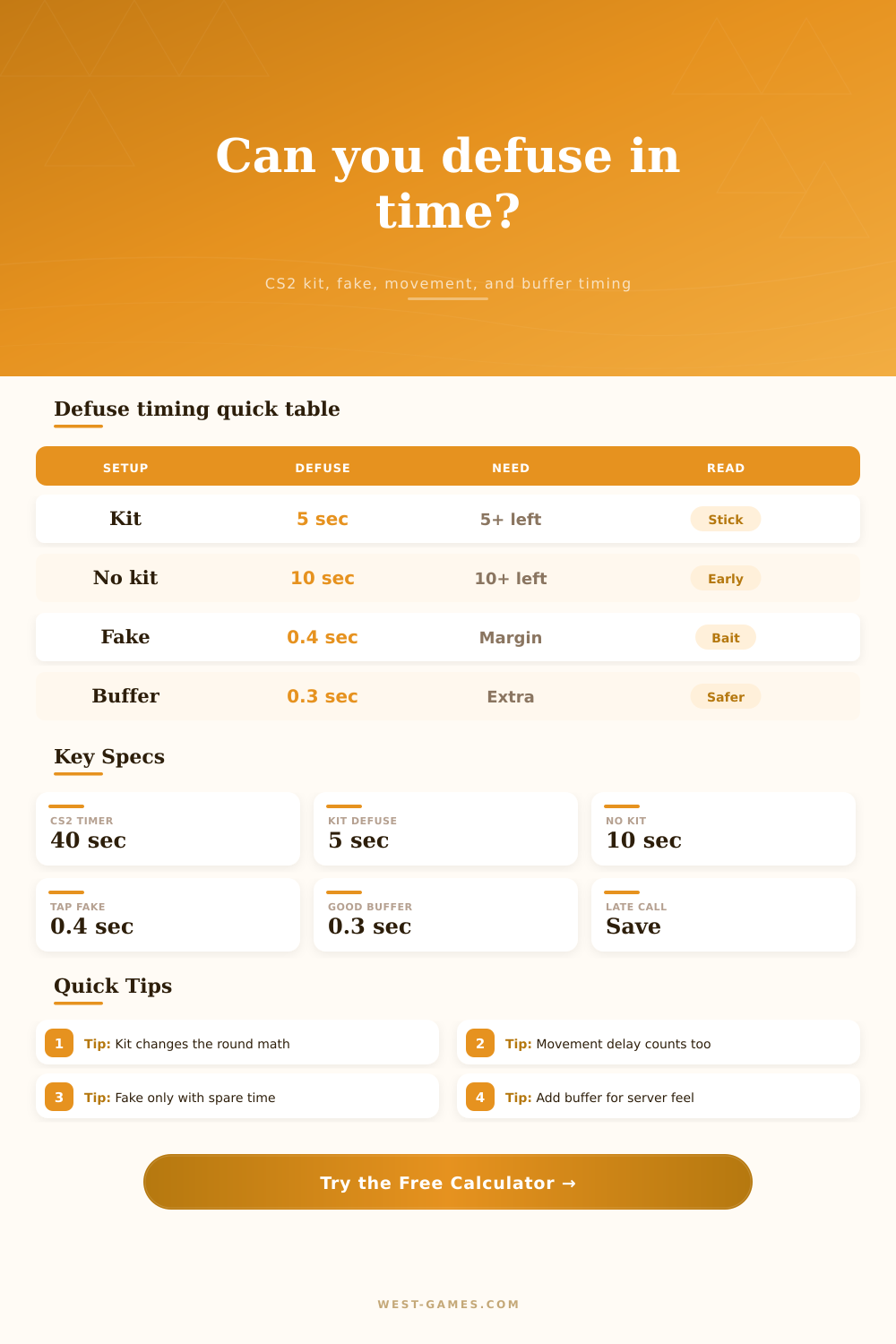
Check whether a CS2 or CS bomb defuse is still live after kit status, no-kit duration, remaining time, fake taps, movement delay, and a reaction buffer are counted.
| Item | Standard value | Calculator role | Practical read |
|---|---|---|---|
| CS2 planted C4 timer | 40 seconds in normal competitive timing | Total timer and elapsed-time reference | Retakes usually need the site under control by the final 5 to 10 seconds. |
| Defuse with kit | 5 seconds | Commit duration when kit mode is selected | Allows a much later stick or one short fake if there is margin. |
| Defuse without kit | 10 seconds | Commit duration when no-kit mode is selected | Requires an early start; a fake is usually too expensive late. |
| Interrupted defuse | Progress resets | Fake taps do not reduce the final commit duration | A half-defuse is not saved for later, so every release spends round time. |
| Reaction buffer | 0.2 to 0.7 seconds typical | Headroom subtracted from the margin | Higher buffer is better when the timer estimate is rough. |
| Remaining after reaching C4 | With kit | Without kit | Best timing call |
|---|---|---|---|
| 15 seconds or more | Defuse is comfortable | Defuse is live | Clear the close threat, then commit or fake once. |
| 11 to 14.9 seconds | Kit has room to fake | No-kit must commit soon | No-kit players should avoid extra clears unless a duel is forced. |
| 7 to 10.9 seconds | Kit can still play a fast decision | No-kit is generally too late | Kit player sticks; no-kit player looks for exit or impossible clutch only. |
| 5 to 6.9 seconds | Kit is tight but possible | No-kit cannot finish | Do not fake; hold the use key immediately. |
| Under 5 seconds | Usually too late after buffer | Too late | Save gear, exit, or deny the final T if the round is already lost. |
| Scenario | Fake plan | Delay counted | Timing warning |
|---|---|---|---|
| Quick audio bait | One 0.3 to 0.5 second tap | Tap length plus re-aim time | Good only when the fake window is larger than the full fake cost. |
| Tap then stick | Tap immediately, then hold | Fake length only | Useful in smoke when the enemy may swing late. |
| Fake and swing | Tap, clear angle, return to C4 | Fake, duel, and movement back | Dangerous below a 2-second success margin. |
| Double fake | Two short taps | Both taps plus both resets | Only reasonable with kit and a large remaining timer. |
| Hard stick | No fake | Movement, buffer, and defuse only | Correct when the calculator shows little or no fake window. |
There’s a bomb. There’s the defuse kit. There’s the timer ticking down in the corner of your screen. You’re by yourself on the site, the defender is hiding in the shadows. You’ve got the time. You’ve got the defuse kit. Or do you?
This is where the best Counter-Strike players becomes separated from the rest of the pack. It is not because of their ability to aim. Because they know how to add under pressure. They know how to do some quick math visualy.
How to Use the Defuse Timer Calculator
That’s what this defuse timing calculator above does. It calculates all that stuff for you. It adds your time left plus how long it takes to move around, adds fake taps and spits out one number, the success margin. Will you make it in time to defuse the bomb or will it blow up in your face?
The math seems easy for most players: there are five seconds to defuse and eight seconds left on the clock. I’m good.” That’s where most folks fail. They don’t factor in the seconds lost before you’re even attempting the defuse. You still has to move toward the bomb. You may need to crouch down to get a better look at its position. Maybe one of your teammates dropped a kit; now you need to go pick that up. Every second add up.
The calculator includes the walk time in the math. It’s that small walk time that can be the difference between winning or losing a game in clutch moments. Plug in your assumptions and that calculator will knock those extra time costs off the top of your total available time. Whatever number remains is how much time you actualy have to defuse.
Defusing makes all the difference. A defuse kit halves the defusal timer. It takes five seconds instead of ten. That additional time gives you the space to mislead. You pretend that you’re defusing when you aren’t. Tap the bomb to make some noise as a cue, lure your opponent to swing. And then re-aim to take them down.
Faking isn’t free though. Each fake reset’s the defuse bar. Spend too long faking and you’ll run out of time before the deed is done. The calculator lets you know whether or not you have margin to spare for fakes. Once the success margin is factored in with the fake, and again with the follow-up re-aim, does it add up to something greater than zero?
If yes, go crazy. Play smart. If no, you’d better pull the trigger now. Don’t mess around. Don’t do any tricks. Hold the button and pray.
Another crucial element is the idea of a buffer. This is additional time that you apply to the calculation. This allows for any uncertainty in how long something will take (or whether the server has enough time, or if you made a mistake). Apply at minimum three-tenths of a second. That doesn’t sound like much but it matters. In a critical round, a hundredth of a second feels like forever.
You get to set the length of your buffer depending on how confident you are with the timer. If you don’t think you have the timer right, make the buffer bigger. If you’re certain you do have the correct time, reduce the buffer. It’s as much a risk management device as it is a timer.
When you understand these inputs, how do they change the way you think about retakes? They are not guesses, but informed decisions. Knowing when to save your gear for the next round, knowing when to commit to the defuse, and knowing when a fake might be a good option and when it is a death sentence.
That’s all laid out in the reference table on the page. It also shows how remaining time impacts your options with or without a kit. Learn those thresholds from it. Know you’ve got to have at least five plus your delays with a kit, ten without. With practice, it becomes second nature.
In the end, CS2 is a millisecond game. Everything costs something. Every second that passes counts. There’s no calculator that plays the game for you. There’s no calculator who makes those decisions for you. Instead, there’s a calculator that provides clarity so you can make better decisions on-the-fly. Remove the anxiety and replace it with data.
Know your deadline. Know your margin. Know when to swing, know when to stick. And when you do, you’re confident. And that confidence is worth more than any one kill. Because the clock is ticking. And now you know exactly how long you’ve got left.