💰 CS2 Round Economy Calculator
Project next-round Counter-Strike 2 team money from current cash, round result, loss bonus, bomb plant or defuse rewards, weapon-class kill rewards, equipment spend, saved gear, and drop plans.
| Player | Current | Income | Kills | Before Buy | Spend | After Buy | Drop Note |
|---|---|---|---|---|---|---|---|
| Run the calculator to fill player rows. | |||||||
| Round event | Team award | Personal award | Planning note |
|---|---|---|---|
| Standard win by elimination or time | $3250 each | Kill rewards only | Used for CT time wins and most elimination wins. |
| T win by bomb explosion | $3500 each | $300 planter | Higher T team reward plus planter cash. |
| CT win by bomb defuse | $3500 each | $300 defuser | Defuse kits affect spend, not the cash award. |
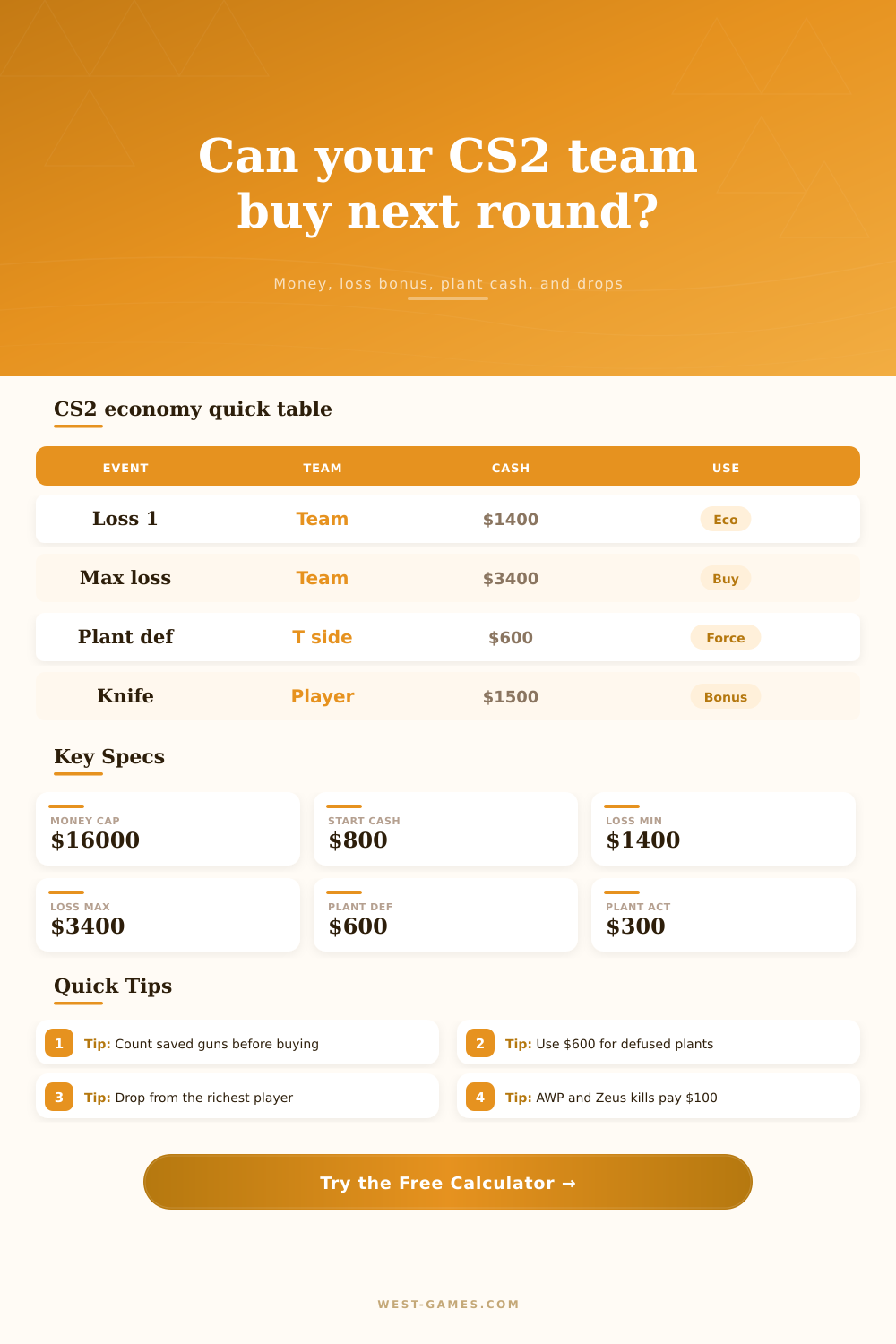
| Loss without T plant | $1400 to $3400 | Kill rewards only | Loss stage rises with consecutive losses. |
| T plants but CT defuses | Loss bonus + $600 | $300 planter | Use $600 per T player after the 2024 economy change. |
| T survives after time, no plant | $0 for saving T players | Kill rewards only | Mark those players as no-income save. |
| Weapon class | Reward | Examples | Use in calculator |
|---|---|---|---|
| Rifle, pistol, grenade, LMG | $300 | AK-47, M4A1-S, Deagle, HE | Default kill class for most frags. |
| Most SMGs | $600 | MAC-10, MP9, UMP-45, MP7, MP5-SD | Eco conversion and anti-eco farming. |
| P90 | $300 | P90 | Treat as rifle/pistol reward, not $600. |
| Most shotguns | $900 | Nova, MAG-7, Sawed-Off | High reward but loadout risk. |
| XM1014 | $600 | Auto shotgun | Exception to the normal shotgun reward. |
| AWP, Zeus x27, CZ75-Auto | $100 | AWP, Zeus, CZ75 | Low reward despite high round impact. |
| Knife | $1500 | Knife kill | Rare but huge personal swing. |
| Spend profile | Assumed spend | Typical contents | When to use |
|---|---|---|---|
| T AK full buy | $4700 | AK-47, armor, core utility | Default T rifle round target. |
| CT M4 kit full buy | $5500 | M4, armor, kit share, utility | CT needs more cash for comparable utility. |
| CT AWP setup | $6900 | AWP, armor, limited utility, kit planning | Use when one player is the primary AWPer. |
| T AWP setup | $6550 | AWP, armor, limited utility | Check if teammates must drop the rifle base. |
| T Galil/MAC-10 force | $3250 | Light armor, Galil or SMG, utility | Plant money or second-round pressure. |
| CT FAMAS/MP9 force | $3600 | Armor, FAMAS or MP9, some utility | Hold economy together on low loss bonus. |
| Pistol armor utility | $1500 | Upgraded pistol, armor, small utility | Half-buy while preserving future cash. |
| Eco or saved gear | $600 | Light utility or pistol upgrade | Used when the next full buy matters more. |
Counter-Strike’s most deafening noise isn’t the AK-47. It’s the unified groan from a team discovering there’s no money left next round. We’ve all been there. An overzealous player pushes too hard on a force buy. Or maybe the bomb defuse didn’t pay out quite enough to afford armor. Next thing you know, you’re looking down at eight hundred dollars and other team is rolling around with full rifles. That economy feel like a trap you can’t get out of.
But it’s really just a math problem, one asking for a solution. Most players think of their wallet as an afterthought. They time their utilities, control the map, and perfect there crosshair placement. They forget that everything they shoot at cost them money, decisions they made two rounds prior.
How to Manage Money in Counter-Strike
Want to stop shooting your way into debt? Start thinking about cash flow as a main part of game instead of a side feature. The mental switch occurs when we understand what we’re putting into the thing. Below, this does all that arithmetic-heavy stuff for us, but first you gotta know what’s going in.
So let’s start with the loss bonus ladder. What is it? It’s not a fixed amount. Each following loss build on it. That’s why losing in the 2nd round stings less then losing in the 1st. And losing in the 5th round basically resets the field. Select which round you’re on now (the calculator will use the appropriate multiplier).
Why does that matter? Because one loss doesn’t feel like four losses. Four feels like “we lost twice. We’re done.” One feels like “oh I got this”. If you say “I’ve got enough for my SMG” you’re lying to yourself if you are on round one.
And of course, there’s the matter of saved gear. It is the silent killer of amateur team. Saving an AWP isn’t simply keeping a gun; it’s keeping value unavailable to the rest of the team. To account for this, the calculator lets you identify certain players as savers. It will then deduct the value of what they’ve saved from their spend requirement.
This way, you won’t make the common mistake of thinking a saver should contribute equally to the team pool. If your AWPer saves his scope, somebody else will need to drop some extra coin. The tool flags that deficit. It reveals precisely who is short and who has the surplus to fill in. That visibility lead to a simple transaction instead of a chaotic argument.
Then there’s kill rewards, another wrinkle. Each frag has a different dollar value on the bank ledger. An AWP kill is worth a paltry one hundred bucks. An SMG kill is worth six hundred. A rifle kill is worth three hundred. That means your kill economy offer some very strange incentives. Do I hold onto my high-priced sniper rifle and wait for a clutch moment? Or does my desire to make more money then my opponent encourage me to go on the push with my submachine guns?
Pushing makes more cash-per-kill, and when this snowballs, it can turn into a huge advantage. Eco rounds aren’t often about winning the round as much as they are about winning the next. The goal is to build up funds by farming kills. With the calculator, you can project your farm. How many enemies do I need to kill with my SMG before I’m within striking distance of a full buy?
In addition to the round, there’s also an economic weight that stay from planting and defusing. Starting with the May twenty twenty-four update, defusing a bomb rewards the Terrorist team with six hundred dollars for each player on their side. That’s a lot of money, enough to flip an otherwise lost round into an economic win.
Because players are preoccupied with how they’re going to lose, many overlook the bonus. Instead, they should focus on recovering. If you know you’ll lose, it’s sometimes the best economic decision you can make to plant the bomb anyway. You don’t want to start following round with pocket lint. See the hidden value in objectives here. Use the reference table on the page to break down awards.
The last piece is dropping money. And man does this feel weird. How can you part with your hard earned cash? How can you give up control? In a team game though, there is no such thing as my money or their money. If you lose as a team, then your personal wealth doesn’t matter.
The drop targets are calculated by the calculator, based off those who have extra and those who lack. There’s no emotion behind it. You’re not giving anything away, you’re reallocating resources for maximum team firepower. Drop down until every player can afford armor and a rifle. It’s a boring process but it ensures you all buy at the same time.
The economy isn’t about wealth. The economy is about consistency. And it takes time. And it means listening to your team when they tell you to drop. And it means losing a round occasionally so you can win the match. Those numbers don’t lie; they’re just waiting for you to read them.
Take away the guessing with the calculator. Let the data answer if you should be pushing or saving. Once you stop worrying about your wallet, you can start focusing on what realy matters. And that’s when the AK-47 starts to sound like victory once again.