🎯 R6 Elo Calculator
Estimate Rainbow Six Siege ranked movement using current rank points, hidden MMR-like strength, squad average, opponent rating, match result, round differential, streak, and calibration.
| Rank | RP band | Divisions | Queue cue |
|---|---|---|---|
| Copper | 0-499 | V to I | Wide skill spread |
| Bronze | 500-999 | V to I | Early climb |
| Silver | 1000-1499 | V to I | Common reset zone |
| Gold | 1500-1999 | V to I | Mid ladder |
| Platinum | 2000-2499 | V to I | Stronger stacks |
| Emerald | 2500-2999 | V to I | High pressure |
| Diamond | 3000-3499 | V to I | Tight queues |
| Champion | 3500+ | Leaderboard | Elite range |
The calculator uses 100-point divisions for estimated movement. Treat the numbers as a practical RP scale, not an official hidden-skill reveal.
| Factor | Effect | Why it matters | Typical swing |
|---|---|---|---|
| Opponent gap | Upset value | Beating stronger teams should move more | 5-25 RP |
| Round diff | Confidence cue | 4-0 and 4-1 wins are cleaner signals | 2-12 RP |
| Streak | Momentum cue | Repeated same-direction results look less random | 0-8 RP |
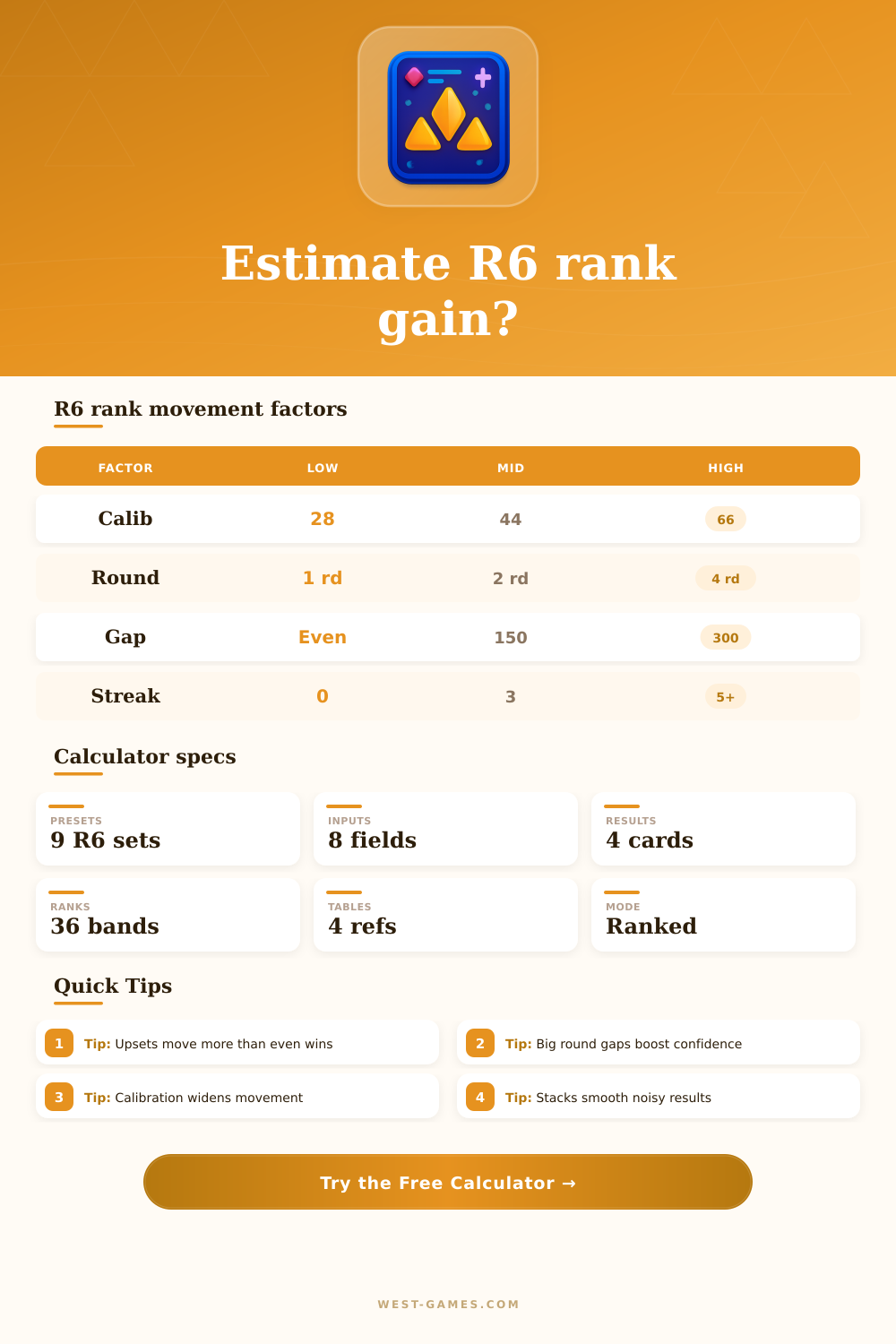
| Calibration | K factor | Uncertain accounts move faster | 28-66 base |
| Rank edge | Promotion risk | Near a division edge, tiny changes matter | 1-99 RP |
The estimate intentionally keeps result, opponent strength, round score, and uncertainty separate so you can see which lever moved the result.
| Score | Diff | Win read | Loss read |
|---|---|---|---|
| 5-4 | 1 | Close overtime | Small penalty |
| 4-2 | 2 | Controlled win | Clear loss |
| 4-1 | 3 | Strong map | Rough map |
| 4-0 | 4 | Dominant map | Heavy signal |
| Wrong sign | Auto fix | Win uses plus | Loss uses minus |
If the selected round sign does not match the match result, the script flips it internally and notes the corrected value in the breakdown.
| Scenario | Visible rank | MMR gap | Read |
|---|---|---|---|
| New season Copper | Copper V | Even | Wide gain |
| Gold stack OT | Gold II | Opponent +125 | Protected loss |
| Emerald upset | Emerald III | Opponent +300 | High gain |
| Diamond stack | Diamond IV | Squad +100 | Sharper loss |
| Champion push | Champion | Opponent +150 | Small elite gain |
Preset numbers are examples for comparing outcomes, especially when visible rank and hidden skill confidence do not line up cleanly.
Every season of ranked play in Rainbow Six Siege has felt distinct thanks to how the game obscures your actual skill through a public-facing rank. The invisible number determine which opponent you’ll be matched with. The visible one indicates which badge you will display to your friends. That distinction is exactly why most people struggle to tell if they are actualy improving or just having a streak of good or bad luck.
What matters most is which inputs describe the context of a game, not simply the raw outcome. How important should result be? That’s your relative skill level in the squad vs the rest of their team. Did you scrape a 5-4 overtime win? That counts less different than if it was against a weaker lobby. Did you clean up and get a 4-0 win on a slightly stronger lobby? That counts more.
Understanding Your Real Skill Level
Round gap act as a kind of confidence score, the larger the gap, the more confident it is that this win reflects true strength. Streak setting shows whether it feels like a result that is within the norm or outside of it. Calibration state adjust how much a score moves because newer accounts, or returning older accounts, do not have as much established data to rely on.
After you enter that information, the calculator does the math for you. It will break it down into your base result. Then, it will show you the adjustment that comes from round wins, losses, streaks, and uncertainty, allowing you to see what really moved the needle. This is important if you’re trying to determine if you should continue queuing up with same stack or if the last match was primarily bad luck.
Run the same match with a few different calibration values to measure just how much uncertainty is currently protecting/punishing you. What the numbers don’t reflect is that it’s different in-game for you if you’re facing an easier or a more difficult lobby. We all know many people tend to tighten up against stronger opposition and loosen up against weaker; that alters actual result before the rating system even kicks in. It also presumes the round differential represents skill, not map luck or some bad utility in a single round. That human element remains beyond any formula.
In practice, I run my final couple of matches through the estimator after every one. Do they has a significant round gap or streak? If so, then that’s probably where the bulk of your actual work was being done, not from raw wins and losses. You should of checked it.
If you do this over time, you’ll begin to see if you’re typically beating out expected outcome, or if you’re merely riding streaks. When your visible rank remains flat for a week or two but the pattern show you’re still climbing, that’s the real tell of your hidden skill level. You don’t expect to get perfect predictions with it. You only want to reduce how often you leave client wondering if the previous match mattered at all.