LoL Armor Calculator
Estimate League of Legends physical mitigation from champion level, base armor, bonus armor, percent and flat armor reduction, HP, item passives, and rune-style defensive modifiers.
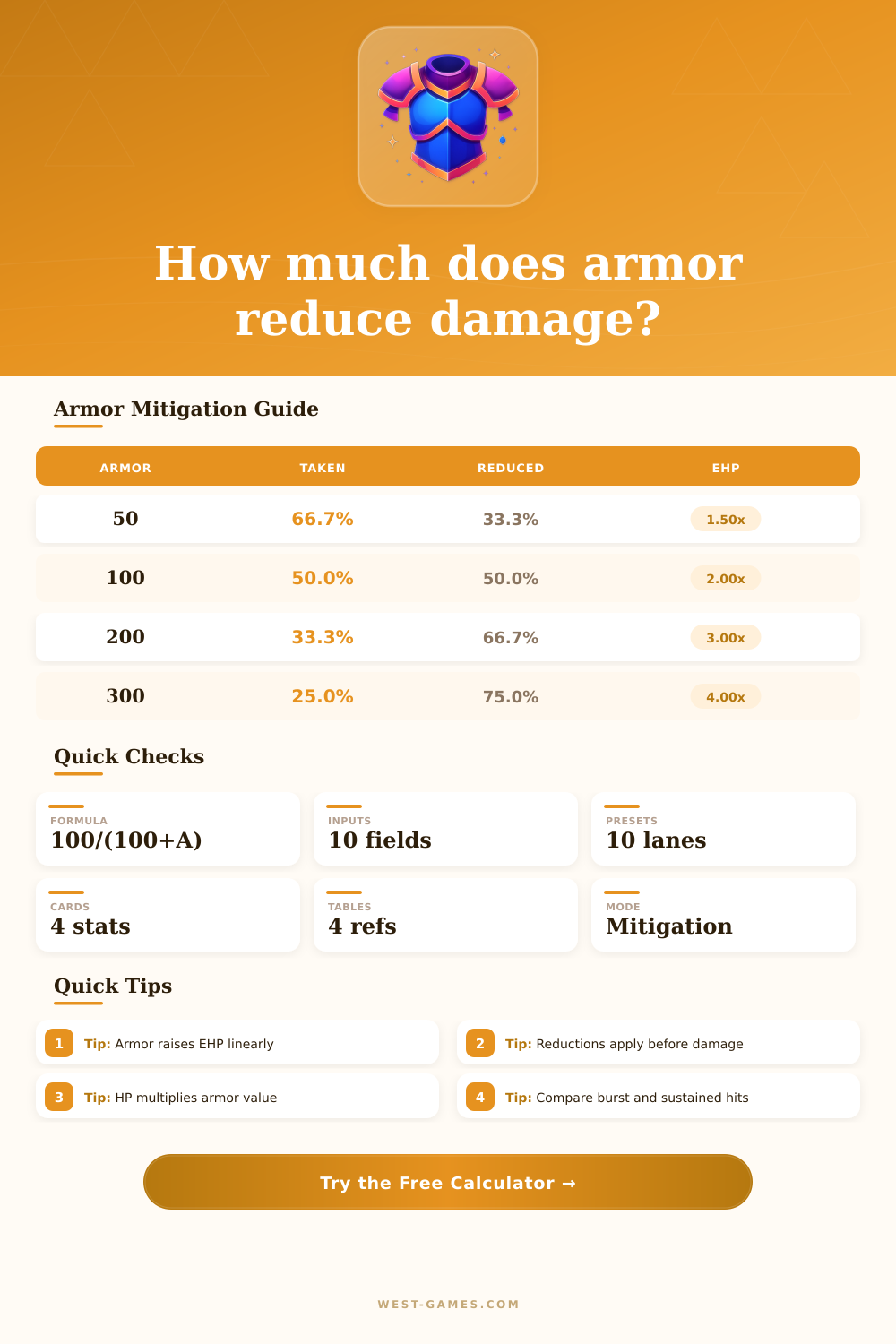
| Final Armor | Damage Taken | Damage Reduced | Physical EHP on 2500 HP | What It Means |
|---|---|---|---|---|
| 0 armor | 100.0% | 0.0% | 2500 | No mitigation from armor. |
| 50 armor | 66.7% | 33.3% | 3750 | Common early tank or bruiser range. |
| 100 armor | 50.0% | 50.0% | 5000 | Physical damage is effectively halved. |
| 150 armor | 40.0% | 60.0% | 6250 | Durable mid-game frontline range. |
| 200 armor | 33.3% | 66.7% | 7500 | Three times base HP versus physical. |
| 300 armor | 25.0% | 75.0% | 10000 | Four times base HP versus physical. |
| Profile | Level 1 Armor | Growth Used | Typical Role | Calculator Use |
|---|---|---|---|---|
| Jinx | 26 | 4.7 | Marksman | Squishy backline survival checks. |
| Ezreal | 24 | 4.2 | Marksman poke | Poke lane and mid-game skirmish checks. |
| Yasuo | 30 | 4.6 | Melee carry | Duel and side-lane trading checks. |
| Darius | 39 | 5.2 | Juggernaut | Top-lane extended trade checks. |
| Leona | 47 | 4.8 | Support tank | Bot-lane engage and all-in checks. |
| Malphite | 40 | 5.0 | Armor tank | High armor dive and engage checks. |
| Rammus | 36 | 5.5 | Armor tank | Extreme armor and taunt-window checks. |
| Ornn | 33 | 5.2 | Tank | Late-game itemized frontline checks. |
| Sion | 32 | 4.2 | HP tank | HP and armor stacking comparisons. |
| Akshan | 26 | 4.7 | Ranged duelist | Side-lane ranged trade checks. |
| Step | Calculation | Example | Result Impact |
|---|---|---|---|
| 1. Base armor | Level 1 armor + growth from levels. | 26 + 10 levels of 4.7 | Creates champion armor before items. |
| 2. Bonus armor | Add items, runes, buffs, and temporary armor. | 73 base + 80 bonus | Raises raw physical EHP. |
| 3. Percent reduction | Raw armor multiplied by remaining percent. | 150 with 20% reduction | Leaves 120 armor before flat reduction. |
| 4. Flat reduction | Subtract flat armor reduction after percent step. | 120 - 30 | Leaves 90 final armor. |
| 5. Damage modifier | Apply item, rune, stance, or vulnerability effect. | Steelcaps-style 12% less | Adjusts final physical damage taken. |
| Modifier | Modeled Effect | Best Used For | Calculator Note |
|---|---|---|---|
| Plated Steelcaps style | 12% less attack damage taken. | Auto-attack lanes and sustained marksman hits. | Applied after armor mitigation. |
| Randuin style | 10% less crit burst taken. | Critical strike pattern comparisons. | Use with crit damage pattern. |
| Warden mail style | 8% less repeated hit damage. | Frequent auto attacks or repeated physical hits. | Applied as a sustained-hit modifier. |
| Conditioning style | 5% more total armor. | Scaling defensive rune checks. | Boosts armor before reductions. |
| Aftershock style | 60 temporary armor. | Engage burst windows. | Added before armor reduction steps. |
| Bone Plating style | 90 flat damage removed. | Short combo and lane trade estimates. | Removed after mitigation modifiers. |
| Stacked stance | 16% more total armor. | Extended fights with resistance stacks. | Boosts armor before reductions. |
| Scenario | High Armor Result | High HP Result | Reduction Sensitivity | What To Compare |
|---|---|---|---|---|
| Marksman burst survival | Often strongest until HP is very low. | Helps against mixed damage and executes. | High if reductions are present. | Damage taken versus remaining HP. |
| Top lane extended trades | Improves every physical exchange. | Lets sustain and shields buy time. | Medium unless shred is active. | EHP and hits to KO. |
| Tank engage window | Very strong during temporary armor spikes. | Strong when damage is mixed or delayed. | High against armor-reduction teams. | Final armor after reductions. |
| Side-lane duel | Great against repeated physical hits. | Great when burst cannot one-shot. | Medium to high depending on champion kit. | Damage saved per rotation. |
| Turret or monster hits | Consistent physical mitigation. | Useful if the fight lasts many hits. | Low unless an effect reduces armor. | Hits to KO under current HP. |
| Crit-heavy fight | Pairs well with crit-specific mitigation. | Still valuable against non-physical follow-up. | High when armor is reduced first. | Mitigation plus item modifier. |
Armor is a vital statistic in League of Legends, since physical damage are the most common cause of death in League of Legends. Armor is an important statistic for players because armor determine how much physical damage that gets through to a champion from enemies. While players may believe that the more armor that a champion has, the more damage that they will reduce from enemies, the relationship between armor and damage is actualy not linear.
Armor use a percentage formula to determine damage reduction, which means that the benefit of each additional point of armor decrease after each additional point of armor. Overall, an armor calculator allow players to input their champions stats into the calculator to view their damage mitigation and health. Another statistic that need to be understood is the level of the champion.
How Armor Works and How an Armor Calculator Helps
All champions gain armor as they advance in level. Thus, a champion at level six will have less armor than that same champion at level thirteen. Armor calculators use the base armor and armor growth values for the champion to account for this, so players does not have to refer to this information themself.
In addition to base armor, players also need to take into account the bonus armor that comes from items and runes. Base armor and bonus armor are not always treated the same within the game. Thus, knowing the difference between these two type of armor helps to inform players about how armor reduction will impact the total armor of their champion.
Armor reduction come in two forms: percent armor reduction and flat armor reduction. Percent armor reduction will reduce the total armor value of a champion by a percentage, while flat armor reduction will remove a specific amount of armor from a champion. For instance, a percent armor reduction of 20% on armor of 200 will remove 40 armor points, but the same percentage reduction on 80 armor will only remove 16 armor points.
Armor calculators allow players to input both types of armor reduction to determine the final armor value of a champion. Armor reduction is important for champions like Darius or Sejuani that use armor reduction to diminish the effectiveness of an enemy champions armor. Armor and health must be used together to determine the total durability of a champion.
For instance, a champion with 4000 health and 100 armor will have more total durability than a champion with 1600 health and 100 armor. Armor calculators will display a value called effective health, which is the total amount of raw physical damage that a champion will take before dying. Thus, effective health includes both armor and health; the armor value alone do not.
For these reasons, effective health is a better statistic to use to make decisions for champions than the armor value alone. Items and runes have modifiers that affect the damage that champions take; however, the damage taken by items and runes does not take into account armor. For example, Plated Steelcaps will reduce the attack damage that a champion takes by a percentage, regardless of armor; Bone Plating will remove a specific amount of damage from the first attack of a trade, but does not take into account armor.
These statistics is different than armor. Thus, these modifiers should also be entered into the armor calculator for the statistics to accurately reflect the damage that will be taken in-game. The tables at the bottom of the page provide references for armor and effective health; however, they do not account for damage from other source.
These tables provide the armor values and the amount of damage that will be reduced at those armor values. These tables can help players to decide whether to purchase armor items for their champions or health items. Such a decision will depend upon the type of damage that is to be taken and the length of the fight with that enemy champion.
Many armor mistake are made by players who treat armor as if it is a solution to all forms of damage. Armor will not protect against true damage or magic damage. Opponents will reduce armor with armor penetration.
Furthermore, armor calculators will focus upon the armor value of a champion. For these reasons, armor calculators can be used to determine whether or not the physical armor is sufficiently high to warrant the purchase of armor items. One of the best ways to use the armor calculator is to model the scenario that a player will encounter in-game within the game.
For instance, the armor calculator can be used to calculate the amount of damage that a champion like Zed or Darius will do to players. In addition, the armor calculator can be used to test the differences in health that certain items will provide; small change to items will have large effects on armor health. For these reasons, the armor calculator should of been used in-game to model different scenario.
Overall, armor is a tool that provides champions with the ability to remain alive for longer periods of time. Armor does not provide champions with immortality, but it does allow their health points to last longer. Armor provides players with more time to set up defenses, to use shields, or to take care of their health.
In this way, the armor calculator provides players with an understanding of the relationship between armor, health, and damage that they take in-game to make decisions based off mathematical facts.