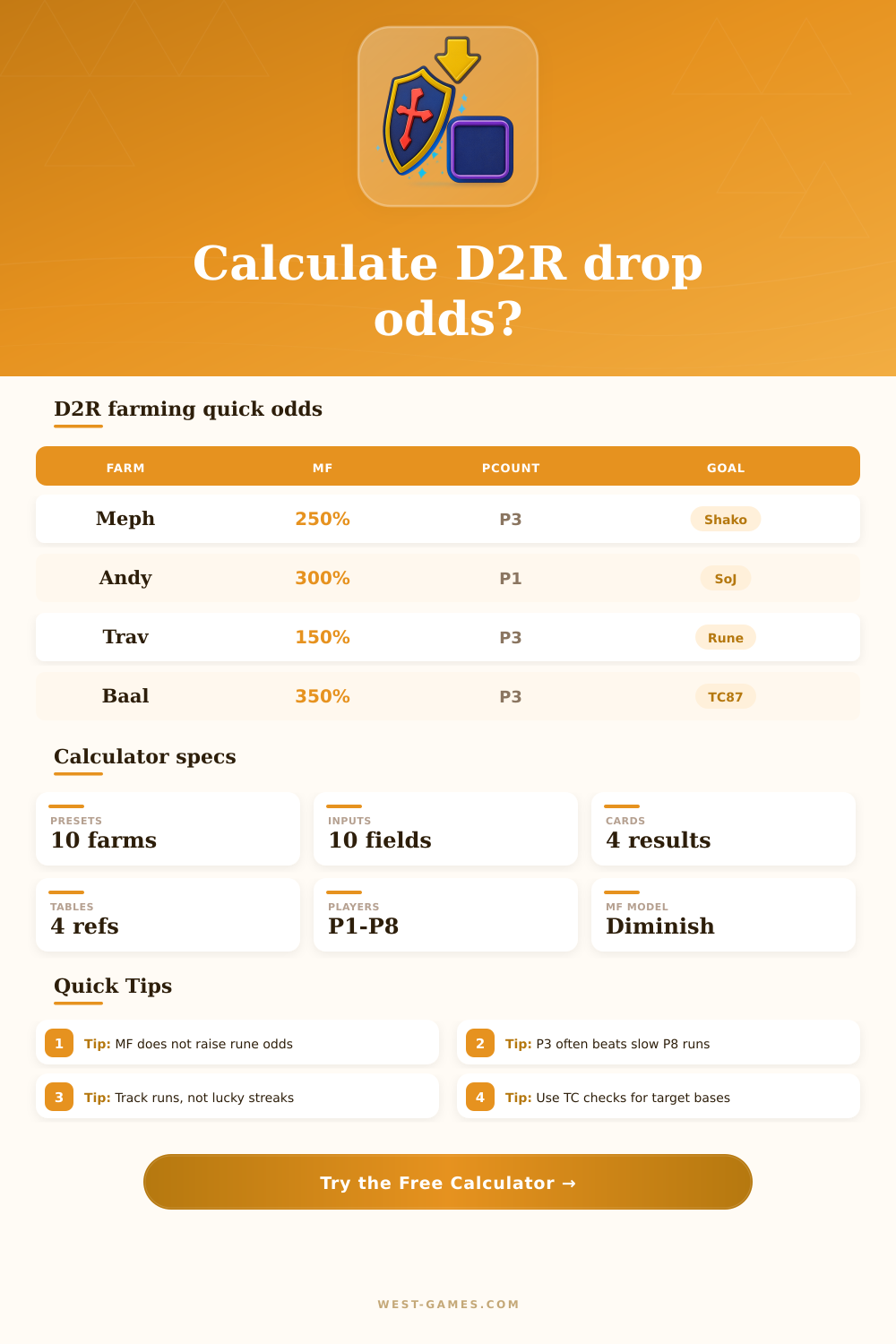
💎 D2R Drop Rate Calculator
Estimate Diablo 2 Resurrected farming odds from boss profile, difficulty, player count, magic find, item rarity, Treasure Class, route speed, and target copies.
| Preset | Target | Base chance | Why it fits |
|---|---|---|---|
| Hell Mephisto | Mid uniques | 0.075% | Fast boss runs |
| Hell Andariel | Jewelry | 0.045% | Quest-bug style loot |
| Pindleskin | TC87 odds | 0.012% | Very fast kills |
| Travincal | Runes | 0.018% | Council density |
| Level 85 Area | TC87 uniques | 0.020% | Many elite packs |
Preset odds are planning baselines. Exact D2R outcomes depend on monster treasure classes, item level, quality rolls, and whether the target base can drop.
| Rarity | Effective MF | MF helps? | Planning note |
|---|---|---|---|
| Unique | MF x 250/(MF+250) | Yes | Steep early return |
| Set | MF x 500/(MF+500) | Yes | Gentler curve |
| Rare | MF x 600/(MF+600) | Yes | Good for rares |
| Magic | Mostly direct | Yes | Can crowd normals |
| Runes/Bases | 0 effective | No | Prioritize speed |
The calculator uses these effective MF curves so 250% MF on a unique target is not treated as a flat 3.5x chance.
| Setting | Solo cue | Drop effect | Speed warning |
|---|---|---|---|
| P1 | Baseline | Lowest volume | Fastest runs |
| P3 | Common breakpoint | Strong gain | Usually efficient |
| P5 | More drops | Moderate gain | Build check |
| P7 | High volume | Near top | Only if fast |
| P8 | XP focus | Small extra | Often slower |
The player-count model approximates no-drop pressure. Some bosses and special tables do not scale like dense normal monster packs.
| Target type | MF weight | TC concern | Best input |
|---|---|---|---|
| Specific unique | Unique curve | Base must drop | Boss chance |
| TC87 unique | Unique curve | Very high | Area chance |
| Set item | Set curve | Base and qlvl | Drop table |
| High rune | No MF | Rune table | Density chance |
| White base | No MF | Item class | Area chance |
For precision, enter the known one-run chance for the exact target. This calculator then handles the planning layer: MF, pace, copies, and cumulative odds.
When you begin farming in Diablo 2 Resurrected, there’s a certain madness that sets in. You’ll promise yourself: just one more Shako… Okay, fine, I’ll take three, now where’s my goddamn fourth? Next thing you know, you’re back in the same act for the fourth straight night.
The issue with thinking like this is that it’s based off hope, not mathematics. Droprates aren’t a suggestion. They’re a hard-coded probability that doesn’t give a shit how long your current dry spell has been or what you’re feeling frustrated about.
Think About Math, Not Luck
If you want to farm efficient, you need to think of loot as a statistical variable, not some personal gift given to you by the game engine itself. This strips the emotion away and gives you the cold hard numbers. By layering multiple factors together, it run the math for you with the calculator above.
For most people, Magic Find is the most important one. But there is a catch that surprises players the moment they start playing. Magic Find doesn’t actualy make monsters more likely to drop an item. It only applies after the game makes its decision as to whether it wants to drop anything. No matter how much magic find you have, if the game didn’t decide to drop a base item, none of it will magically conjure one into existence.
Why does this matter? This determines which stats you focus on getting. Unless you’re going after white bases or runes, don’t bother stacking lots of Magic Find. Instead, invest all of your points into speed (to get more kill per hour). In practice, the true measure here is speed. You type in the number of runs per hour you expect to achieve, grounding the otherwise odd percentage rates in real-world hours.
If your build doesn’t allow you to run a farm super fast, then that farm with a tiny improvement to the drop rate may actually require double the time investment. That’s where running the majority of these bosses in parties of three becomes such an advantage. The player count multiplier give you way more drop rolls. The few seconds spent waiting to coordinate with other players aren’t nearly as important than the increase in drops. Eight tends to be the point of diminishing returns because the run gets so long that even though you get some additional drop rolls, you’re losing out on so many minutes. It’s easy enough to see that trade off on the reference table on the page, where they break it down by player count and how it affects both efficiency and volume.
The other thing that few people understand about Treasure Classes is how they influence your strategy. If you’re farming for endgame uniques (TC87 and above), you want to make sure you’re killing monsters that are capable of dropping those uniques in the first place. You can’t get a high-tier helm if the monster’s Treasure Class is capped lower, even if you have 100% Magic Find while killing low level monsters.
That’s why the calculator asks what kind of bosses you plan to farm and what your target rarity is. It knows which diminishing returns curves to apply to your Magic Find because getting from zero to one hundred percent Magic Find is very different than going from four hundred to five hundred percent.
Before you go grind away, I’d encourage everyone to come up with some fair expectations using these estimates. Run 50 times and expect a 20% success rate? You know what’s possible, so make an educated choice about whether to keep running or change up your target. It’ll keep you from falling into the trap of sunk cost fallacy during your run. Need an item to progress your build? Know that math shows it takes you 40 hours on average to get it? Then make an educated decision about whether it’s worth spending your time. You should of planned better.
Bottom line: Farming isn’t as much about getting lucky as it is making intelligent choices about pace and probability. Your goal is to run the most efficient routes possible while avoiding wasting time on unrealistic odds. Manage your runs efficiently, monitor your Treasure Classes, and let your numbers dictate your patience. Let efficiency replace streak-chasing and, eventualy, the loot will find its way to you.