Rainbow Six Siege Ranked Placement Calculator
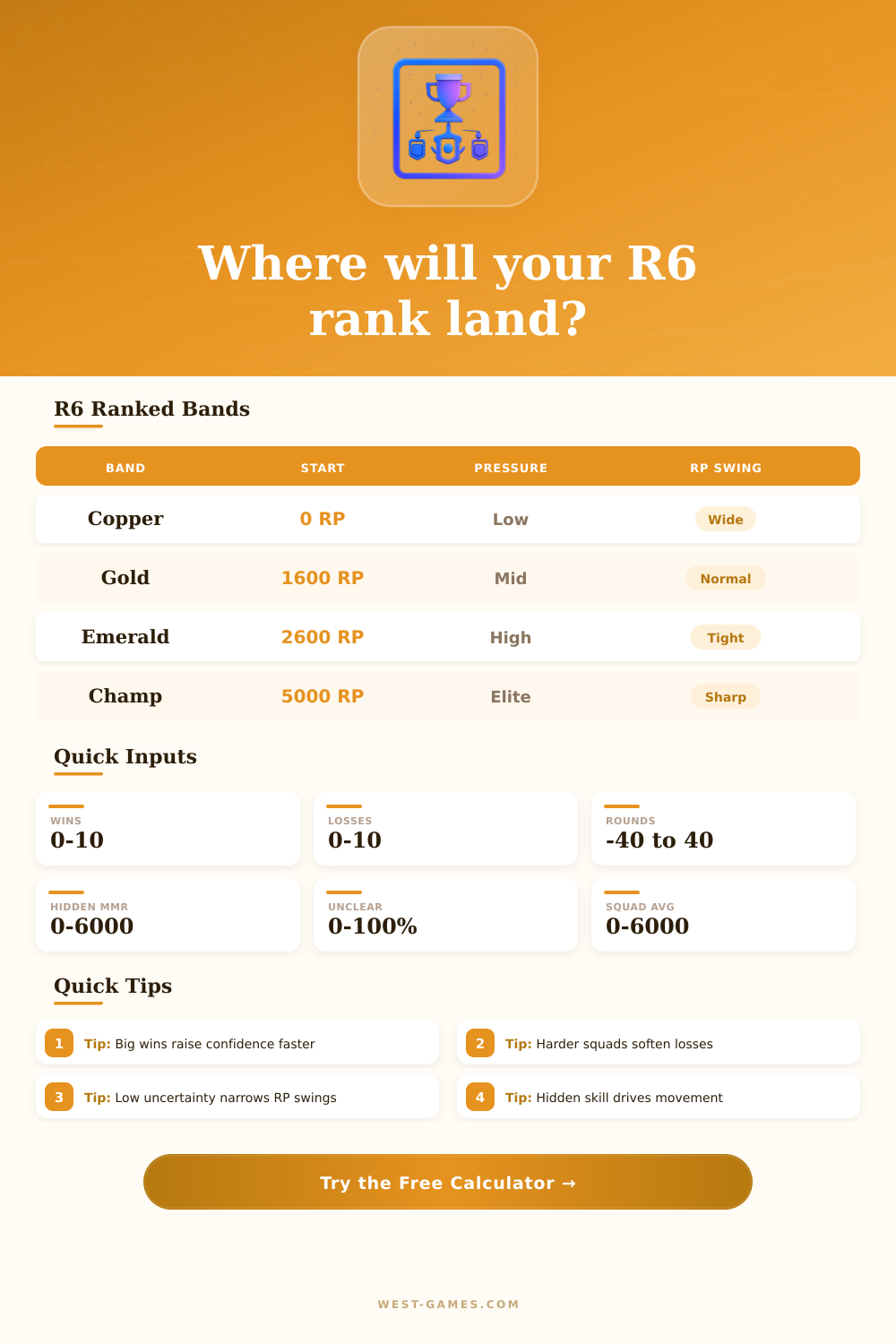
Estimate your Ranked 2.0 path from hidden skill, previous rank, placement record, round differential, squad strength, uncertainty, and projected RP movement.
Ranked 2.0 Movement Breakdown
| Visible Rank Band | Model RP Range | Pressure Zone | Placement Read |
|---|---|---|---|
| Copper V to Copper I | 0 to 499 RP | Very wide correction | Hidden skill can pull gains sharply upward. |
| Bronze V to Bronze I | 500 to 999 RP | Wide correction | Winning streaks can climb several divisions quickly. |
| Silver V to Silver I | 1000 to 1499 RP | Moderate correction | Round differential starts separating stable players. |
| Gold V to Gold I | 1500 to 1999 RP | Normal correction | Visible rank usually tracks skill more closely. |
| Platinum V to Platinum I | 2000 to 2499 RP | Tighter correction | Losses punish weak lobby and low confidence profiles. |
| Emerald V to Emerald I | 2500 to 2999 RP | High pressure | Stack strength and role impact matter more. |
| Diamond V to Diamond I | 3000 to 3499 RP | Elite pressure | Small RP edges become meaningful across blocks. |
| Champion race | 5000+ RP | Leaderboard pressure | Consistency and lobby difficulty dominate projection. |
| Signal | Low Value | High Value | RP Movement Effect |
|---|---|---|---|
| Hidden skill above visible RP | 0 to +150 | +700 or more | Raises win gains and reduces loss damage. |
| Rank uncertainty | 0% to 25% | 70% to 100% | Higher uncertainty widens both gains and losses. |
| Match sample | 1 to 8 games | 30+ games | Larger samples reduce surprise movement. |
| Previous season file | Far below current | Near hidden skill | Helps estimate whether visible rank is catching up. |
| Round Differential | Typical Match Shape | Confidence Signal | Calculator Adjustment |
|---|---|---|---|
| -20 or worse | Repeated 2-7 or 3-7 losses | Skill estimate likely too high | Sharp downward RP and confidence pressure. |
| -8 to -1 | Close losses, few overtimes | Mixed read | Small penalty unless win rate is strong. |
| 0 to +8 | Stable 7-5 and 8-6 results | Solid placement read | Small positive RP and certainty boost. |
| +9 to +20 | Clean executes, fewer thrown rounds | Hidden skill may be higher | Meaningful boost to projected placement. |
| +21 or better | Dominant lobbies | Visible rank is lagging behind | Strong boost, capped to avoid runaway output. |
| Queue Setup | Lobby Read | Projection Bias | Best Use |
|---|---|---|---|
| Solo queue | High variance in comms and roles | Lower confidence, wider risk | Testing individual carry pressure. |
| Duo queue | Reliable calls, still random map control | Balanced confidence | Most normal placement modeling. |
| Three-stack | Some role coverage and trade structure | Small positive consistency | Tracking role synergy and clutch conversion. |
| Five-stack | Coordinated executes and bans | Higher confidence, less noise | Projecting true team-ranked strength. |
| Scrim-like stack | Harder opponents and sharper defaults | Bonus for hard-lobby wins | Testing Diamond and Champion pressure. |
Ranked 2.0 reset makes you anxious. A new Copper V appear, and you’re wondering: Will this season be a slog through Bronze? Or will I quickly climb into Gold? Every match feels weighted, each round carries the weight of your trajectory for the next three months. Early games become luck tests; many people respond aggressively to losing a single game, while others gets ahead of themselves after winning two.
That’s where the calculator come in. It shifts perspective from “how did I do?” to “what does it mean?” The beginning is part of a larger system. The visible data (RP) is combined with invisible variables (skill estimate + round differential). Where does the math put you?
How Ranking Reset Works and How to Use the Calculator
Ranked play in Siege makes a mistake that many people make: they think wins matter more then losses. That’s not necessarily true. It really comes down to confidence and uncertainty. When the system doesn’t know too much about you, it swings really hard for each win/loss. Why? Because it wants to learn your real level as fast as possible. To do so, it looks at uncertainty of rank and match sample size.
So if you’ve played very few matches, it thinks there’s high variance. In turn, that means that the RP movement you get will be wider (more volatile) when projected. And that matches the way gameplay work. New players experience volatile swings until their performance stabilize. Matchmaking isn’t broken; it’s calibration.
Win record isn’t everything: It’s also important to play the game well… And that’s where Round Differential comes into play. While a high win record can be the result of good luck (and carrying teammates), it could of also mean a player lost 20 rounds in five matches. That is a lot for tool to account for. A high win percentage with a negative or flat round difference mean the system suspects your visible rank is higher than your hidden skill.
Crushing opponents signals that your real MMR is probably above your current ranking. That’s what separates those players who feel like they’re stuck even if they’re winning half of their matches. Sure, maybe you won the coin flip, but you lost statistical war.
Your queue composition biases each input. Your role coverage and communication will be less consistent when you play solo. That’s going to naturaly lower the confidence score in whatever it projects. Five stack provides consistency with lobby control & repeatable executes. The model has much more trust in those wins. The reference table on the page shows the breakdown of how each queue style biases results.
In other words, it takes stronger individual metrics for solo players to achieve the same projected rank as coordinated stacks of player. Again, not punishing for playing solo. Simply acknowledging the chaotic nature of random lobbies. While you can’t necessarily see it with your own eyes, all of this movement is still powered by hidden skill. You can plug in a guess of what your actual MMR might be based off past peaks and estimations.
If you feel like you’re currently under-skilled for your division (i.e., you think you have more than what’s being shown via RP), the calculator will adjust loss penalties and gain wins based on that fact. It’ll set up a situation in which you don’t get as upset about dropping divisions while getting placed since the system “knows” you’d run into overmatched people now and again. That way, grinding doesn’t seem as hard… Because you realize those drops should be corrective instead of punitive.
It’s more about creating consistent value each round, and less about individual aim. It can’t predict map preferences or clutch plays, but it does offer a snapshot of where those trends are pointing. Apply this tool to set realistic expectations and don’t demand promotion immediately. If your inputs indicate a slow climb, understand that building a foundation in lower brackets (Silver/Gold) might be required before pushing to higher ones.
The idea is gradual improvement, not instant gratification. Understanding your starting position lets you concentrate on the next match. Stop stressing about invisible numbers which determine how your season starts.