🛡 ARC Raiders Skill Tree Calculator
Plan Raider points across mobility, survival, scavenging, combat, and utility before your next extraction.
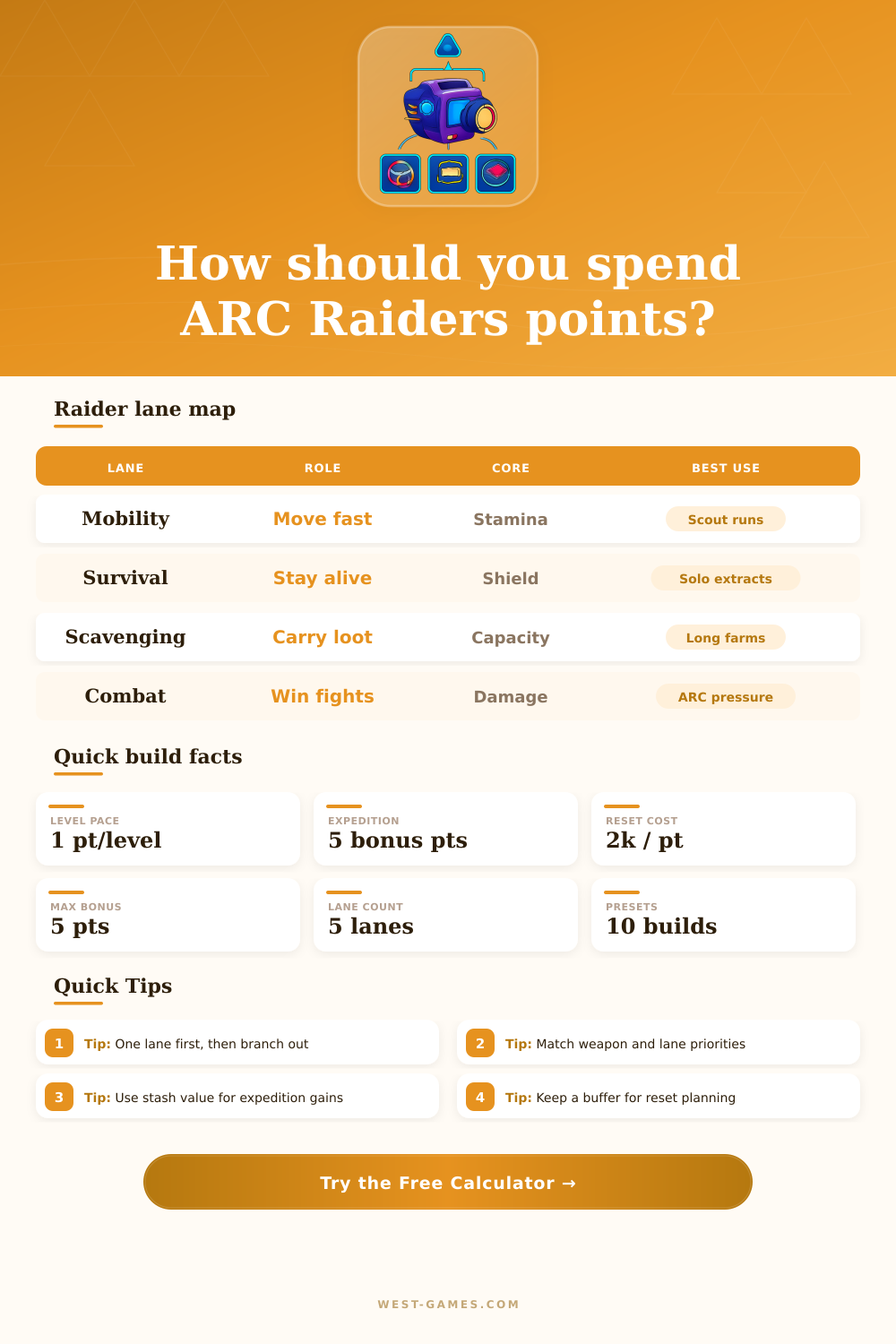
| Lane | Focus | What it drives | Best use |
|---|---|---|---|
| Mobility | Move fast | Stamina and dodge windows | Scout runs |
| Survival | Stay alive | Shielding and recovery | Solo extracts |
| Scavenging | Carry loot | Loot speed and capacity | Long farms |
| Combat | Win fights | Damage and pressure | ARC hunts |
| Utility | Help team | Gadgets and revives | Squad play |
The game rewards smart extraction, so a lane only needs to be deep enough to support the route you actually play.
| Band | Point pace | Planner goal | Note |
|---|---|---|---|
| Early | 0-9 | Open one lane | Keep it simple |
| Mid | 10-19 | Unlock a second lane | Start branching |
| Deep | 20-29 | Anchor a core lane | Specialize hard |
| Wide | 30+ | Hybrid support | Spread with purpose |
This calculator treats deeper lanes as the clearest sign of build identity, even when you keep a flexible off-lane.
| Condition | Lane lean | Why it helps | Risk |
|---|---|---|---|
| Night Raid | Mobility | See and move first | Low light pressure |
| Storm | Survival | Bad weather punishes mistakes | Visibility loss |
| Bunker | Utility | Doors and close fights | Trapped routes |
| Solo Extract | Combat | No one covers you | Harder escapes |
| Expedition | Scavenging | Long-term value matters | Overfilling fast |
Official ARC Raiders updates call out Night Raids, storms, and expeditions, so those are the most natural planning anchors here.
| Stash value | Bonus points | Reset note | Use case |
|---|---|---|---|
| 0-999k | 0 | No carry bonus | Fresh start |
| 1m-1.9m | 1 | Small reset boost | Light storage |
| 2m-4.9m | 2-4 | Good bonus tier | Mid wipe plan |
| 5m+ | 5 | Max expedition value | Deep prep |
Official notes say one million Coins worth of stash value equals one extra skill point, up to five for a departure.
The skill tree system consist of five lanes that offer players specific advantage. When a player levels up, they earns one skill point. Additionally, players can also earn skill points from expeditions based off the player’s stash value.
If the player reach one million coins in their stash, they earn an extra skill point. Furthermore, if the player reaches five million coin in their stash value, the player will earns five extra skill points. These resets cost real money, so players must plan their skill tree carefuly to avoid spending money on an inefective skill tree.
How to Build and Use Your Skill Tree
There are five skill tree lanes to choose from in the game. The mobility lane improve the player’s speed. The survival lane increase the player’s shield strength.
The scavenging tree increase the player’s carry weight. The combat tree increase the player’s damage strength. Lastly, the utility tree increase the player’s access to gadgets, revives, and doors.
A player should choose a skill tree based on their role in the game. Scouts needs to have a focus on mobility to allow them to move quick across the map. Anchors should focus on survival skill to allow them to stay in one spot while their teammates loots the area.
Scavengers needs to focus on scavenging skills to allow them to gather the most loot. Hunters will focus on combat skills to eliminate their enemy quickly. Supports will focus on utility to help their teammate in the game.
To create a skill tree, players can develop a strategy regarding how many skill point go into each tree lane. Players should focus on one skill tree deep and then develop others later in the game. When a player has between zero and nine points, they should focus on basic skills.
Between twenty and thirty points, players should establish their main skill tree lane. When they have more than thirty points, players can specialize in several skill trees to become a hybrid player. Hybrid players will spread their points across several skill trees but must ensure they dont spread their points too thin.
There are skill tree presets to help players create their trees quick. For instance, the night raid scout preset puts players focus on mobility and combat to allow them to flank their enemies in low light. The solo extract preset allow players to focus on survival in case they are playing alone.
The arc hunter preset allow players to focus on combat as they will be using more aggressive play style in their games. The loot runner preset allow players to focus on scavenging to gather as much loot as possible on their expeditions. Additionally, players can take a snapshot of their skill tree to see how many skill point they have and the bonus points and cost of resetting their skills.
The fit score show players how well their skill tree matches their in-game role. There are skill trees that give players fit scores ranging from S to lower grades. A deep skill tree in a player’s role will give them a higher fit score.
Additionally, if players have too many skill points, they should trim their skills before resetting their skill tree. Certain weapon work better with certain skill trees then others. For instance, shotguns have a better fit with the utility skill tree for breaking doors.
A player’s team also determine what skills are needed. For example, if a player is going to play with their friends, they should develop a skill tree that focuses on utility to assist their teammate. However, if they are playing alone, they should not spend their skill point on utility skills.
Furthermore, the player’s knowledge of the map can also supplement the skills in their tree. For instance, if a player knows the movement of the enemies in an area, they can succeed in their game even with fewer points dedicated to their mobility skills.