🍬 Pokemon GO Candy Calculator
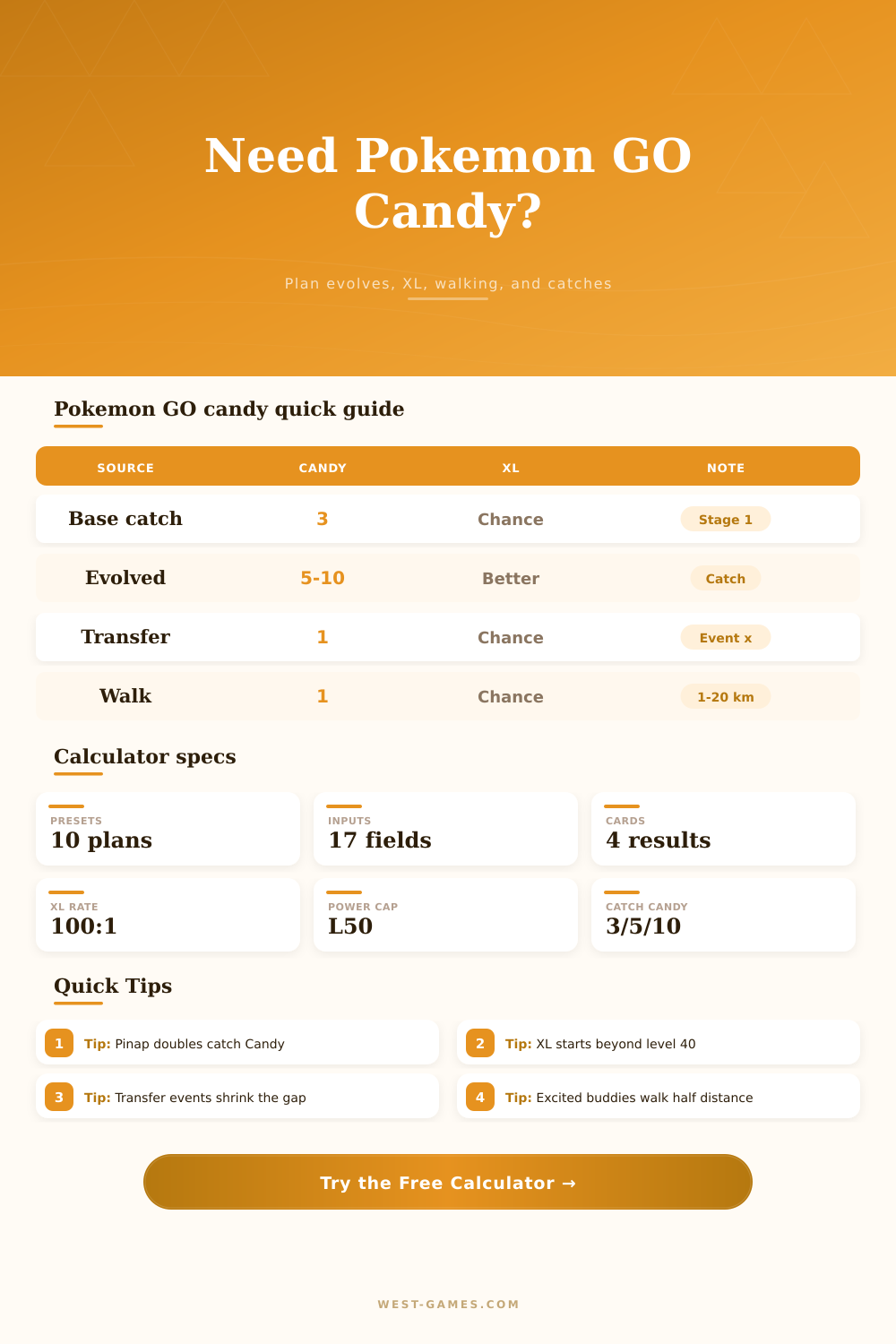
Plan evolution Candy, regular power-up Candy, Candy XL, Rare Candy, transfers, buddy walking, Pinap catches, Mega bonuses, and event multipliers in one Pokemon GO farming sheet.
| Source | Regular Candy | Multiplier input | Calculator use |
|---|---|---|---|
| Base-form catch | 3 Candy | Pinap, event | Core catch loop |
| Second-stage catch | 5 Candy | Pinap, event | Evolved spawn route |
| Third-stage catch | 10 Candy | Pinap, event | Rare evolved spawn |
| Transfer | 1 Candy | Transfer event | Storage cleanup |
| Buddy walking | 1 Candy | Distance modifier | Passive finish |
Pokemon GO Help states Candy is acquired from catching, hatching, and transferring Pokemon, and used to evolve and strengthen Pokemon.
| Buddy band | Normal distance | Excited distance | Planning note |
|---|---|---|---|
| Very short | 1 km | 0.5 km | Fast Candy route |
| Common short | 3 km | 1.5 km | Good nest backup |
| Common long | 5 km | 2.5 km | Many rare species |
| Legendary | 20 km | 10 km | Slow Rare Candy target |
Adventure Sync can record distance for Buddy Candy, and Pokemon's Buddy Adventure reference lists 1, 3, 5, and 20 km Candy distances.
| Level band | Candy per power-up | Shadow estimate | Use |
|---|---|---|---|
| 1 to 10.5 | 1 | 2 | Low level start |
| 11 to 20.5 | 2 | 3 | Early raid prep |
| 21 to 25.5 | 3 | 4 | Weather catch base |
| 26 to 30.5 | 4 | 5 | Bulk regular push |
| 31 to 39.5 | 6 to 15 | 8 to 18 | Final non-XL push |
The calculator sums every half-level power-up from the current level to the target level, then applies Shadow or Purified modifiers.
| Level band | XL per power-up | Regular total | Profile note |
|---|---|---|---|
| 40 to 42 | 10 | 40 XL | XL starts here |
| 42 to 44 | 12 | 48 XL | Moderate ramp |
| 44 to 46 | 15 | 60 XL | Mid XL grind |
| 46 to 48 | 17 | 68 XL | Late XL grind |
| 48 to 50 | 20 | 80 XL | Final stretch |
A regular Pokemon needs 296 Candy XL from level 40 to 50; Shadow and Purified Pokemon use different XL totals.
| Scenario | Best inputs | Main bottleneck | What to adjust |
|---|---|---|---|
| Community Day evolution | 2x catch, Pinap, many catches | Regular Candy | Catch multiplier |
| Legendary level 50 | 20 km buddy, Rare Candy XL | Candy XL | Rare XL and raids |
| Storage cleanup | High transfer count, 2x transfer | Transfer timing | Transfer event |
| Walking finish | Buddy distance and planned km | Distance | Excited buddy |
| XL conversion | Reserve regular Candy first | 100:1 rate | Reserve setting |
Use the checklist to match the calculator to a real Pokemon GO loop, then tune expected Candy XL per catch from your observed results.
Do you remember catching Magikarp? You reel in fish, get three candies out of it, then have to wait until you evolve it into a Gyarados, four hundred away. Yikes! That’s quite alot of effort for one evolution. So many players simply cast blindly, waiting for those numbers to fall into place. It’s burnout inducing.
Instead, open up your inventory and see what you’re missing before heading outdoors. When you type in your current collection and level you want to achieve, the calculator figures out the rest. No more guesswork with complicated multipliers for you.
How to Use the Candy Calculator
Candy and Candy XL are not the same resource. Regular Candy powers up your Pokemon and evolves them all the way up to level forty. Early on, it’s the primary currency. Candy XL is what you need when pushing those last few levels to level fifty. These are two currencies that players frequently confuse.
That means a player gets a level forty Pokemon and can’t go any further. By separating these pools into their outputs, the tool point out exactly which one has that gap. Those gaps matter because filling them require different strategies.
If you’re familiar with regular Candy, then you know how to farm it. You walk, transfer, and catch. Every catch double when using a Pinap Berry. On special weekend events, or during community days, the landscape shift. Multipliers for catches will increase your earnings by 3x or even 4x.
Plug in those event bonuses into the calculator. What does that do? That will tell you how many fewer catches you actualy need. It is not just about catching more, it’s about catching smarter. During the right windows.
That’s when things get grinding with Candy XL. Catching and transferring Pokemon give you a random chance to get XL Candy. And it’s not great odds either; you shouldn’t of count on luck.
There’s also the option to convert regular Candy into XL. It is a one hundred to one ratio. That’s costly. It takes one hundred regular for every one XL. Only do that as a last resort once you’ve exhausted all other possibilities.
The app allow you to see this trade off. It also provides a way to set aside regular Candy to protect your stock of evolution.
Another trustworthy method is walking your buddy. If you have a kilometer buddy, you get Candy for each kilometer walked. A legendary might require 20 kilometers before it give you even one. Putting an almost-evolved Pokemon as your buddy help close that gap. No items required.
With Adventure Sync, you can also pick up distance passively. Earn some Candy at work and sleep.
If you don’t know where to begin, it has some handy presets that load up common scenarios, such as pushing a legendary to level fifty or evolving a starter. Then, you have something as a starting point. From there, you can tweak the inputs to fit your situation.
Purified Pokemon need less resources than non-purified ones. Shadow Pokemon need more.
It’s about shifting from reactive farming into proactive planning. Instead of chasing after random spawns, you hits specific targets. Pokemon GO is a game of resource management. Raids are exciting, the monsters are fun but it’s all run by the economy of Candy. Every decision matters, from saving your Pinap Berries to walking for your buddy Candy. That’s what keeps you engaged, understanding how to fill that gap between your needs and what you have.
Use this calculator to make those decisions clear. It takes your vague feeling of scarcity and turns it into a concrete plan. Next time you spot a hard-to-find species, look at the numbers first. Then go get ‘em.