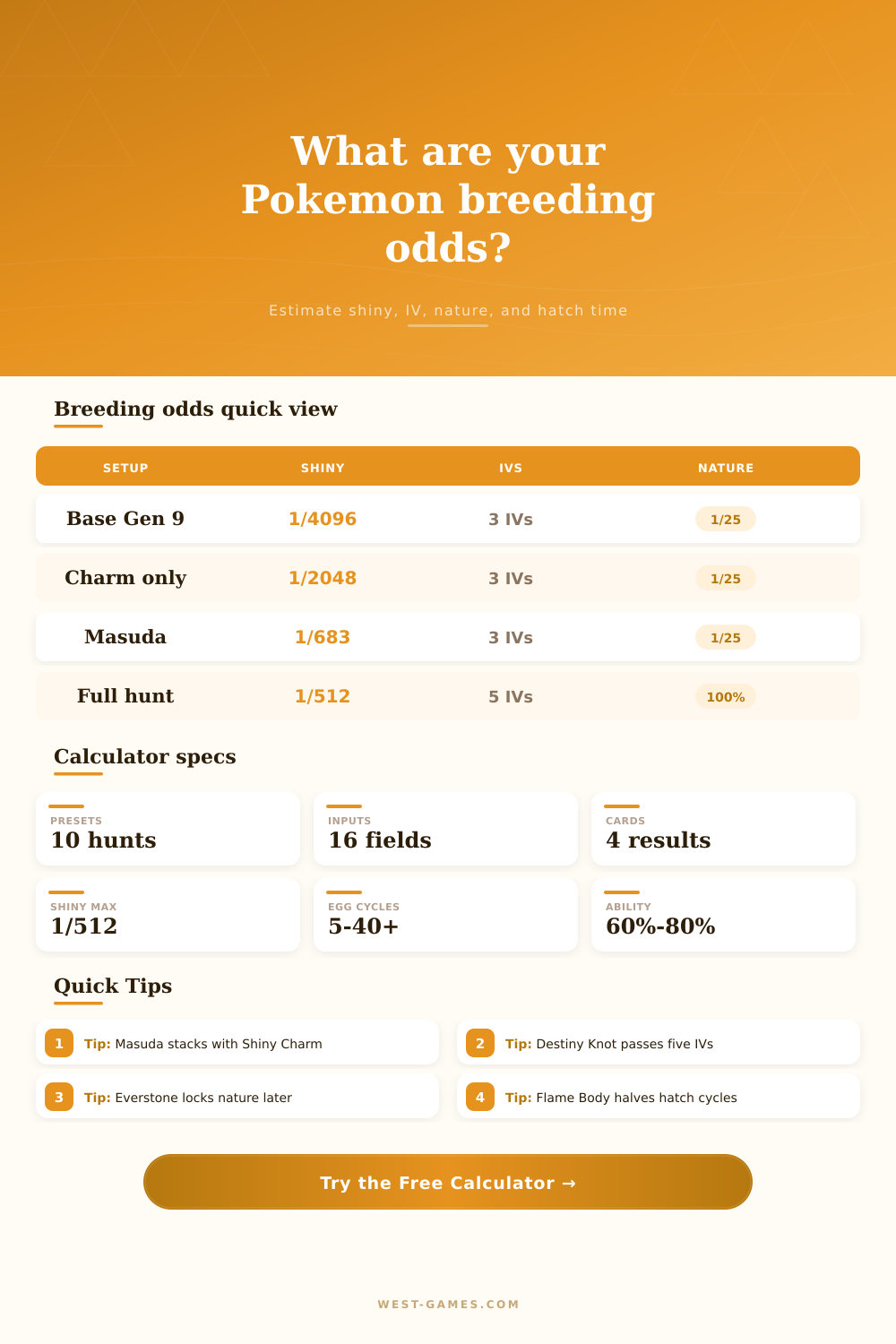
🥚 Pokemon Breeding Odds Calculator
Estimate shiny egg odds, Masuda and Shiny Charm rolls, Destiny Knot IV inheritance, Everstone nature odds, ability passing, egg cycles, steps, and hatch time.
| Generation | Base | Masuda | Masuda + Charm |
|---|---|---|---|
| Gen IV | 1/8192 | 5/8192 | Not available |
| Gen V | 1/8192 | 6/8192 | 8/8192 in B2W2 |
| Gen VI-VII | 1/4096 | 6/4096 | 8/4096 |
| Gen VIII-IX | 1/4096 | 6/4096 | 8/4096 |
Gen VIII and IX breeding keep the practical Masuda and Masuda plus Charm rates at about 1/683 and 1/512 because of the egg shiny roll bug documented by mechanics researchers and summarized by Bulbapedia.
| Parent match | Trainer IDs | Egg check | Day Care phrase |
|---|---|---|---|
| Same species | Different | 70% | Very well |
| Same species | Same | 50% | Get along |
| Different species | Different | 50% | Get along |
| Different species | Same | 20% | Do not like |
Classic Day Care games check for a new egg after each step interval. Generation IX picnic egg collection is paced differently, so treat this as a compatibility-rate model when using Scarlet and Violet.
| Mechanic | Without item | With item | Calculator use |
|---|---|---|---|
| IV inheritance | 3 IVs | 5 IVs | Destiny Knot |
| Nature | 1/25 | 100% | Everstone |
| Standard ability | 50/50 early | 80% slot pass | Parent ability |
| Hidden Ability | Unavailable early | 60% modern | HA parent |
The IV model estimates the chance to meet or exceed the selected perfect-IV count from the parent counts. Exact spread planning still depends on which stats are perfect on each parent.
| Cycle profile | Cycles | Base steps | With helper |
|---|---|---|---|
| Magikarp-style | 5 | 1,280 | About 640 |
| Quick baby | 10 | 2,560 | About 1,280 |
| Starter-style | 20 | 5,120 | About 2,560 |
| Slow hatch | 40 | 10,240 | About 5,120 |
Older references often describe 255-step egg cycles and 256-step egg-generation checks. The calculator uses 256-step planning intervals so route estimates stay conservative and easy to adjust.
| Scenario | Best inputs | Main odds driver | What to watch |
|---|---|---|---|
| Shiny only | Masuda plus Shiny Charm | 8 shiny rolls | Egg volume |
| Competitive shiny | Masuda, Charm, Destiny Knot, Everstone | Combined target odds | IV overlap |
| Hidden Ability hunt | Hidden Ability parent | 60% ability pass | Parent eligibility |
| Fast hatch species | Low egg cycles and Flame Body | Hatch workflow time | Party slots |
| Legacy Gen IV | Masuda without modern charm | 5/8192 shiny odds | Everstone limits |
Use the scenario table as a settings checklist. The calculator intentionally keeps purchase advice, team recommendations, and walkthrough material out of the embedded tool.
The math isn’t always visible, especially if you’re breeding pokemon for shininess. That’s one of those things that requires managing probability. Here you sit, at the picnic blanket (or day care). And you wait. For eggs. Then, for each egg, the game spits out a personality value. If it matches your game ID, then you have a shiny on your hands.
But most people treats each egg as an individual event. They don’t realize there’s a pattern. It is a statistical pattern. The calculator does that for them. It converts abstract chances into concrete expectations.
How a Pokémon Breeding Calculator Works
The chance for a shiny begins here. For today’s games, that means the default probability is 1/4,096. That sounds like small odds, unless you use the Masuda method. This means you breed two Pokémon from different language games. This introduces additional chances to result in a shiny.
The Shiny Charm also stacks on top of that. This item is earned after completing the regional Pokédex. Together, these methods have a powerful synergistic effect: they increase likelihood and lower the number of eggs you must hatch. These multipliers are what the calculator accounts for. They follow the game generation-specific rules of each title you play.
Perfect IVs are required to breed competitively too. Your Pokemon’s raw stats is determined by their IVs. That’s where the Destiny Knot comes in. In normal circumstances, three of the baby’s six IVs will be inherited from its parents. Holding the Destiny Knot allows you to inherit five instead.
That means planning out who should breed with whom. You’ll get much better odds if both parents possesses perfect IVs in the desired stats. It is even better to have a Ditto from another region that has perfect IVs in different stats. That almost ensures an offspring with perfect IVs. Use the calculator to input your parents’ IV counts. Based off that information, it calculates how likely you’re to succeed.
Nature and ability inheritance follow similar logic; the Everstone ensures the offspring inherits the holder’s nature. It eliminates randomness that previously made breeding so slow. If one of the parents has hidden abilities, there’s a sixty percent chance their offspring will inherit it too. In later generations, either parent could pass it down.
All this stacks on top of each other. At once you’re rolling for the right IVs, the right ability, the right nature and the shiny rate. Getting everything right lowers your chances even more than just the shiny rate alone.
The process has limits. There’s a limited number of steps for each egg cycle. Depending on the egg, that means it will take some number of steps to hatch. For example: Five cycles for a Magikarp. Forty cycles for a Dratini. This number is halved if one of your party members have either Steam Engine or Flame Body.
Your hatch helpers and your movement speed goes into the calculator. The calculator provides a reasonable estimate. It tells you what your chances are. And it tells you how long it might be.
Most people who stop playing don’t understand variance. If I hatch two shinies in a row, that’s just part of random distribution. If I didn’t hatch any after 50 eggs, that was bad luck. Both of those statements are wrong. This is random distribution.
How does the tool help? It takes away the emotional guesswork and gives you the bigger picture. It tells you how many eggs you need with a certain amount of certainty. You no longer wonder if you’re on an unlucky streak. You see exactly where on the statistical curve you are.
There’s a reason it takes a lot of tiny chances to breed something. Every egg is an individual data point. The more you learn about the mechanics, the less you have to hope and chance into things. Instead of luck, you rely on strategy.
Whether you’re shooting for a shiny to put in your frame or a competitive specimen, the numbers don’t change. Manage the odds. Respect the time. Wait for the sparkle.
How do you know if you’ll be satisfied or frustrated? Often it depends on how well you understand the actualy odds ahead of time.