⏱ Honkai Star Rail Speed Breakpoint Calculator
Plan Honkai: Star Rail SPD breakpoints with action value, cycle count, first and second cycle turns, temporary speed buffs, speed debuffs, advance forward effects, and target-turn requirements.
| Breakpoint | Natural AV | Cycle result | Why players check it |
|---|---|---|---|
| 100.0 SPD | 100.00 AV | 1 action in cycle 0, 2 by cycle 1 | Baseline character speed with no speed build. |
| 120.1 SPD | 83.26 AV | 3 actions by cycle 1 | A moderate target for supports or carries that want earlier second-cycle tempo. |
| 133.4 SPD | 74.96 AV | 2 actions in cycle 0 | The common "134" breakpoint because 2 x AV fits inside 150 AV. |
| 142.9 SPD | 69.98 AV | 5 actions by cycle 3 | A useful long-window tempo point when planning 4-cycle clears. |
| 160.1 SPD | 62.46 AV | 4 actions by cycle 1 | Fast DPS and relic set checks such as high-SPD damage thresholds. |
| 171.5 SPD | 58.31 AV | 6 actions by cycle 2 | High-investment turn compression across three total cycles. |
| 200.1 SPD | 49.98 AV | 3 actions in cycle 0 | Extreme speed or heavy buff windows for front-loaded turns. |
| Goal | AV window | Required SPD | Formula check |
|---|---|---|---|
| 2 turns in cycle 0 | 150 AV | 133.4 | 2 x 10000 / 150 |
| 4 turns by cycle 1 | 250 AV | 160.0 | 4 x 10000 / 250 |
| 5 turns by cycle 2 | 350 AV | 142.9 | 5 x 10000 / 350 |
| Mechanic | Input used | Modeled as | Practical reading |
|---|---|---|---|
| SPD | Base SPD plus gear | Raw action interval = 10000 / effective SPD | Use this for natural breakpoint planning. |
| Speed buff | Percent, flat, uptime | Average SPD added before the AV interval is solved | Best for Asta-style or temporary speed windows. |
| Speed debuff | SPD loss percent | Reduces the buffed SPD before AV is calculated | Use when a character is slowed or has a self-slow penalty. |
| Advance forward | Opening and recurring advance | Shortens current or future action interval by percent | Do not treat this as permanent sheet SPD. |
| Action delay | Delay percent | Adds extra AV to the adjusted timeline | Use as a penalty check when a turn is pushed back. |
Magic isn’t always magic, it’s just really detailed arithmetic. Like how fast you think your DPS should be firing (twice per enemy action?), or when you want your buffer looping exactly on beat without falling out of rhythm. Typicaly this means just adding faster stuff until it all “clicks”. This works occasionally.
But it also leads to over spending your resources on things that don’t actualy move you up in turn order. Once you put in your base speed, gear, and buff uptime, the calculator do all the math for you. This saves you a headache of dealing with conversions and coefficients.
Understanding Action Values and Speed Breakpoints
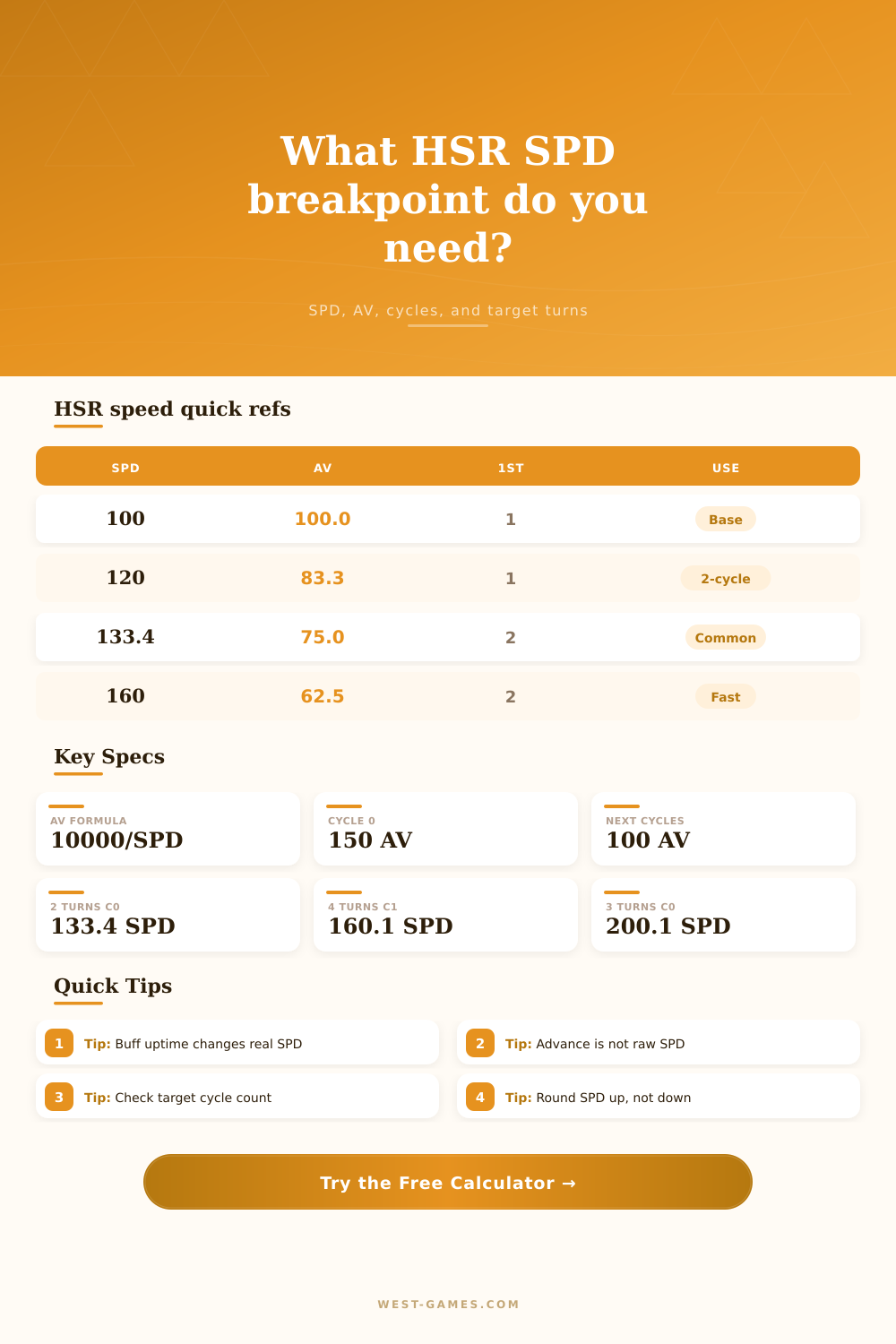
But the real heart of it all is the action value (AV). AV can be thought of as a ticket to your turn. Each character starts with a ticket with ten thousand points on it divided by their speed. So once the ticket reaches zero, they takes their turn. There’s a bigger window in the first cycle (~one hundred and fifty points) and each cycle after that becomes tighter (one hundred points). That’s important because most players only care about those early turns. They want to get two actions off during the first one-hundred-and-fifty point window, which gives them a huge tempo advantage.
The reference table on the page show why one-hundred-and-thirty-four speed is the ultimate goal of carry builds for so many people. Why? Because it’s the sweet spot where you can squeeze two normal turns into the first cycle. But that’s not the full story.
Things gets very complicated when we throw in temporary buffs. Maybe your support gives you a 20 percent speed buff, but it doesn’t last forever. Now we need to consider uptime. Your buff falls off halfway through the cycle? Your effective speed goes way down and your action value goes up. The tool averages your buffed and unbuffed states based on the uptime percentage you enter. It is a small thing, but it makes a difference.
Lots of people assume they are permanently buffed. They then discover their character miss turns during a long fight because the speed window has shut. Then there’s the advanced mechanics on top of all of it. Advances don’t make your friend go faster, at least not in terms of how much speed they have as a stat. An advance makes them go now instead of later. It is a push, not a boost. That’s why the calculator keeps it separate from the permanent speed.
Someone might think an advance means they can go twice, but it actually just moves their next action up by one turn. After that, their actual speed takes over again. Most folks should of grasped this. They see someone go twice in a row and think “oh, their speed must be high.” No. Once was from an advance then regular speed took over.
And don’t forget about the penalties. Certain debuffs and enemy mechanics can slow you down, increasing your action value cost. You want to make sure that a slow debuff won’t screw up your perfect synergy with the rest of your team. By entering in the percent of slowdown, you can run the numbers for worst case situations. If your character still manages to reach their breakpoints while penalized then your build is good. And if not? Well, it’s time to either add more buffs to cover it or increase raw speed instead.
In the end though, that’s all speed break points are: Consistency. If you’re building for common one hundred and twenty speeds, or if you’re reaching for the extreme one hundred and sixty, it doesn’t matter. What matters is putting your team on a set pace so they can avoid wasting time.
When you begin to realize that the timing for taking an action shrinks with every cycle, the numbers won’t feel arbitrary anymore. Instead, you’ll know exactly what each point of speed gets you. A turn here, a bit quicker wait there. That’s the difference between feeling powerful and feeling efficient, and usually it comes down to those hidden decimals.