🃏 Pokemon TCG Pocket Pack Odds Calculator
Estimate pack-slot odds, target card probability, at-least-one chance, expected pulls, rare pack chance, pack point fallback, and Wonder Pick comparisons.
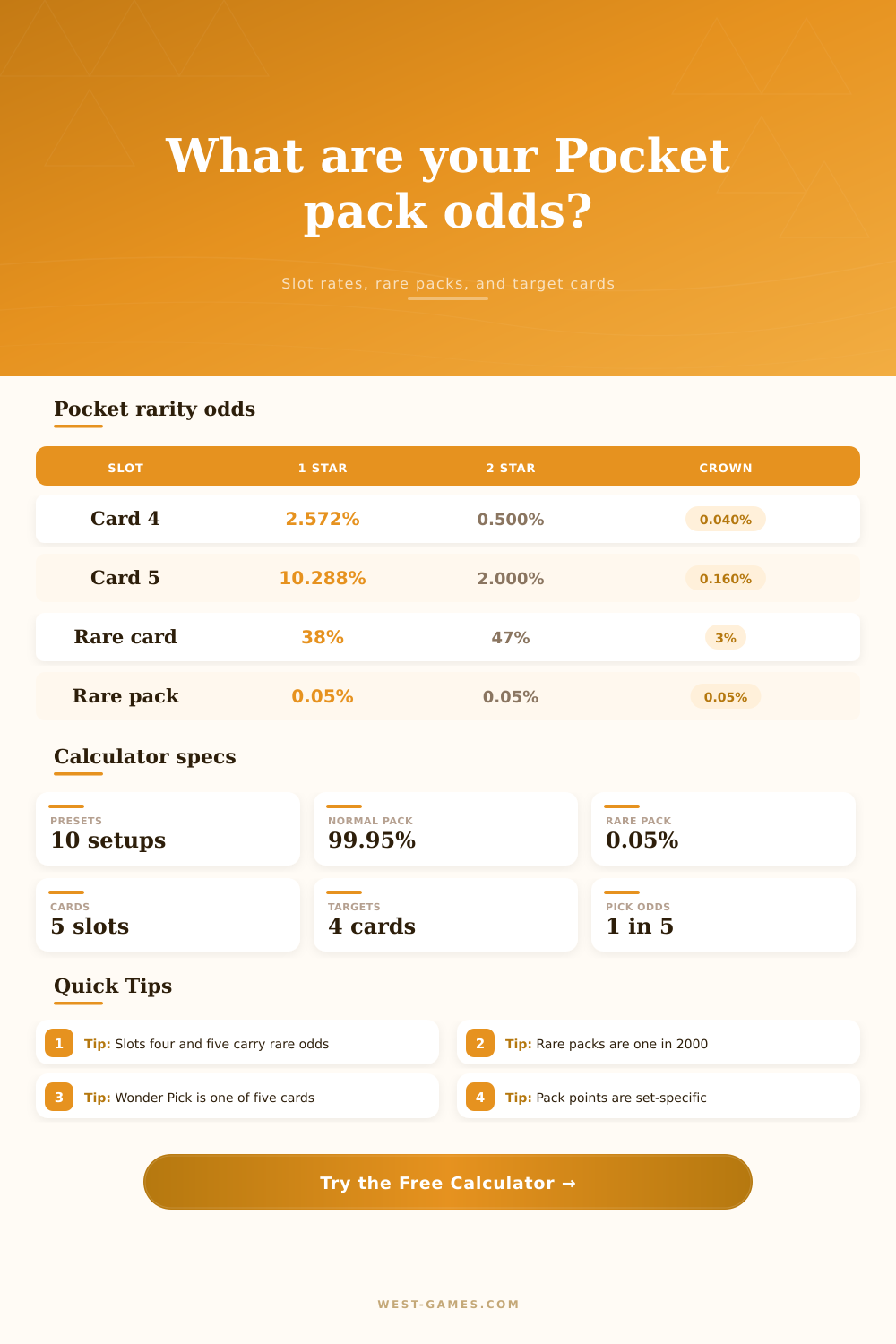
| Rarity | Cards 1-3 | Card 4 | Card 5 |
|---|---|---|---|
| 1-Diamond | 100% | 0% | 0% |
| 2-Diamond | 0% | 89.000% | 56.756% |
| 3-Diamond | 0% | 4.952% | 19.041% |
| 4-Diamond | 0% | 1.666% | 6.664% |
| 1-Star | 0% | 2.572% | 10.288% |
| 2-Star | 0% | 0.500% | 2.000% |
| 3-Star | 0% | 0.222% | 0.888% |
| 1-Shiny-Star | 0% | 0.714% | 2.857% |
| 2-Shiny-Star | 0% | 0.333% | 1.333% |
| Crown Rare | 0% | 0.040% | 0.160% |
Normal pack cards may be visually shuffled after opening; these are generation slots, not necessarily final reveal positions.
| Rare pack card | Rate | One in | Notes |
|---|---|---|---|
| 1-Star | 38% | 1 in 2.6 | Every slot can roll it |
| 2-Star | 47% | 1 in 2.1 | Largest rare-pack bucket |
| 1-Shiny-Star | 5% | 1 in 20 | Current shiny table |
| 2-Shiny-Star | 2% | 1 in 50 | Current shiny table |
| 3-Star | 5% | 1 in 20 | Immersive bucket |
| Crown Rare | 3% | 1 in 33 | Gold crown bucket |
Rare packs occur at 0.05% before their five high-rarity cards are rolled.
| Target | Rarity | Per pack odds | At least one | Expected copies |
|---|---|---|---|---|
| Card A art rare | 1-Star | 1 in 388 | 22.7% | 0.26 |
Specific-card estimates divide the rarity slot rate by your matching-card share of the booster rarity pool.
| Output | Formula | Input | Use |
|---|---|---|---|
| Per-pack target | 1 - product misses | Slot rates | Exact card chase |
| At least one | 1 - (1 - p)^N | Packs | Session odds |
| Expected pulls | N x slot sum | Packs | Average copies |
| Target copies | Binomial tail | Copies | Dupes or decks |
| Confidence packs | log miss / log miss | Target % | Long-run plan |
| Visible targets | One pick odds | Five picks | Best use |
|---|---|---|---|
| 1 of 5 | 20% | 67.2% | Exact card shown |
| 2 of 5 | 40% | 92.2% | Two useful cards |
| 3 of 5 | 60% | 99.0% | Collection filling |
| 4 of 5 | 80% | 99.97% | Nearly any hit |
| 5 of 5 | 100% | 100% | All cards useful |
Wonder Pick is not a pack-opening reroll; it is a one-card pick from a visible five-card result.
| Scenario | Recommended inputs | Typical signal | Practical note |
|---|---|---|---|
| Exact 1-Star art rare | 1-Star, 1 match, pool 20 | About 1 in 155 normal packs | Pool size drives exact-card odds. |
| Exact 4-Diamond ex | 4-Diamond, 1 match, pool 10 | About 1 in 120 normal packs | Often better than the symbol suggests. |
| Exact 2-Star full art | 2-Star, 1 match, pool 14 | About 1 in 560 normal packs | Rare packs add a tiny extra chance. |
| Exact Crown Rare | Crown, 1 match, pool 3 | About 1 in 1500 normal packs | Pack points can become the fallback plan. |
| Rare pack chase | Mixed model, any rare pack | 0.05% per pack | Roughly one in 2000 packs. |
Maybe your buddy’s full art print pulls make you jealous as you’re opening up common trainers from booster boxes. It doesn’t seem fair! But there’s no magic to it, just math.
Pokemon TCG Pocket has a tiered system. Some slots is reserved for common cards, while others roll for higher rarities. The way these slots work together is what differentiate mindless opening from strategic collecting.
The Math Behind Pokemon TCG Pocket Cards
Once you know which rarity slot(s) you want, the calculator does all the hard probability math so you don’t have to guess if you should of open five packs or five hundred packs to get to a particular goal.
Players get confused between the odds of pulling one specific rare card vs. The odds of pulling ANY rare card. Each pack have five cards, but typically the first three is locked into low rarity slots. Slots 4 & 5 are where the game rolls for anything ranging from standard diamond cards all the way up to crown rares.
While there’s a decent chance you could pull a two star card within a given pack, that pool represent dozens of different card. When you’re specifically after only ONE full art illustration, your odds take a big hit since that one card is now simply a tiny slice of overall rarity pie.
Then there’s the issue of the rarer packs. Rare packs shows up about once every couple thousand packs. This is statistically not enough to matter for short term openers. But even though they’re rare, the cards inside them is heavily skewed toward high-end hits. They’re fun if/when you get them but they aren’t something you can reliably rely on to fill out collections over time.
Trying to find a specific crown rare in random packs is a losing game that only works if you have a lot of patience and hundreds and hundreds of tries. Trading is often far more efficient and it’s the whole reason behind the pack point system, because you can’t count on the random number generator to come through again and again.
Then there’s another type of probability play: Wonder Pick mechanics. Picking one of five cards and seeing if it matches your criteria is simple mathematics. Assuming that one of the five card is the card you’re trying to find, you’ll only have a twenty percent chance of getting it right on any given pick. But across five picks? That makes it much more likely that you will find the card you’re after compared to simply opening random packs for it.
And here, the tool lets you look at both together, and see how much more likely it is to get an exact card with targeted picks than without. It’s basically swapping out randomness for visibility. It is a good trade-off when you specifically know what you are looking for.
You also have an option to set up input settings for the card pool size in each tier of rarities. Why? Because it’s much easier to pull a card from a set with twenty one star cards than it is to pull a single one specifically. Enter the amount of cards that constitute a win for your collection and you will find that grouping similar cards helps increase your overall odds. That way, what would otherwise be a nearly impossible chase becomes a possible project.
If you are wondering when to stop opening packs, use the confidence targets. These shows the odds of landing at least one card from a specific set based off how many packs you open. This helps you know when you have paid too much for diminishing returns.
There’s no doubt that collecting is part psychology. It is the art of pulling something out and feeling excited, and the management of expectations. But there’s also math, which puts guard rails around the thrill.
Understanding how the slots work, knowing what actualy odds are, helps you set a plan of attack and avoid feeling like the algorithm got you again. It empowers you whether you’re grinding for pack points or saving up for a bulk buy.
Opening a pack doesn’t matter if you don’t know what you’ll get. Knowing the numbers lets you take back some control and turn what was once a game of chance into a game of skill.