🔮 Summoners War Rune Efficiency Calculator
Score a Summoners War rune with slot and main stat validation, current substats, innate stat, grindstone value, enchanted gem tracking, efficiency percentage, speed value, and crit value.
| Line | Current | Grind | Max basis | Weight | Contribution |
|---|
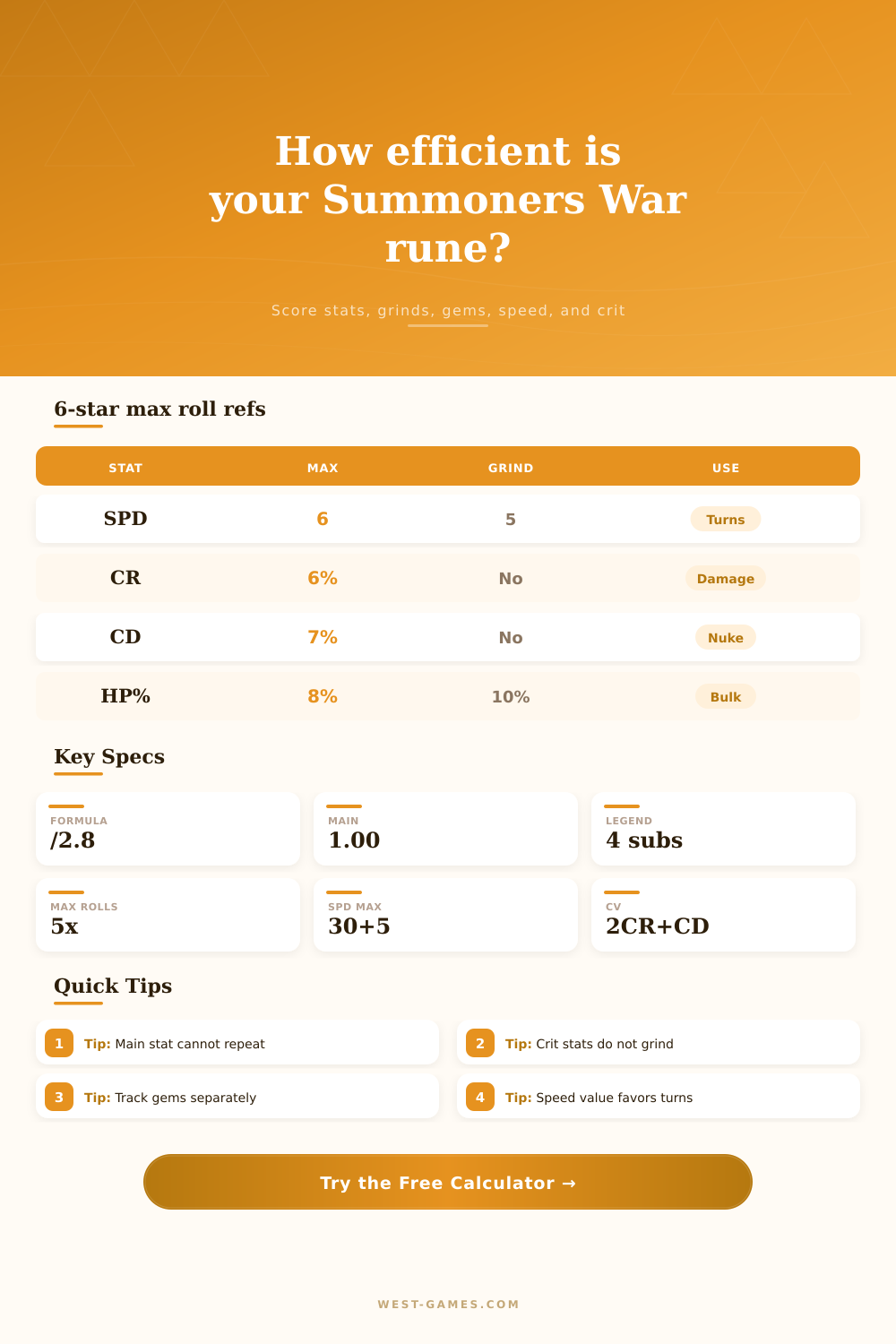
Max basis means five max rolls of a normal 6-star rune. For SPD that is 30 before grind, then up to 35 with legend grind included.
| Substat | Max initial or roll | Max at +12 | Legend grind max | Calculator note |
|---|---|---|---|---|
| SPD | 6 | 30 | 5 | Grindable; speed value uses current plus included grind. |
| CRI Rate | 6% | 30% | Not available | Used in crit value as 2 x CR. |
| CRI Dmg | 7% | 35% | Not available | Used directly in crit value. |
| HP% / ATK% / DEF% | 8% | 40% | 10% | High efficiency and grindable. |
| Accuracy / Resistance | 8% | 40% | Not available | Can be gemmed, but not grinded. |
| Flat HP | 375 | 1875 | 550 | Usually weighted lower than percent stats. |
| Flat ATK / DEF | 20 | 100 | 30 | Usually weighted lower than percent stats. |
| Slot | Fixed or common main stats | 6-star +15 max | Calculator behavior | Conflict rule |
|---|---|---|---|---|
| 1 | Flat ATK | 160 | Main is locked to ATK. | ATK flat cannot appear as substat. |
| 2 | SPD, HP%, ATK%, DEF%, flats | 42 SPD or 63% | Select the actual slot 2 main. | Matching substat is flagged. |
| 3 | Flat DEF | 160 | Main is locked to DEF. | DEF flat cannot appear as substat. |
| 4 | CRI Rate, CRI Dmg, HP%, ATK%, DEF%, flats | 58% CR or 80% CD | Damage runes usually compare CV. | Matching substat is flagged. |
| 5 | Flat HP | 2448 | Main is locked to HP. | HP flat cannot appear as substat. |
| 6 | ACC, RES, HP%, ATK%, DEF%, flats | 64% ACC/RES or 63% | Support runes often use ACC or RES. | Matching substat is flagged. |
| Original rarity | Starting substats | Power-up events before +12 | Upgrade rolls by +12 | Interpretation |
|---|---|---|---|---|
| Magic | 1 | Three reveals, one upgrade | 1 | Lowest ceiling before reappraisal or gem work. |
| Rare | 2 | Two reveals, two upgrades | 2 | Can still matter if speed rolls high. |
| Hero | 3 | One reveal, three upgrades | 3 | Common keep/sell breakpoint for quality runes. |
| Legend | 4 | Four upgrade events | 4 | Best chance to stack one premium stat. |
| Stat group | Can grind? | Legend grind max | Can gem? | Calculator handling |
|---|---|---|---|---|
| HP%, ATK%, DEF% | Yes | 10% | Yes | Grind box adds extra value when enabled. |
| Flat HP | Yes | 550 | Yes | Flat value is weighted lower by default. |
| Flat ATK, Flat DEF | Yes | 30 | Yes | Useful on specific scaling units. |
| SPD | Yes | 5 | Yes | Speed value includes grind if enabled. |
| CRI Rate, CRI Dmg | No | None | Yes | Gem checkbox marks the line for audit only. |
| Accuracy, Resistance | No | None | Yes | Support profile raises these weights. |
A lot of players just rely on guesswork. They see a rune that looks great on paper: solid main stat, good substats, pulled out of a Legendary chest. You put it on then notice your unit plods around during combat. Damage are average. Turn order sucks. That’s because you didn’t understand efficiency for your unit’s role.
Oftentimes, it’s not the rune; it’s your definition of “efficient.” Now you know the calculator’s doing the math for you, and it’s dividing by 2.8 so you understand why you has faith in the answer. That figure is the industry benchmark which levels the scoring across different kinds of stat. So a high-speed rune isn’t punished because it has a lower raw cap on speed compared to other percentage stats.
How to Check If Your Runes Are Good
When you look at your efficiency percentage, what you’re looking at is how close the rune came to a perfect roll. It’s not assessing the strength of character. It assesses the statistical purity. A lot of players will view that score as a raw power level. It is not a measure of performance, but a measure of potential.
The trick is choosing the correct weight profile. If you want a nuke build, then you need damage and crit rate. If you want a support unit, then you need resistance and accuracy. You can swap that around based off the situation. For example, you could have a willpower rune which has low damage and high hp percentage. It looks average at first glance. It’s excellent in a bruiser profile. Because the calculator swaps out its own internal weights based on your build intent, you’re no longer stuck throwing away good runes because they don’t conform to some generic template.
This is all made more complicated by grindstones and enchanted gems. After leveling up, your runes can increase their speed and percentage stats. They are not able to increase their critical stats. These additions is tracked separately in the interface. Why? Because investing in a rune might transform it into a top tier piece. Knowing whether it’s worth the investment or not is important. On the page, there are reference tables displaying how much of an increase you can get per stat type. So you should of don’t waste your resources trying to upgrade a rune which can never get you as far as what you want.
Critical rate also suffers from intuition failures. Multiplying critical damage by double your critical rate gives you a good idea of how good something is offensively. It takes into account nothing about enemy defense or skill multipliers. This is by design. You aren’t simulating fights. You’re comparing runes. If you’re making a damage dealer, then this is a good place to tell whether or not one rune is statistically superior in terms of burst damage. It’s a fast filter, not the last word. Still want to take into account flat attack and attack percentage? Sure. But crit value is a solid sign of consistency.
The most debated stat in the game is speed. That tiny bit of speed makes all the difference in moving first. And moving first can win or lose your whole match. Because of this we highlight speed value as its own stat on the calculator. Often it’s worth sacrificing some other stats for a couple points of speed. In higher levels of play, this is a totally legitimate trade off. The tool will help you quantify that trade-off and make an informed decision instead of just guessing.
Context matters for runes. If you don’t like how it’s distributed on your character, a great rune isn’t much good. Let this tool eliminate the duds. From there, your game knowledge should help you pick the most useful one. The numbers point you in the right direction; your plan determines where you go next.
You begin by asking “Is this any good?” and finish by answering “Will this work for me?”