🎮 Pokemon EV Training Calculator
Plan current and target EVs, vitamins, feathers, Power items, Pokerus rules, battle yields, sessions, and exact stat gains at your chosen level.
| Tool | Gen III-VI | Gen VII+ | Planning note |
|---|---|---|---|
| Vitamin | +10 to 100 | +10 to cap | Use before fights |
| Feather/Wing | +1 to cap | +1 to cap | Exact finish |
| Power item | +4 per KO | +8 per KO | Specific stat |
| Macho Brace | 2x battle EV | 2x battle EV | No stat choice |
| Pokerus | 2x battle EV | 2x except Gen IX | Not SV active |
The calculator applies item EVs first, then battle EVs, while enforcing stat and total caps.
| Stat | Power item | Modern bonus | Older bonus |
|---|---|---|---|
| HP | Power Weight | +8 HP | +4 HP |
| Attack | Power Bracer | +8 Atk | +4 Atk |
| Defense | Power Belt | +8 Def | +4 Def |
| Sp. Atk | Power Lens | +8 SpA | +4 SpA |
| Sp. Def | Power Band | +8 SpD | +4 SpD |
| Speed | Power Anklet | +8 Spe | +4 Spe |
A different Power item can be useful for dual-stat training, but it consumes total EV cap space.
| Target | Use case | Level 50 feel | Level 100 feel |
|---|---|---|---|
| 4 EVs | Leftover point | Often visible | +1 point |
| 44 EVs | Small tune | Build specific | +11 points |
| 76 EVs | Benchmark | Noticeable | +19 points |
| 196 EVs | Bulky tune | Major shift | +49 points |
| 244 EVs | Near max | Very high | +61 points |
| 252 EVs | Modern max | Max useful | +63 points |
At level 50, some EV breakpoints depend on base stat, IV, and nature rounding.
| Stat type | Formula core | Nature | EV term |
|---|---|---|---|
| HP | Base, IV, EV | Ignored | floor(EV/4) |
| Other | Base, IV, EV | 0.9/1/1.1 | floor(EV/4) |
| Level 50 | Half scaling | Rounds down | Breakpoints vary |
| Level 100 | Full scaling | Rounds down | 4 EV = 1 stat |
| Total cap | 510 EVs | All stats | Stops gains |
Projected stat gain compares the current EV stat value against the plan's final selected-stat EV value.
The game doesn’t make Effort Values obvious, so you have to plan ahead when training a Pokemon for combat. What do you need more of? Do you want something with higher power or faster speed? That information is hidden until you dig through certain menus.
The calculator will do it for you. It’ll calculate how many items (or battles) you need and precisely what you’re aiming for. No more guesswork.
Why You Should Plan Your EV Training
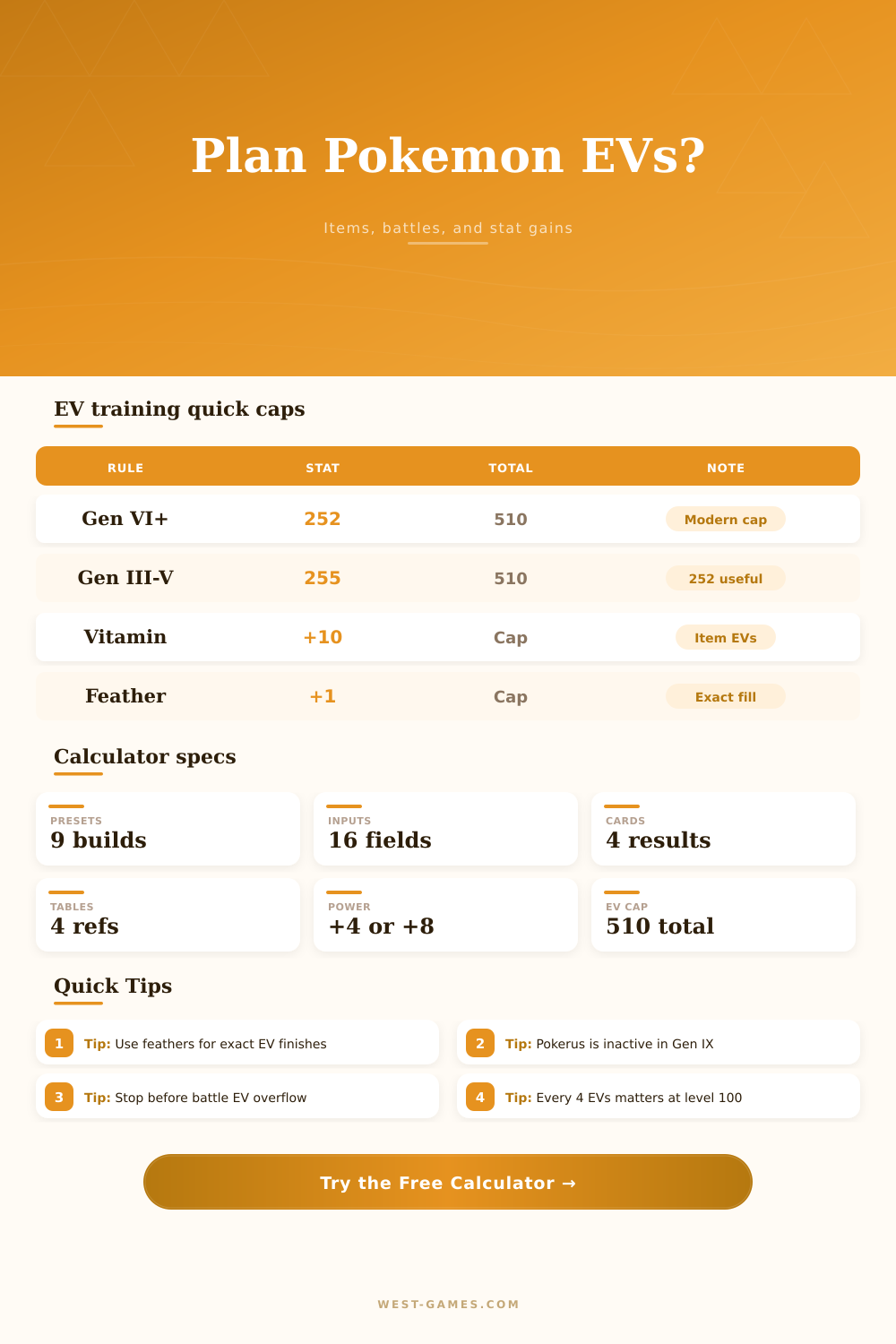
Nowadays, you get 252 EVs in each stat which makes things easier (as opposed to the old system when you could get up to 255, but stats only increased every four EVs). So you have 6 stats with 510 EVs that need to be spread out among them. That’s enough to boost two stats to maximum and leave six spare for boosting a third one. However, those extra points aren’t huge so most people focuses on two main attributes.
Here’s how the feather/vitamin distribution fits into this new scheme:
Vitamins work fast. They give 10 EVs each with no cap on their respective stat, which is handy if you’re trying to max out one of your stats quickly. Vitamins take up resources and time to obtain but if you have them, using them first makes the rest of your training predictable.
Feathers also grant 1 EV per feather. Unlike vitamins, feathers allow you to be precise with your stat boosts which makes it easy to hit exact values such as 196, without overshooting. This is important in competitive play. Tiny stat differences can mean the difference between attacking first or being attacked first.
The best way to get EVs for free is by battling. How much you will get varies depending on what items you have, as well as who you are fighting. An example of an item is a Power item which adds eight EVs to one stat. There’s also the Macho Brace which will double your gains.
These multipliers is considered in the calculator. It can tell you how many times you’ll have to win until you reach your desired EVs.
In Scarlet and Violet, there is no more Pokerus. You won’t be able to double your stats from an infection anymore so you will have to rely solely on items and lots of battles. This will change your training duration.
In the short term, there’s no immediate gain from stat increases. Level 100 requires four EVs per stat point. For levels under 100, stat increases are concealed until they round up. You may be getting EVs for a stat but the stat won’t show an increase below level 50.
Since the tool predicts eventual stat based off nature, IVs and base stats, check your nature and IVs early so you don’t waste time on penalized stats.
The EV training is predictable (and it has a result). There is no randomness like in damage calculations. If you understand the rules, you can plan out how to win.
That’s where the calculator takes away the planning struggle. Auto-battle or SOS battles, it doesn’t matter, you know what you need so you can just execute the battle. When you reach the number, then you’re done fighting. And that sort of discipline is what separates a good team from a great one.
EV training is all about managing limited resources. You only have so many EV caps, so much time, so many items. Without planning ahead, you’ll spread out those EVs too thin. By mapping out your needs before you start, you avoid spreading your EVs too thin and learn to prioritize what actualy wins fights.
You’ll become more precise and patient as it rewards you for your forward-thinking. When you know exactly what you’re working towards, the grind becomes less tiresome. Everything lines up; the stats gets better; the battle outcomes confirm your planning.
You should of planned ahead to avoid mistakes.