♟ FIDE Elo Calculator
Estimate FIDE rating change from current rating, opponent ratings, result score, age-based K-factor, rating-period games, expected score, and performance rating.
| Player status | Base K | Main condition | Cap check |
|---|---|---|---|
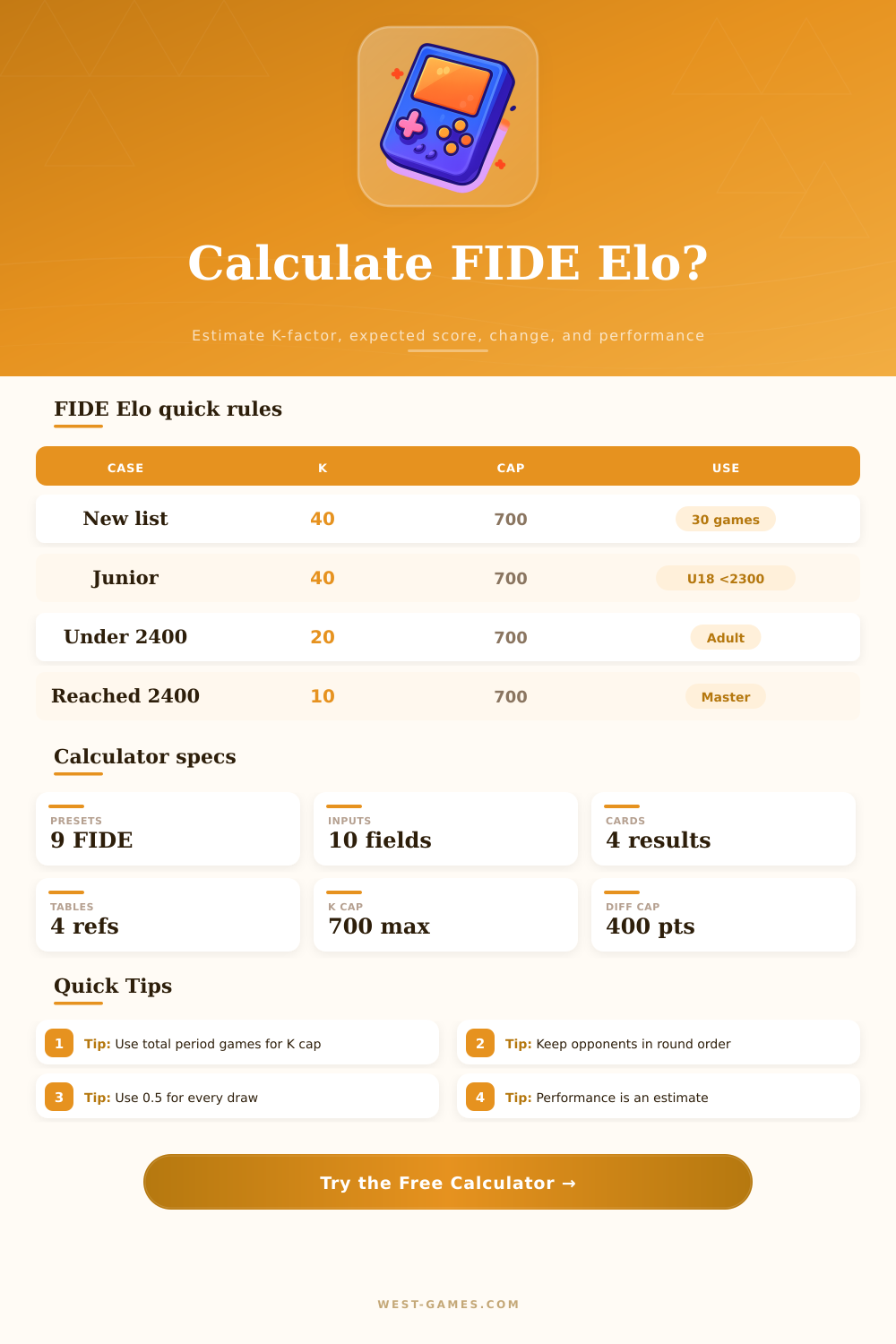
| New to rating list | 40 | Until at least 30 games completed | K x n not above 700 |
| Junior developing player | 40 | Until end of year of 18th birthday and below 2300 | K x n not above 700 |
| Established player | 20 | Rating remains below 2400 | K x n not above 700 |
| Reached 2400 before | 10 | Permanent after published 2400 | K x n not above 700 |
Use the total rated games in the rating period for the cap, because FIDE caps K times period games at 700.
| Entry | Score | Chess result | Rating impact |
|---|---|---|---|
| W or 1 | 1.0 | Win | Above expected gains |
| D or 0.5 | 0.5 | Draw | Depends on opponent |
| L or 0 | 0.0 | Loss | Below expected loses |
| Blank result | Manual | Override score | Uses total only |
For a clean breakdown, keep each result aligned with the opponent rating in the same round order.
| Rating gap | Higher expected | Lower expected | Planning meaning |
|---|---|---|---|
| 0 | 0.50 | 0.50 | Even pairing |
| 100 | 0.64 | 0.36 | Clear favorite |
| 200 | 0.76 | 0.24 | Strong favorite |
| 400 | 0.91 | 0.09 | Large mismatch |
The calculator uses an Elo-style probability curve and applies the selected FIDE rating-difference cap.
| Score percent | Performance sign | Usefulness | Watch point |
|---|---|---|---|
| Below 35% | Under field | Flags tough event | Small samples swing |
| 50% | Near average | Stable benchmark | Pairing mix matters |
| 65% to 75% | Strong event | Norm-style signal | Opponent spread matters |
| 85% plus | Dominant | High performance | May be capped by field |
Performance rating is a practical estimate; official tournament reports and norm rules may use stricter definitions.
Half the game of chess is what happens on the board. The other half is the rating system that measures how well you’re playing and how that math affects your preparation between tournament. Your FIDE Elo isn’t just a badge of honor; it’s a living number that change with each game you play.
The calculator above take all those complex probability curves into account after you plug in your position and opponent information. It frees you to concentrate on the strategy behind each outcome without having to remember any formulas yourself. But here’s what it comes down to: Expectation. Before the game starts, the system knows approximately how many points you are expected to get based off the difference between your rating and your opponent’s. You beat somebody way below your level? That wasn’t unexpected, so you don’t gain much. You perform better or worse than they expected? That’s where the rubber meets the road.
How to Use the Chess Rating Calculator
A 50 percent result doesn’t necessarily mean there is no change at all in your rating. Who were they playing? Depending on the competition, a half-score can increase your rating (when matched up against a horde of grandmasters) or lower it (against lesser competition). By considering all that nuance, the tool first figure out what it expects you to get and how close you came to meeting that standard.
The second element to consider here is the K-factor; think of it as volatility dial in your rating system. Because we don’t yet know what junior players and newcomers to the game are truly capable of, they receives a higher coefficient (their ratings adjust more quickly to reflect their actual skill level). Players rated below 2400 with established ratings is on a more moderate setting, and those who’ve crossed over to master level are set to a slower adjustment rate. That ensures that once you reach a high level, your rating won’t bounce around all willy-nilly based on one bad tournament.
The page’s reference tables break these categories down well, so you can get a sense of where you fit and why your rating may be feeling a bit sticky when compared to the rapid rise of some teenage newcomer. It is a small detail but it is worth understanding when you wonder if your last loss was just luck or if it means you are entering a slump.
Beyond the raw points, there’s also a performance rating. That number attempt to gauge how well you played in the context of the event. Did you beat up on a weak field? Or was it a really good showing despite having a lower Elo? Having a high performance rating with a weak field may indicate you’re prepared for stiffer competition. If you had a low performance rating facing a strong group, you held your own relative to the score, even though it wasn’t reflected in your Elo. That difference can show the gap between competence and confidence. Losing some games but feeling like you’re playing above what you are now can be an encouraging sign heading into next time.
So the calculator spits out that guess to give you something to reflect back upon and maybe help explain the result, something that captures how you played instead of how you did. You should of used it more often.
Be disciplined when entering your data. There are separate systems for blitz, rapid, and standard opponent ratings. Enter the right one. Garbage data in = … well, you get it. Be truthful with your results. Losses and draws carry significant weight. Deviations from expectations is included in the system. One upset victory over a highly seeded player might mean more than three expected losses.
The interface makes it simple to enter the details, but understanding how to interpret the results is what matters. Don’t get hung up on swing tournaments. Examine the trend line across multiple events. Everyone experiences rating inflation and rating deflation; so pay attention to relative performance instead of an absolute number. A 200 point increase doesn’t mean the same thing in different regions of play or at different times. Use the tool to track your own trajectory against comparable field.
This way, the tool can show you how you are doing compared to others on the field, or in comparison to where YOU started from. The math works as long as you stay within that frame of reference. Feed it good data and learn to read what it gives you with a bit of caution. Your rating is not the game but a map of the game. Play the chess, not the number.