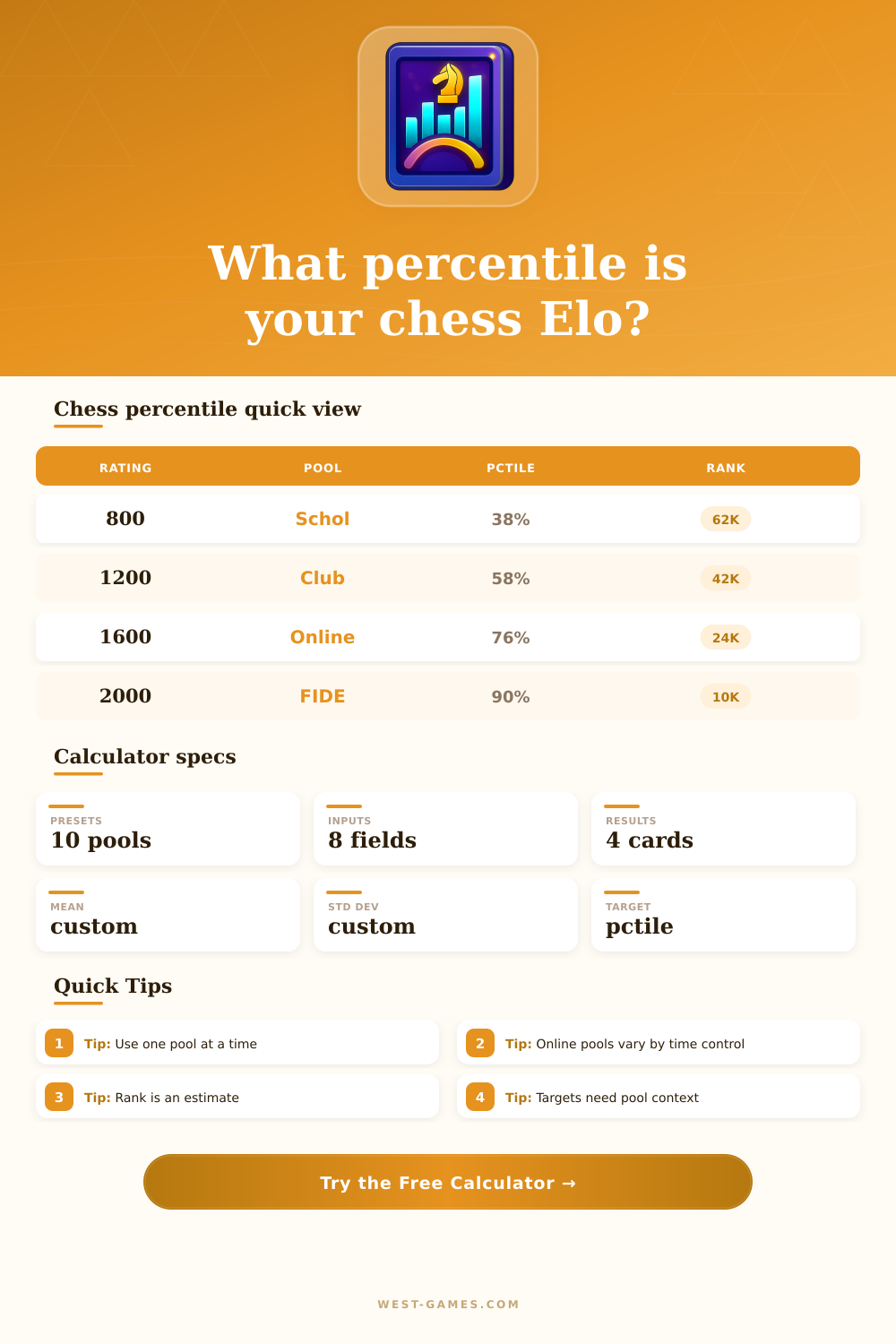
♟ Chess Elo Percentile Calculator
Estimate where a chess rating sits inside a selected OTB or online pool, including percentile, z-score, estimated rank, and rating needed for a target percentile.
| Comparison pool | Mean | Std dev | Percentile | Top share | Target gain |
|---|---|---|---|---|---|
| FIDE Open Classical | 1450 | 350 | 66.6% | 33.4% | +299 |
This grid keeps your entered rating and target percentile, then swaps only the pool assumptions. It is useful for seeing why online, scholastic, and OTB percentiles should not be mixed.
| Preset | Mean | Std dev | Pool size |
|---|---|---|---|
| FIDE Open Classical | 1450 | 350 | 100000 |
| USCF Weekend Adult | 1350 | 360 | 85000 |
| Chess.com Rapid Active | 950 | 410 | 12000000 |
| Chess.com Blitz Active | 820 | 390 | 18000000 |
| Lichess Blitz Active | 1500 | 300 | 5000000 |
| Club Championship | 1550 | 260 | 64 |
Preset numbers are practical modeling defaults, not official rating-list percentiles.
| Percentile | Z-score | Top share | Meaning |
|---|---|---|---|
| 50th | 0.00 | 50% | Middle of pool |
| 68th | 0.47 | 32% | Above average |
| 84th | 1.00 | 16% | One std dev up |
| 90th | 1.28 | 10% | Strong section score |
| 95th | 1.64 | 5% | Elite local result |
| 99th | 2.33 | 1% | Top cohort rating |
A z-score tells how many standard deviations the rating is above or below the pool mean.
| Category | Best use | Typical spread | Caution |
|---|---|---|---|
| FIDE classical | OTB adults | Wide | Inactive lists skew high |
| USCF regular | Weekend events | Wide | Kids improve quickly |
| Online rapid | Long online games | Very wide | Site systems differ |
| Online blitz | Fast pool standing | Wide | Time control matters |
| Scholastic | School sections | Uneven | Age group matters |
Do not compare raw ratings across platforms unless the rating systems and player pools are aligned.
| Band | Club view | Online view | Percentile clue |
|---|---|---|---|
| Under 800 | New tournament player | Learning tactics | Depends on pool |
| 800 to 1199 | Developing player | Common rapid range | Mean-sensitive |
| 1200 to 1599 | Club competitor | Solid online player | Often above average |
| 1600 to 1999 | Strong club player | High casual rating | Usually upper pool |
| 2000 plus | Expert or master path | Advanced cohort | Tail estimate |
The same Elo can mean different things depending on whether the pool is scholastic, club, national, or online.
| Preset | What it compares | Default target | Good question |
|---|---|---|---|
| FIDE Open Classical | Adult OTB classical list | 90th percentile | How strong is my tournament rating? |
| Chess.com Rapid Active | Large online rapid population | 85th percentile | Where does my rapid rating land? |
| Lichess Blitz Active | Higher-centered blitz pool | 85th percentile | Is this blitz rating above the active pack? |
| National Master Chase | Strong cohort near expert/master | 75th percentile | How far from master-level peers? |
| Scholastic Beginner | Youth beginner event section | 80th percentile | What score range stands out in a school pool? |
Use the custom fields when a tournament director, coach, league site, or export gives a better mean and spread.
A 1600 rating are a number that expresses a persons skill level in chess. However, the rating is difficultly to understand unless you know how it compare to other players with the same rating. Many players uses percentile tools to compare their rating to others in a specific group.
That specific group change depending on the rating format. For instance, a tournament may have a different group of player than an online rapid server. To understand the percentile results, a person must understand the mathematic inputs.
How a 1600 Chess Rating Compares to Other Players
The mean represent the average skill level of players in the group. The standard deviation calculate how spread out players’ ratings are from the mean. If the standard deviation is high, then a 1600 rating is spread out over many different skill levels in the group because the group may contain beginner and experts.
Another mathematical figure to consider is the number of players in the player pool. The size of the player pool can impact the estimation of a persons rank in the group of player. The percentile calculator can carry out mathematical operation when a player enter a preset or their rating.
The calculator assume that the group of players has a normal distribution. Based off the skill of the players in the group, the percentile calculator can provide a percentile rank, a z-score, an approximate rank in the player pool, and the target or desired rating for that player. The reference tables include the assumptions behind each preset to help players understand why the same 1600 chess rating return different percentile on different platforms.
Another very important factor to consider for each player is the size and make of the comparison pool. A 1600 rating on an online blitz server may compare higher than another 1600 rating on classical over the board chess events. This is due to the number of casual player on blitz servers.
A 1600 rating in the scholastic section of the tournament may compare higher than a 1600 in an adult chess club due to the lower mean rating of scholastic player. The z-score show the distance between a persons rating and the mean of all players’ ratings in a group. The z-score allow a player to compare their rating to another time period using the same format of game.
For instance, the distance between a z-score of 0.4 and 0.9 is a greater measurement of distance than a percentile rating of 66 to 82, even though both percentile shows the same change in skill level. This is due to the change in the player pool over time. The limitation of rank and percentile estimate should be noted.
The estimation of rank assume that the player pool is stable and that every player is active in the same way. These assumption may be incorrect. However, even with these flaw, a player can use the rank estimate to determine if their desired rating is worth pursue in their current league or rating server.
Target planning is a method that player can use to determine how to achieve their desired rating. By entering the desired gain in a player’s rating per month, the target rating planner will provide a player with a timeline to achieve that desired monthly gain. While high speed in gaining a player’s rating are enticing, the best way to gain the highest number of rating point is to focus on consistency over speed in gaining those points.
Finally, each percentile is a snapshot of a population at a specific time. A percentile rank is not permanent and can change based on the change in the player pool. Thus, every time a player change chess server or formats, the inputs should be updated.
Additionally, the statistic of a players current league may change, so the inputs must also be updated to remain reflective of the actual player pool.