Ashes of Creation Character Planner
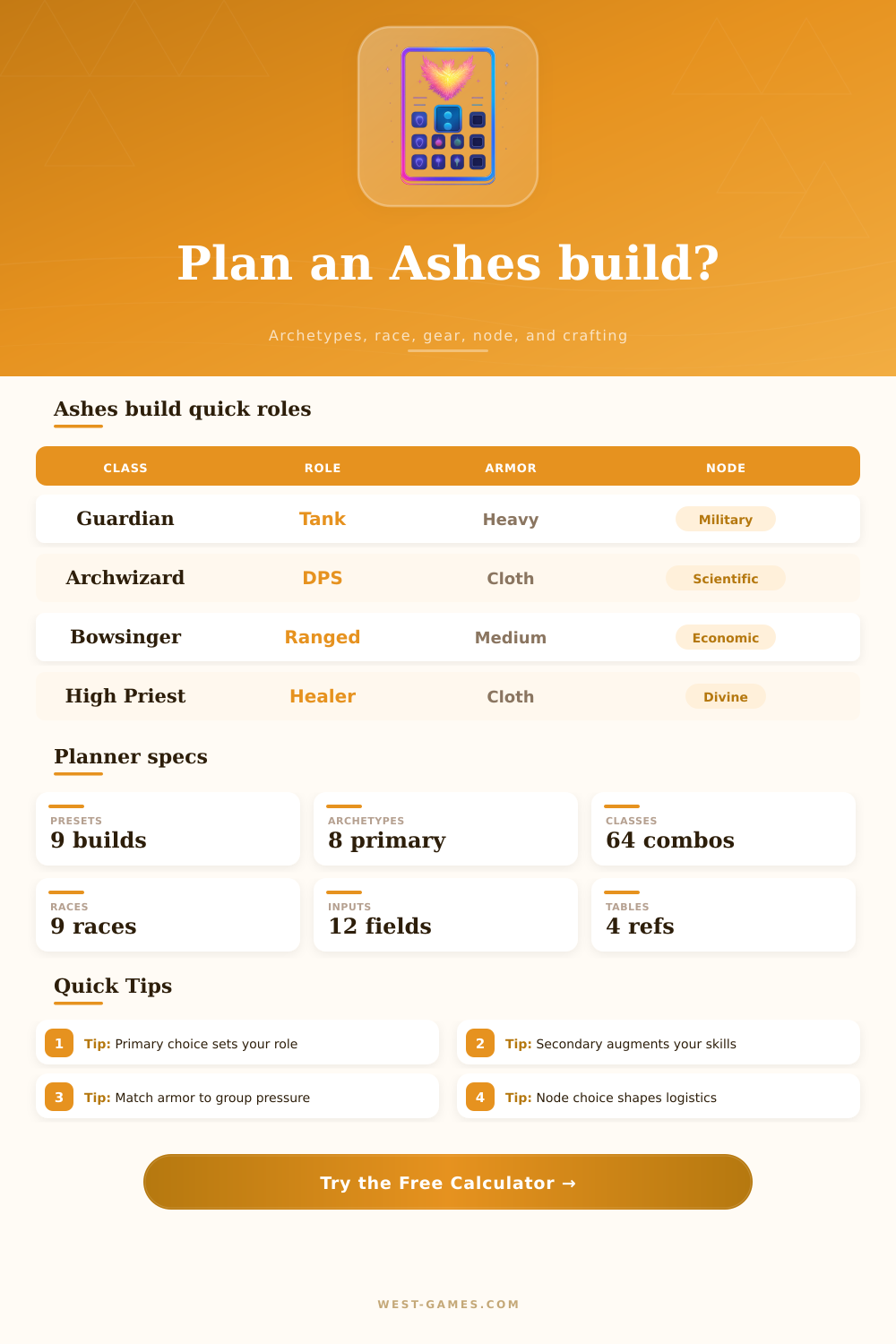
Plan a Verra build by combining primary archetype, secondary augment, race, role, weapons, armor, group target, node focus, and artisan synergy.
Formula Breakdown
Role Core
Tank and Cleric primaries receive the strongest scores for main tank and healer duties. Bard gains support value, while Fighter, Ranger, Rogue, Mage, and Summoner push damage or flex pressure.
Augment Logic
Secondary archetype adds 4 to 12 points depending on whether it reinforces the chosen role, improves utility, or creates a durable hybrid. Same-primary combinations get reliable identity bonuses.
Civic Fit
Node and artisan scores reward practical loops: armor crafters near frontlines, scribes and alchemists near research hubs, and caravan-ready weapon or mount paths near trade nodes.
| Primary | Best role | Planner strengths | Common secondary goals |
|---|---|---|---|
| Tank | Main tank | Threat, mitigation, group protection, disruption | Tank for Guardian, Cleric for Paladin, Bard for Argent |
| Cleric | Healer | Recovery, cleanse, party sustain, divine utility | Cleric for High Priest, Tank for Apostle, Summoner for Shaman |
| Bard | Support | Buff rhythm, debuff coverage, morale tools | Bard for Minstrel, Ranger for Song Warden, Cleric for Soul Weaver |
| Fighter | Melee DPS | Momentum, cleave pressure, gap closing, weapon uptime | Mage for Spellsword, Rogue for Shadowblade, Cleric for Highsword |
| Ranger | Ranged DPS | Kiting, tracking, ranged pressure, target control | Bard for Bowsinger, Cleric for Soulbow, Ranger for Hawkeye |
| Mage | Ranged DPS | Area pressure, control zones, elemental burst | Mage for Archwizard, Rogue for Shadow Caster, Summoner for Warlock |
| Rogue | Melee DPS | Stealth, burst windows, flanking, escape play | Rogue for Assassin, Mage for Nightspell, Bard for Charlatan |
| Summoner | Hybrid | Pet pressure, flexible utility, group adaptation | Cleric for Necromancer, Summoner for Conjurer, Ranger for Beast Master |
| Race | Planner flavor | Best-fit plans | Synergy note |
|---|---|---|---|
| Kaelar | Human empire builder | Military, tank, fighter, node leadership | Scores civic builds and disciplined frontliners. |
| Vaelune | Human trade culture | Economic, caravan, support, healer | Scores trade escorts and social utility. |
| Empyrean | Structured Pyrian elf | Mage, scribe, scientific node | Scores spell and research-heavy paths. |
| Py'Rai | Nature-attuned Pyrian elf | Ranger, hunting, animal husbandry | Scores scouting, ranged, and wilderness loops. |
| Dünir | Dünzenkell mountain dwarf | Heavy armor, armorsmithing, tank | Scores sturdy armor and forge planning. |
| Nikúa | Coastal Dünzenkell dwarf | Caravan, ranged, leatherworking | Scores mobile routes and practical gear loops. |
| Ren'Kai | Disciplined Kaivek orc | Fighter, tank, melee pressure | Scores physical stat and frontline builds. |
| Vek | Stargazing Kaivek orc | Summoner, mage, divine or scientific | Scores magic, ritual, and analytical plans. |
| Tulnar | Underrealm survivor | Rogue, hybrid, high-risk roaming | Scores ambush routes and adaptable builds. |
| Package | Best role | Armor fit | Planner bonus |
|---|---|---|---|
| Shield and mace | Main tank, Paladin, Argent | Heavy | Survival and role fit bonus for Tank primaries. |
| Greatsword | Fighter pressure, node war bruiser | Heavy or Medium | Damage bonus when Strength or Constitution is prioritized. |
| Dual swords | Fighter or Rogue skirmisher | Medium | Pressure bonus for melee DPS and small party PvP. |
| Longbow | Ranger, scout, caravan overwatch | Medium or Light | Ranged readiness bonus for Ranger and Dexterity builds. |
| Daggers | Rogue, Shadowblade, ambusher | Light | Burst and risk-tolerance bonus in contested routes. |
| Wand and focus | Mage, Cleric, Summoner | Cloth or Light | Spell or heal throughput bonus for mental stats. |
| Staff | Archwizard, High Priest, Necromancer | Cloth | Large-group control and sustain bonus. |
| Instrument and rapier | Bard support, Bowsinger, Soul Weaver | Light or Medium | Support uptime and utility bonus for Charisma paths. |
| Node focus | Best content target | Artisan pairings | Planner use |
|---|---|---|---|
| Military | Node war, castle siege, small party PvP | Weaponsmithing, Armorsmithing, Leatherworking | Raises combat logistics for frontliners and PvP groups. |
| Economic | Caravan escort, trade loops, open-world routing | Animal Husbandry, Jewel Cutting, Weaponsmithing | Raises mobility, escort, and trading support scores. |
| Scientific | Dungeon 8-player, raid prep, artisan hubs | Scribe, Alchemy, Tailoring | Raises research, crafting station, and caster planning scores. |
| Divine | Raid 40-player, recovery groups, temple play | Alchemy, Scribe, Armorsmithing | Raises healer, support, sustain, and recovery scores. |
| Result | Formula | Main inputs | Interpretation |
|---|---|---|---|
| Role Fit | Primary role base + secondary role bonus + gear bonus + stat bonus | Primary, secondary, role, weapon, armor, stats | How naturally the build fills the selected group job. |
| Combat Readiness | (Survival x 0.45) + (Pressure x 0.35) + (Utility x 0.20) | Archetypes, armor, weapon, content, party size | Readiness for the selected fight scale and risk level. |
| Node and Craft | Node match + artisan match + race flavor + content logistics | Node, artisan, race, role, group target | How well the civic plan supports the character loop. |
| Breakdown | Each visible row lists the exact sub-score used | All selected fields | Use it to spot the weakest part of the plan. |
Choosing a character in Ashes of Creation requires the consideration of various factor. You must consider the effect that each of these factors has upon the others. Each of these factors includes your archetype, your race, your weapons, and your civic plan.
Each of these factors interact with each of the other factors. A planning tool can help you to understanding how each of these factors interact with each other. The input for the planning tool includes your primary archetype, your secondary archetypes, your race, your node focus, and your artisan skill.
How to Plan Your Character in Ashes of Creation
Each of these factors is important to understanding how your character will interact with the other factors. Your primary archetype is the foundation of your character. Your primary archetype determines what types of contribution that your character will make to the groups that you fight in.
Your secondary archetypes will influence your primary archetype. Your secondary archetypes will determine if you are taking an archetype that focus upon dealing damage to enemies, utilizing useful abilities for your allies or both. Your race will influence your nodes and artisan skill.
Your node focus and artisan skills will influence the way that you spend your time while you are not fighting enemies. Your services in the game will rely upon your character to perform specific task. The calculator will mathematically calculate the impact of each of your choice.
The calculator will calculate a score regarding how well your character will fit into the role that you want it to have, how ready your character will be for the types of combat that you will encounter, and how well your civic plan will work with the activities that you will perform daily. These scores will not give you a best build for your character. However, they will allow you to understand where friction may occur in your build.
A high role fit score will indicate that your weapon, armor, and stats support your primary contribution to the group. A low combat readiness score indicate that your character may not have any survival capabilities against the types of enemies that you have selected for your character to fight. A low node and craft score will indicate that you will have to travel a long distance to access the services that you require due to your chosen artisan.
Many players may become frustrated by attempting to balance two factor of the game at once. For instance, if you choose to build a tank with heavy armor but also choose a scientific node and a scribe artisan, the type of armor that you are required to wear for defense will require your character to travel long distances between services. The same is true for a cloth caster that chooses the military node and the weaponsmithing artisan.
The planning tool will allow you to see these frustrations in advance so that you can avoid building these types of characters. The reference tables on the planning tool contain information that will help you understand each of the interactions between the factors of your game. The reference tables include information about which archetypes has a tendency to contribute to specific roles in the group.
The reference tables indicate which weapons will work best with which armor weights. The reference tables also indicate which artisan skills will be rewarded for selecting specific nodes. You dont need to remember all of the information in the reference tables.
However, if your selections for your game are different than what is represented in the tables, then you may experience problems within your game. One of the most common mistakes that people make is to treat their secondary archetypes as though they are a second complete kit for your character. The game will not provide you with two complete kits.
You do not get two complete hotbars for your character. You will only get one kit and your secondary archetypes will only provide an enhancement to that kit. The planner will score your second archetype lower than your primary because it is only an enhancement and not a second complete kit.
Thus, if you expect your second archetypes to provide half of your character’s abilities, you will be disappointed. Another of the most common mistakes is to ignore your party size when you are selecting your risk level. If you are building your character to compete in small parties in PvP mode, the requirements for your build will differ from if you want to compete in 40 player raids.
Choosing a build that is created for small parties but wanting to compete in 40 player raids will result in a lower score in the combat readiness portion of the planner. The planner will not prevent you from choosing this, but it will show the trade-off that you are making. Finally, there are some aspects of the game that the planning tool does not account for.
For instance, the sieges of those nodes may change the nodes in the game. Economic nodes can change based upon the routes for trading items. Additionally, some nodes provide healing abilities that may be more beneficial if you have many healers in your group.
These variables outside of the planning tool may change a sound plan into a potential headache. However, the purpose of the planning tool will help you to decide which trade-offs are acceptable to you.