🎮 Parallel XP Calculator
Compare multiple simultaneous skills, cards, companions, weapons, classes, or tracks with XP split modes, active and passive gain, catch-up modifiers, target tiers, session allocation, and bottleneck timing.
| Track | Current | Share | Session XP | Remaining | Projected |
|---|---|---|---|---|---|
| Calculate to fill the allocation table. | |||||
| Tier | Total XP | Next gap | Use case |
|---|---|---|---|
| 1 | 1,000 | 1,500 | Intro unlock |
| 2 | 2,500 | 2,500 | Basic perk |
| 3 | 5,000 | 4,000 | Stable route |
| 4 | 9,000 | 6,000 | Build shaping |
| 5 | 15,000 | 8,000 | Mid grind |
| 6 | 23,000 | 11,000 | Role online |
| 7 | 34,000 | 14,000 | High demand |
| 8 | 48,000 | 18,000 | Late grind |
| 9 | 66,000 | 22,000 | Near cap |
| 10 | 88,000 | Cap | Complete |
| Source | Control | Split impact | Planner note |
|---|---|---|---|
| Active play | High | Mode-based | Best for focus plans |
| Passive gain | Low | Often even | Raises all lanes slowly |
| Catch-up buff | Medium | Dynamic | Pulls weak tracks closer |
| Event boost | High | Global | Multiplies the pool |
| Downtime | Medium | Global loss | Reduces practical XP |
| Mode | Rule | Strength | Weakness |
|---|---|---|---|
| Even split | Same share | Simple balance | Ignores urgency |
| Primary focus | Track 1 share | Fast one lane | Creates gaps |
| Priority weighted | Manual weights | Role control | Needs tuning |
| Catch-up rotation | Gap adjusted | Closes deficits | Less burst |
| Signal | Meaning | Adjust | Expected effect |
|---|---|---|---|
| High ETA | Bottleneck | Raise priority | Lower all-target time |
| Low coverage | Big gap | Extend session | More tier movement |
| High surplus | Overfilled lane | Lower share | Less wasted XP |
| Passive heavy | Slow trickle | Use even split | Cleaner progress |
| Preset | Progression style | Best when | Main bottleneck |
|---|---|---|---|
| Balanced Squad Tracks | Four lanes near target | No single urgent unlock | Total session time |
| Main Carry Rush | Primary lane heavy | One track unlocks power | Support lanes |
| Crafting Catch-Up | Weak lane recovery | Profession trails combat | Old tier gap |
| Card Collection Set | Set bonuses in parallel | Several cards need tiers | Lowest card |
| Weapon Rotation Night | Rotating equipment XP | Testing multiple builds | Uneven priorities |
| Idle Party Progress | Passive-heavy leveling | Background gains matter | Low active XP |
| Raid Role Allocation | Role weighted progress | Tank, healer, damage split | Role mismatch |
| Season Track Sprint | Event boosted session | Temporary multiplier active | Downtime penalty |
| Alt Account Recovery | Strong catch-up modifier | Several tracks behind | Old progression debt |
It begins when you create a character that feels awesome, but then you look up and find there are another ten systems to pay attention to. Before long, the main tank is still on tier three, while the secondary weapon become a novelty and crafting skill gets ignored. That’s the progress-trap where enthusiasm outpace resource management.
One way to turn that chaos into clarity: Use our parallel XP calculator (above) to see where your time actualy goes. By comparing four different paths simultaneously, it’ll show you exactly what lane is slowing entire party down to next milestone… Stripping away guesswork.
Turn Your Grind Into a Plan
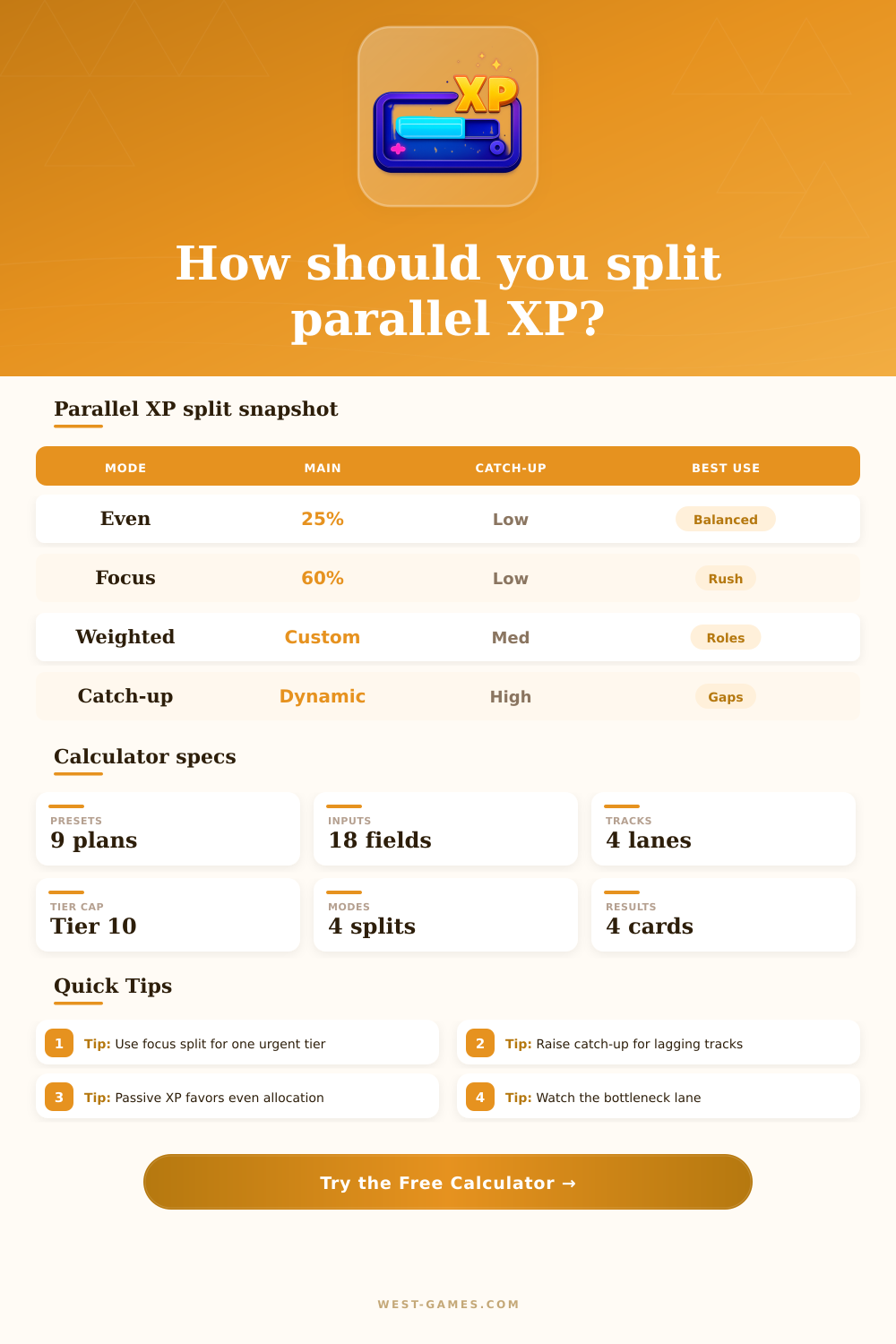
There’s a fundamental tradeoff in most multi-track systems: Do you want to be broad or deep? Do you want to spread out knowledge across skill so they’re all just okay, or do you want to have one really good thing going on? That’s a question you can test with the split modes of the tool.
If you go “even” then it keeps things well-balanced and slow; if you pick “focus” you can dump resources into one lane and unlock its urgent perks fast. There’s also a “weighted” mode that lets you manually control what matters more, so you can favor the roles that best suit your current raid build. Each mode will show you something different about how you spend your time and what that mean for your power gains.
One important detail: It’s critical that you tell the difference between passive and active gains, because they’ll behave very differently in pool. Your active gains is things you’ve done directly, crafted something yourself, ran a dungeon, etc. These are your deliberate actions. Your passive gains are those little bits of progress that drip down while you’re offline or sitting doing nothing, usually spreading them out evenly over every track.
The calculator break up these flows so you can identify what portion of each skill is due to manual grinding vs. It builds up automatically. If you have good passive income, then you can be more discerning about when you choose to do active stuff; the background stream will ensure that underused skill don’t get too far off the wagon.
Another dimension of strategy that lots of people don’t consider is catch-up mechanics. Some of these systems will adjust their gain rates automatically to compensate for the fact that one particular track might be well-behind its target tier. To model this in the calculator, I added a catch-up strength slider, which allows you to crank it up and observe how aggressively the system will compensate for weaker lanes without robbing from your top priority.
This is helpful if you want to know if the game is “kind” enough to let you get away with ignoring certain things for now, especially if you’re on an old account where you’ve not paid attention to your skills before. This is also helpful if there is a new expansion and you decide to ignore certain tracks that used to be lower than they are now.
That said, the most useful output is probably the bottleneck one which tell you what’s holding you back the most. Sure, you might have three tracks nearly at their ideal tier, but that fourth one will dictate just how quickly you’ll be able to make use of that sweet bonus build or set.
This is why the reference table on the page is so helpful, it shows generic tier curves so that you can see how much XP it take exponentially as you level up. It’s not linear! Each jump-up requires far more effort than previous ones. Understanding this is key to avoiding disappointment when you feel like you’re stuck in “stall-mode” around certain later tiers. Instead of expecting a big burst of increased gains, you understands the reality. You adjust your expectations to match, either by increasing your session time or adjusting your uptime.
In other words: parallel leveling comes down to making tradeoffs; not finding the perfect balance between everything. No matter how much time you spend playing, there’s no practical way to do so while maxing out in all lanes at once. By putting numbers to your time investment, however, the calculator lets you weigh your priorities logically and make informed sacrifices.
If you know for sure that one track is dragging your overall progress down, you’ll either want to spend more time there, or you’ll realize it will always be second-place material. But either choice means you’re playing with purpose, as opposed to blindly moving from screen to screen, hoping that something finally levels up before you fall asleep.
And that’s why a grind becomes a plan.
You should of known the difficulty would be higher.