🏃 Agility XP Calculator
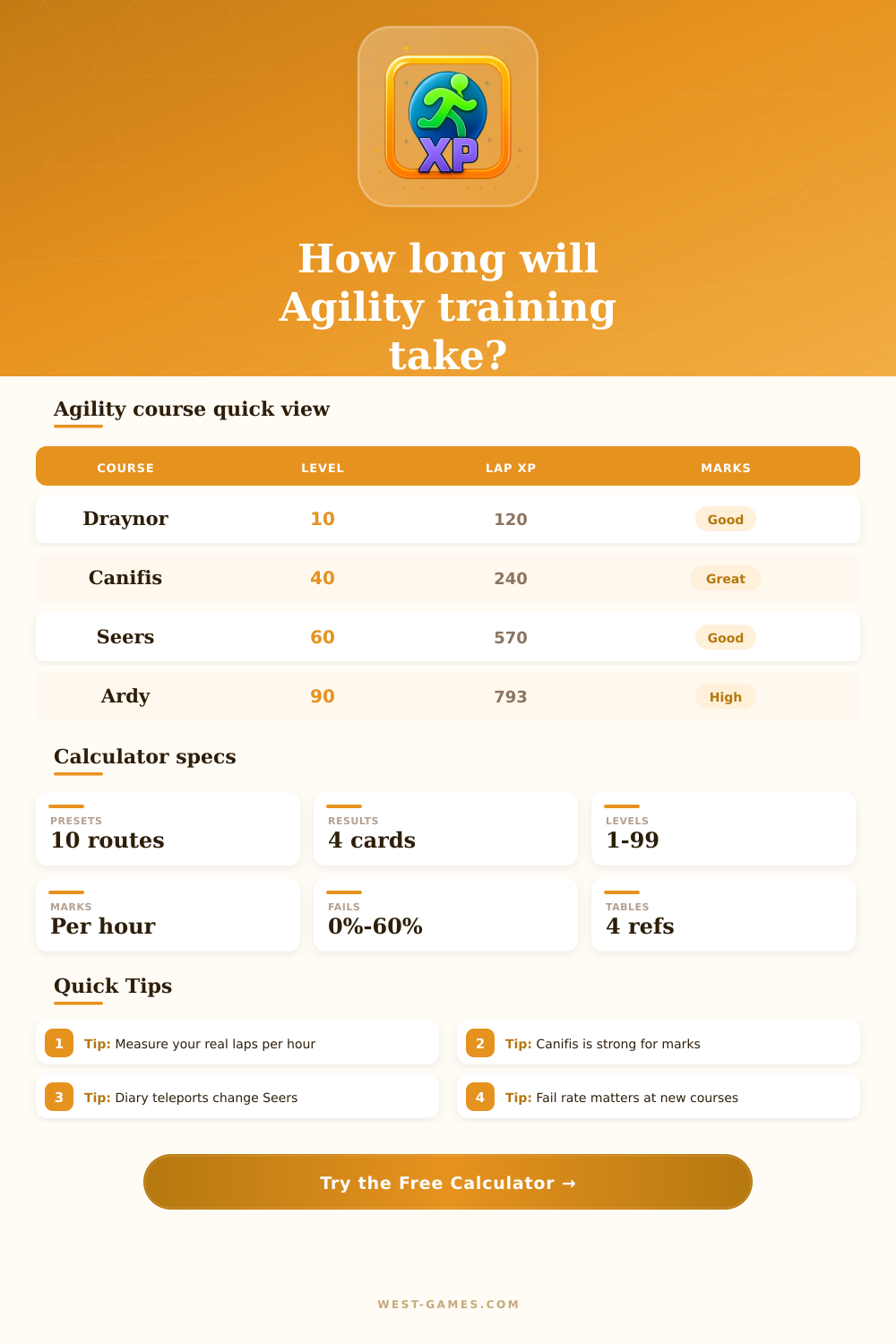
Estimate OSRS-style Agility training by course route, current and target level, lap XP, laps per hour, mark rate, fail rate, stamina use, and shortcut modifiers.
Compares this route to common rooftop training speeds.
Rates how useful the route is for marks of grace.
Shows whether obstacle failures are meaningfully slowing the plan.
Checks whether your planned session makes visible progress.
| Course | Req | Lap XP | Typical use |
|---|---|---|---|
| Gnome Stronghold | 1 | 86.5 | Starter laps before rooftops |
| Draynor rooftop | 10 | 120 | First marks of grace route |
| Al Kharid rooftop | 20 | 180 | Low-level rooftop alternative |
| Varrock rooftop | 30 | 238 | Bridge to Canifis |
| Canifis rooftop | 40 | 240 | Popular mark farming route |
| Falador rooftop | 50 | 440 | Higher lap XP before Seers |
Lap XP presets are course-completion values; practical XP per hour depends on laps, fails, and route modifiers.
| Course | Req | Lap XP | Typical use |
|---|---|---|---|
| Seers Village rooftop | 60 | 570 | Strong with bank teleport |
| Pollnivneach rooftop | 70 | 890 | Good XP but more active |
| Rellekka rooftop | 80 | 780 | Late-game mark route |
| Ardougne rooftop | 90 | 793 | High marks and steady XP |
| Custom obstacle route | Any | Manual | Use for shortcuts or leagues |
Seers can change dramatically when a teleport or diary route shortens the lap.
| Route type | Mark behavior | Planning value | Calculator cue |
|---|---|---|---|
| Non-rooftop course | No marks | 0 per hour | Set mark rate to 0 |
| Low rooftops | Steady marks | Useful early Graceful progress | Draynor to Varrock |
| Canifis rooftop | Very strong | Often 15 to 18 per hour | Marks focus friendly |
| Overleveled rooftops | Usually reduced | Use the 20+ option | Mark score drops |
| Ardougne elite | Boosted marks | Use diary boost option | Target marks rise |
| Input | Low value | High value | What it changes |
|---|---|---|---|
| Fail rate | 0% to 3% | 15%+ | Completion XP and time |
| Stamina modifier | -10% | 5% to 12% | Movement uptime |
| Shortcut modifier | -15% | 8% to 18% | Lap speed after unlocks |
| Bonus XP | 0% | 50%+ | XP per completed lap |
| Session length | 0.5 hr | 4+ hr | Session XP and marks |
| Route | Strength | Weakness | Best calculator signal |
|---|---|---|---|
| Fast early rooftops | Simple clicks and early marks | Low XP per lap | Short target levels and steady marks |
| Canifis mark route | Excellent Graceful progress | XP per lap stays modest | High mark score, medium XP pace |
| Seers teleport route | Strong XP with smooth laps | Requires teleport setup | High shortcut modifier and XP pace |
| Pollnivneach push | Large XP per lap | More attention and fail risk | Good pace if fail pressure is low |
| Ardougne finish | Stable late marks and XP | Very high requirement | Strong marks and low fail pressure |
This planner is OSRS-style and editable. It does not replace in-game timing; use it to compare route assumptions before committing to a long grind.
At level 40, with a clear head, you begin running laps at a reasonable pace. You can handle Canifis Rooftop and before long you’re clicking on each obstacle and raking in your marks of grace. It’s feeling productive; those experience number are ticking up.
By the time you reach level 60, however, something changes: The course starts picking up speed relative to how fast you move. Marks aren’t dropping as frequently, and what once seemed like a solid strategy (that hourly rate) starts to feel more like a trap. You’ve reached the Agility plateau… Where math take over and intuition falls short.
How to Plan Your Agility Training
After plugging in your real-world performance data, the calculator above do all the work. You might remember watching some tutorial videos or guessing at how many laps an hour you can pull off, but the truth is that you will almost certainly be worse. Your hand will start getting tire, you’ll start forgetting to drink stamina potions and your clicks will become sloppy.
The calculator allows you to account for those real world frictions by allowing you to enter a stamina modifier and a fail rate. That little bit of percentage difference in missed obstacle adds up fast. Missed a 5% on one lap? No big deal. But 5% over two months of grinding? Looks more like time wasted.
Most plans fall apart when they don’t understand the difference between their raw lap XP and their adjusted hour gain. There are some courses that provides very high XP per lap, but only if you’re able to sustain speed to justify them. If course is too hard at your current level, then your failure rate will increase and the high-per-lap reward gets lost. This is what the tool calculates for you. It tells you when pursuing higher-XP laps is in fact dragging on your total progress. Occasionally a slower course with lower failures result in greater total experience gained throughout the day. That odd outcome is one you should of double check before committing to any given route.
Marks of grace also add a complication. These only start appearing reliably early on. Each rooftop course will drop one. Low-level courses such as Al Kharid or Draynor are surprisingly effective at leveling equipment, despite poor experience gain. The game punishes over-leveled training by reducing mark drops later on as your character grows in power. The calculator factor in that decrease. At some point, maybe if you’re two dozen levels ahead of a course’s requirements, they stop dropping completely. This creates something of a dilemma: Do you want to optimize for gear efficiency, or do you want to maximize your speed? Depending on where you are relative to ninety-nine, the answer vary.
Course choice isn’t everything; how you choose to use stamina is just as important. Walking from lap to lap wastes time you could spend ascending. And running without potions slows down your pace, too. That’s where the stamina uptime modifier come in. It accounts for the variation in how you use it. If you consistently use potions, or if you always wear a perfect Graceful outfit, that’s a positive number. If you run out of supplies and walk around because of it. That’s a negative. It’s a single setting, yet it’s one that will frequently swing the last hour estimation by 15 minutes or more.
It reminds me: agility training is as much a logistical exercise as it is an exercise in clicking speed. Manage your resources with as much care as you do your obstacles. Consider how much you’ll gain vs. Think about how much it will hurt if you fail under pressure.
For instance, the Rooftop Courses in Ardougne and Pollnivneach both provide great rewards. Ardougne’s is slower but more reliable. It also has a much higher skill requirement different than Pollnivneach. This trade-off is reflected in the tool’s comparison grid. It doesn’t only score your routes by speed; it scores them based on reliability and mark yield, though high fail pressure can lead to frustration in practice. Your favorite course may appear fast on paper, but it will make you rage quit when it actualy happens. And rage quitting isn’t good, it hurts your consistency.
Consistency > burst speed. Every. Single. Time.
It all boils down to this: When you plan your training, you take the grind out of guessing. You know exactly how many laps it’ll take to close the gap to your next goal. You know whether shortcuts are worth the time invested in them. You know which activities generate the most bang for your buck. The math reveals the way forward.
The hazy urge to get better becomes a clear-cut program of laps, potions, and breaks. With those numbers in hand, what once felt like a blind climb up a mountain begins to look like a series of achievable steps. All you need to do now is run.