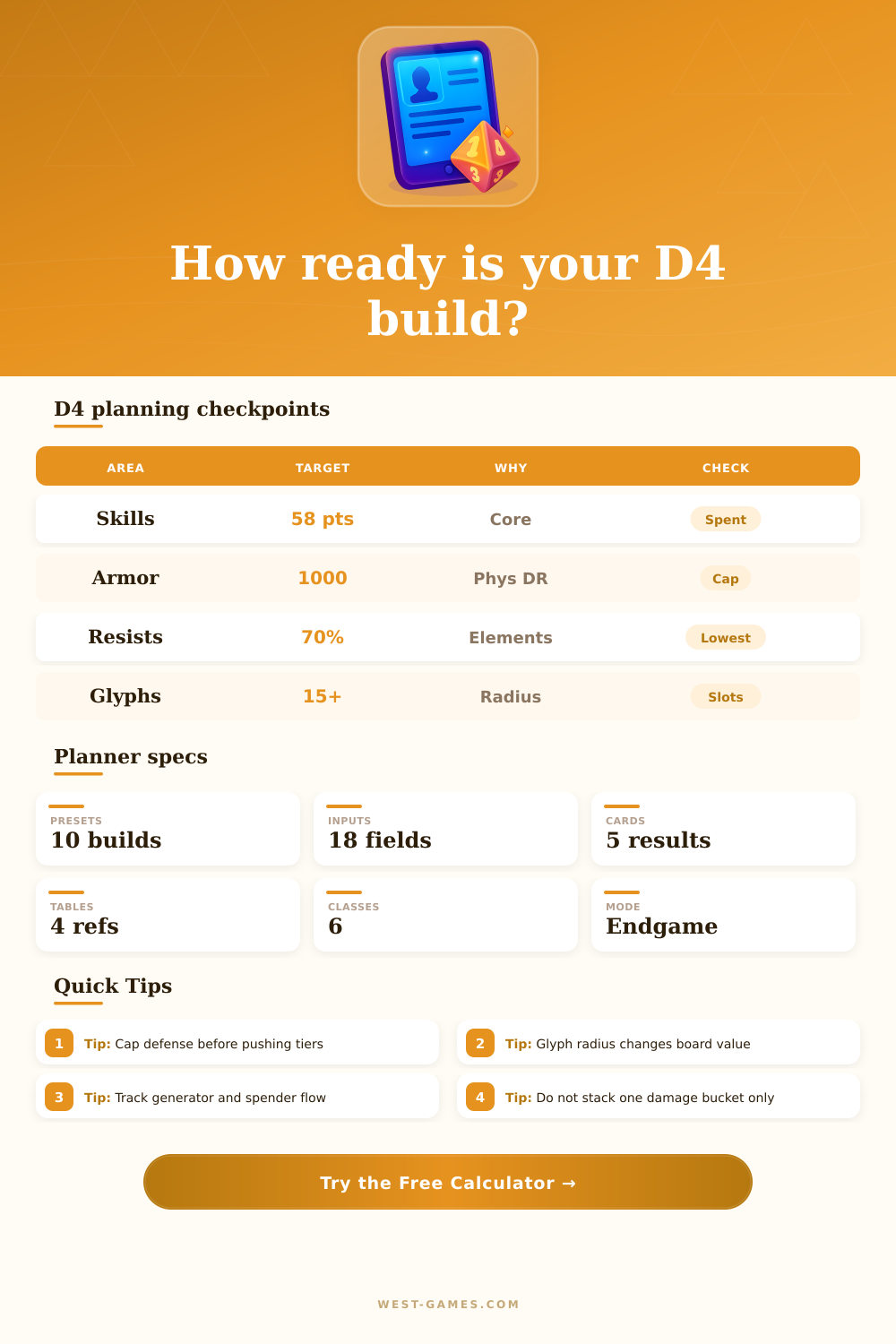
🔮 D4 Character Planner
Model class identity, skill point allocation, paragon and glyph assumptions, defensive caps, aspects, resource flow, damage buckets, and endgame activity fit.
| Build Stage | Core Damage | Defense | Check |
|---|---|---|---|
| Leveling shell | 5-7 pts | 6-10 pts | Reliable spender |
| World tier ready | 8-10 pts | 10-14 pts | Mobility online |
| Endgame baseline | 9-12 pts | 12-18 pts | Key passive fit |
| Push setup | 10-15 pts | 15-22 pts | Utility not skipped |
| Stat | Common Target | Planner Use | Warning |
|---|---|---|---|
| Armor | 1000 or custom | Physical cap check | Overcap can waste affixes |
| Resistance | 70% baseline | Lowest element check | Raise only with max-res sources |
| Life | Activity based | EHP confidence | Low life punishes boss hits |
| DR uptime | 50% plus | Survival multiplier | Gaps cause one-shots |
| Area | Baseline | Strong | Planner Impact |
|---|---|---|---|
| Boards | 3-4 | 5-7 | Legendary node access |
| Glyph sockets | 3 | 5+ | Multiplier density |
| Glyph level | 15 | 46+ | Radius and scaling |
| Main stat | 800 | 1400+ | Damage and rare nodes |
| Bucket | Good Signal | Bad Signal | Planner Input |
|---|---|---|---|
| Critical | 35%+ chance | Low uptime | Crit chance |
| Vulnerable | 60%+ uptime | Only opener | Debuff uptime |
| Aspects | One loop | Mixed tags | Aspect synergy |
| Additive | Matches tags | Random rolls | Bucket focus |
| Activity | Main Demand | Resource Need | Defense Need | Best Planner Signal |
|---|---|---|---|---|
| Nightmare Dungeon | Fast clear and control | Medium | Medium | Balanced readiness |
| The Pit | Scaling and boss damage | High | High | Caps plus buckets |
| Infernal Hordes | Area damage and uptime | Very high | High | Positive loop |
| Tormented Bossing | Single-target burst | Medium | High | Vuln and survival |
| Helltide | Mobility and sustain | Low | Medium | Utility points |
| PvP | Burst windows | Medium | Very high | DR uptime |
Targets are planning assumptions. Update armor and resistance caps in the form if your season, patch, item, or activity changes the effective cap.
Endgame character performance consist of several components, and endgame character performance require that you balance the components related to damage with components related to survival. Many player focus solely on the damage numbers of there characters because they believe that focusing on doing high amount of damage is the only way to survive in-game encounters. However, focusing solely on damage will cause you to die quick or to run out of resources within the game.
Your characters components can be divided into damage component and survival component category. Damage components can include crit chance and vulnerable uptime, while survival components can include armor, resistances, and damage reduction. If you do not focus on increasing only one of these components, you will experience diminishing return, and your character will not perform good in the endgame.
Balance Damage and Survival for Endgame Characters
A build planner will allow you to see if your character build identity match the goals you have established for your character. For instance, a build that excels at clearing Helltides may fail within the high-level Pit encounter. Your character’s build identity must match the specific game activity that you are performing.
Skill points are not merely an list of the skills that you will purchase for your character. The skill points that you purchase for your character involve a balance between the damage skill you purchase and the utility skill you purchase. If you focus solely on purchasing skill points for damage, you might not have enough utility to survive encounters with enemies.
You need to balance your skill point investment between damage and utility. Tables can be used to determine how many skill points you should allocate for defense and how many skill points you should allocate for damage skills for your character. Resource flow for your character is another important component for endgame.
Resource flow will allow you to determine whether you can use all of your skill. Many player will feel that purchasing a generator skill for their character is enough to generate the resources they need for their skills. However, if the resources you generate are less than the resource cost for your skills, you will run out of resources.
By calculating your resource gains over a ten-second window, you can ensure that you do not run out of game resources. If you find that you have a resource debt, focus on purchasing resource generation or cost reduction skill for your character instead of damage skill. The paragon board is the component of your game that give your character their identity.
The interaction between your glyphs and your paragon boards will have a tremendous effect on how strong your character will be during the endgame. If your glyphs have a low level, they will have a small radius for their area of effect. This means that they will not be able to reach the legendary node that your character will need to gain there full potential damage and utility skill.
If your character does not reach these legendary nodes, your character will experience an efficiency loss in their damage or utility skill. By using a build planner, you can input the level of your glyphs and the number of socket for your character. The planner will provide you with your multiplier density.
This will allow you to determine if your paragon investment are creating benefit for your character or if you are wasting resources on these investment. Survival in the endgame is dependent upon your lowest resistance to damage. This is different than your total amount of life.
For example, if you have high resistance to fire damage but low resistance to poison damage, a single enemy that do poison damage can kill you. Your lowest resistances must be maximized, and your armor must reach your target amount. If these component are satisfied for your character, you will have a baseline of safety for your character.
This baseline of safety is what allow the other damage reduction skill or defenses for your character to effectively function during endgame encounters. Building your character involve tweaking the fine detail of your character over time. A tool is available to model your character’s build.
Using this tool will save you and your material from attempting to upgrade your character in ways that will not make your character more effective in the endgame. To build an effective endgame character, you must layer your defense, balance your resource loop, and diversify your damage bucket. When you have all of these component in place, you will find that your character can survive and perform good during endgame encounters.