🏰 Kingshot Resource Calculator
Estimate food, wood, stone, iron, and gold for Kingshot castle upgrades, building gates, research targets, troop queues, hero boosts, optional dragon boosts, alliance helps, gathering marches, production buffs, and shortfall time.
| Preset | Target | Main gate | Timer style |
|---|---|---|---|
| Castle 16 Push | Castle level 16 | Wood | Castle build |
| Castle 20 Gate | Castle level 20 | Stone and iron | Castle build |
| Castle 25 Prep | Castle level 25 | Iron | Long build |
| Academy 24 Build | Building gate | Gold support | Building timer |
| War Research | Research stack | Gold and iron | Research timer |
| T9 Archer Queue | Troop tier 9 | Food | Split queues |
| Resource | Common use | Best fix | Calculator output |
|---|---|---|---|
| Food | Troop queues, healing, castle | Food focus and crates | Food wait |
| Wood | Castle, wall, academy | Wood marches | Wood wait |
| Stone | Mid and late buildings | Stone tiles | Stone wait |
| Iron | Late castle and war tech | Iron focus | Iron wait |
| Gold | Research and hero prep | Events and gold tiles | Gold wait |
| Input | Default role | Applied to | Planning note |
|---|---|---|---|
| Production buff | City income | Hourly production | Multiplies passive income |
| Hero boost | Economy heroes | Gathering and half production | Useful for march planning |
| Dragon boost | Optional account boost | Gathering and production | Set 0 if not relevant |
| Alliance helps | Timer support | Queue time | Applied before speedups |
| Speedups | Saved time | Remaining queue | Cannot go below zero |
| Resource wait | Status | Recommended action | Risk |
|---|---|---|---|
| 0 to 3 hours | Ready | Start after helps | Low |
| 3 to 12 hours | Small gap | Gather bottleneck | Low |
| 12 to 24 hours | Daily gap | Use reset rewards | Medium |
| 1 to 3 days | Large gap | Open targeted crates | High |
| 3+ days | Delayed | Split the plan | Very high |
| Preset | Food | Wood | Stone | Iron | Gold | Base hours |
|---|---|---|---|---|---|---|
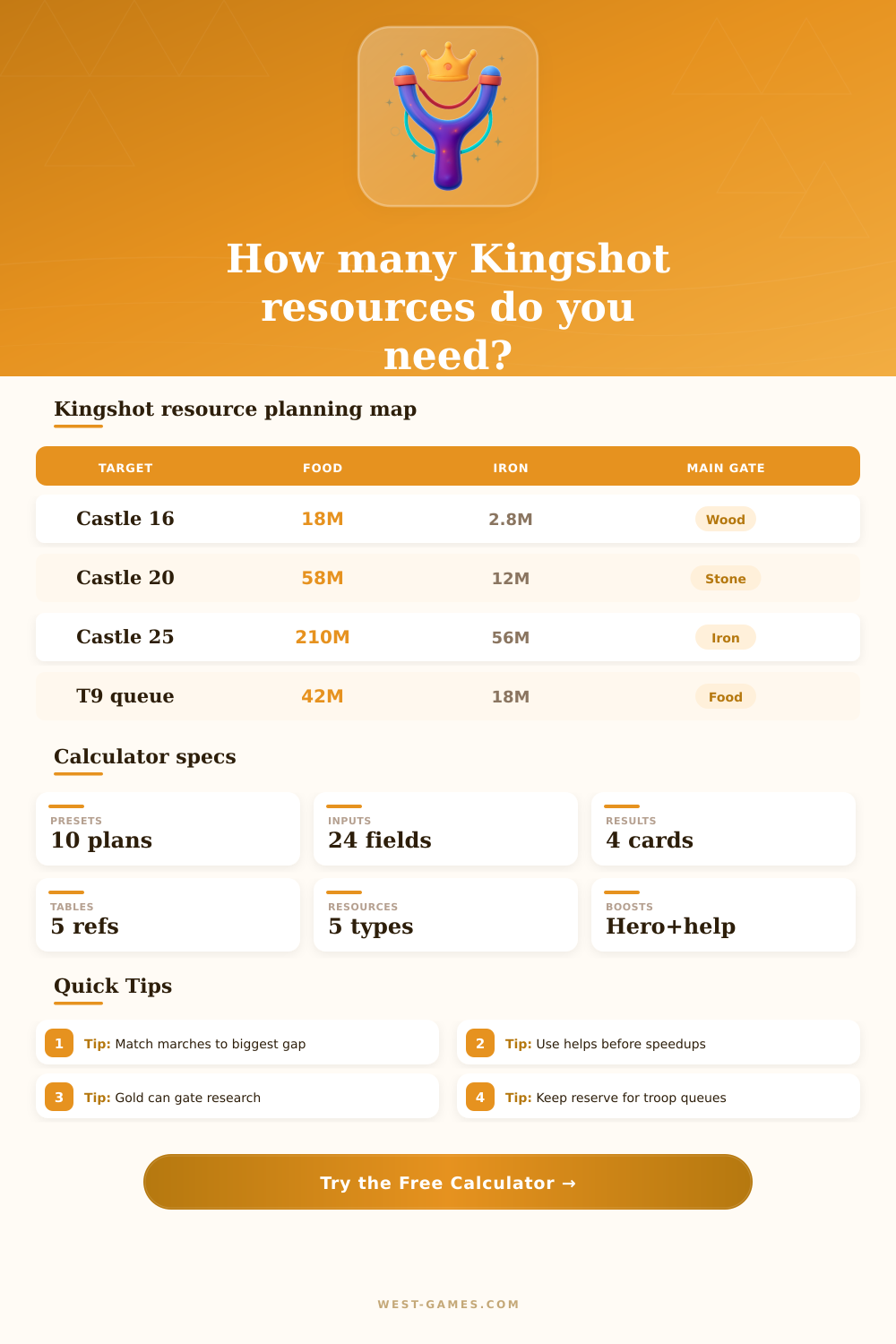
| Castle 16 Push | 18M | 24M | 9M | 2.8M | 700K | 36 |
| Castle 20 Gate | 58M | 76M | 42M | 12M | 2.8M | 96 |
| Castle 25 Prep | 210M | 260M | 150M | 56M | 15M | 280 |
| War Research | 34M | 48M | 28M | 36M | 42M | 120 |
| T9 Archer Queue | 42M | 24M | 0 | 18M | 3.5M | 28 |
Kingshot: Hovering over the button to upgrade a castle makes you anxious. What if it’s too much? What if you don’t have enough wood or food? What if you waste all these resources only to realize you’ve stalled yourself for days? It’s more than having the resources. You need time as well. Can you spare 48 hours for the timer to run out while your enemies makes progress? Should you hold off until you save up enough to upgrade right now?
With this page, the math is done for you. Just copy-paste some of your numbers from game screen and the calculator will tell you clearly when you’ll be finished with whatever research or building project you’re working on.
Use This Tool to Plan Your Upgrades
Resources are more than just buckets to be filled. Most people view them as such. “Okay, I need 10 million wood. Let me gather up to the number.” But they forget how much they produce and if they have any active boosts. Every hour, no matter what, your city generate passive income. It is free income every hour. Without factoring in this base, you’re going to either over-gather (accidentally) or undersupply (such as with slower resources like gold).
The tool factors in not only how fast you’re marching but also how much you produce per hour. It allows you to plug in specific boosts from events or other hero economy bonuses. Why? An event buff of +50% could save you eight hours of wait time, which would take away from your sleep. Do you really want to know whether it’s worth spending another minute tweaking your heroes build for the hour you’ll gain?
In most of these plans, the silent killer is gold. Gold gates upgrades for heroes and research tend to be more precious over time than levels for castles themselves. Because gold is different than other resources like stone and wood, the calculator cleanly shows how much you need to get by. Since you cannot collect as much of it from tiles, you need specific gathering activities and events. A gap in gold that lasts multiple days should instantly tell you: gathering alone will not save you. Time to look at saved speedups or alliance helps.
To help in understanding when certain resources become bottlenecks, the tool comes with some reference tables that outline common problem points across the game’s progression. For example, they point out that once you get past about level 20 for your castle, stone tends to be the main limiting resource. Knowing ahead of time lets you build up ahead off the pinch.
The other lever people misuse is alliance help. Because most players don’t know their alliance offers free hours, they burn through speedups far too soon. The planner will subtract the help you expect from your alliance from the timer. This mimics how effective guilds work. They wait for the free seconds and fill in the rest with time or premium items. It’s a tiny math change, but it saves precious speedups for emergencies down the line.
Before you lock in your plan, always ask your alliance leader if they think they can offer any help. If you have a good ally on your side, a three day wait becomes an afternoon project.
The tool assumes average costs for typical goals such as unlocking tier nine troops or getting to castle level twenty-five. These are just starting points; they are not absolute truth. Your specific costs will vary based off the buildings you have, the discounts you get, and what goals you actualy want to achieve. Never take the presets as truth; always replace them with the actual cost that appears on screen within the game itself.
Pay special attention to the safety reserve field. This means leaving some number (10% is a good start) of each resource unused so that you won’t run out of something just as you finish up a build. If you run out, then you can’t train troops instantly, and if someone’s about to raid your village, you’re toast too! Better to be a little late completing a castle upgrade than to find yourself out of cash when the weekend rolls around and it’s war time.
Below is a comparison grid that displays how different gathering focuses change your wait time. As you can imagine, it’s tempting to balance everything out just to be safe. However, in reality, it’s typically best to focus your marches based on whatever has the largest gap. For example, you’re low on wood? Ignore it! Sounds crazy right? You don’t wanna waste another day going without wood, but if your stone is still two days off, well…gathering an extra bag of wood doesn’t bring the end date any closer.
This tool will highlight the bottleneck for you and force you to think about what takes longest instead of what is easiest. That mental switch avoids wasting marching time. The main takeaway is that planning is about removing idle time from your queues. Don’t wait on one type of resource; keep everything churning when you’re asleep. Add in alliance support and active gathering. Then throw some production data into the mix to account for events down-time or bad luck. Drill in on where your real constraint exists. Then focus work there to close that gap.
The point isn’t to upgrade. The point is to upgrade without burning through your patience or your inventry. Save some for the upcoming push.