⛏ Ashes of Creation Gathering Quality Calculator
Estimate artisan skill pressure, tool quality, material rarity, node tier, survey and certification bonuses, processing loss, quality roll chance, and expected common, uncommon, and rare yield.
| Rank | Bonus | Tier help | Use case |
|---|---|---|---|
| Novice | 0 score | Tier 1 | Starter node loops |
| Apprentice | 7 score | Tier 2 | Regional materials |
| Journeyman | 15 score | Tier 3 | Contested routes |
| Adept | 24 score | Tier 4 | Danger-zone nodes |
| Master | 34 score | Tier 5 | Rare-node farming |
| Grandmaster | 46 score | Tier 6 | Guild-grade loops |
| Tool | Score | Rare push | Best fit |
|---|---|---|---|
| Crude | -8 | -2% | Emergency gathering |
| Common | 0 | 0% | Basic local nodes |
| Uncommon | 8 | 2% | Low-tier farming |
| Rare | 16 | 5% | Focused routes |
| Heroic | 24 | 8% | Scarce materials |
| Legendary | 34 | 12% | High-risk nodes |
| Material | Score | Base rare | Penalty |
|---|---|---|---|
| Common | 0 | 2% | None |
| Uncommon | 8 | 5% | Light |
| Rare | 18 | 9% | Moderate |
| Heroic | 30 | 14% | High |
| Legendary | 44 | 20% | Severe |
| Tier | Penalty | Yield | Route note |
|---|---|---|---|
| Tier 1 | 0 | 1.00x | Local safe nodes |
| Tier 2 | 8 | 1.10x | Regional routes |
| Tier 3 | 17 | 1.22x | Contested spawns |
| Tier 4 | 29 | 1.36x | Danger-zone trips |
| Tier 5 | 43 | 1.52x | Elite harvests |
| Tier 6 | 60 | 1.72x | Guild objectives |
| Preset | Profession | Skill | Tool | Rarity | Tier | Bonus | Loss |
|---|---|---|---|---|---|---|---|
| Novice Basalt | Mining | 12 | Common | Common | T1 | 2% | 8% |
| Copper Bloom | Mining | 28 | Uncommon | Uncommon | T2 | 10% | 10% |
| Desert Saffron | Herbalism | 46 | Rare | Rare | T3 | 18% | 14% |
| Moonbell Rare | Herbalism | 63 | Rare | Heroic | T4 | 28% | 18% |
| Guild Caravan | Mining | 88 | Heroic | Legendary | T6 | 41% | 20% |
For those artisans with Ashes of Creation’s souls in their eyes, the specific type of broken heart that comes from spending three hours collecting something, only to have it melt down into common-grade dust will be familiar. The node is a heavily fought-over Tier 4 one. You’ve got enough gear. The survey map seems ideal. And then the numbers within the game engine don’t give a damn what you did. They care about scores. That’s where most players end up losing ground.
It is not because of travel time or hostile mobs, but because they dont understand exactly how quality rolls stack against one another in real time. So what’s the main point of a given gathering path? How do you balance material quality with raw quantity? For one thing, higher tier nodes has higher base pulls, which seems efficient at first, but it comes with a downside: Poor gathering skills can reduces an entire harvest to common quality.
How to Gather Better in Ashes of Creation
The calculator does all the math for you. You input your skill level and node tier, and it spits out results. You don’t need to crunch numbers as you attempt to mentally determine whether that elite run will net you anything at all. Efficiency isn’t just about quantity. It is about amount of quality materials you will either use yourself for a high-tier recipe or sell on the auction house to someone else without being undercut by middlemen who take a cut of your silver.
The quality of your tools matters more then many new players realize. Going from common to rare doesn’t just make your gatherer look cooler when they’re getting stuff. They also gains a massive number of points to their effective quality score. This directly moves the probability curve in favor of uncommon and rare results. If you have low-quality gear, it’s going to be a drag that suppresses your rolls regardless of how skilled you are yourself. While it may save you some money initially by letting you use cheaper equipment, that loss, where you could of had those rare materials instead, is typically far higher.
Processing loss is the silent killer of profit margins. It could be material spoiling during transport, the refinery doing damage during refining, or just wasting stuff because of a crap roll. It is all post-yield material, and that’s what hurts most. If you’re getting thirty percent of whatever you haul turning into ash before you even get to your bank tab, you don’t care how good of a quality roll you got. Most players only focus on improving their chances of a rare drop. They do not realize they will still lose a certain percentage during those post-processor steps which can turn a run that seems profitable into a loss.
Beyond just stat sticks, however, there’s another level of complexity added in by ranking up your artisan profession. There’s a quality score bonus awarded for each rank bracket which scales back the penalty inflicted upon you by higher tier nodes. Even if two Journeymen has the exact same raw skill levels, one who happens to be on a Tier 3 node is going to fare much different from an Apprentice performing the same journey. This encourages specialization and depth. You’ll need to decide if you’d rather farm nodes at maximum efficiency despite being lower tier, or take on deadly high-tier spawns with help of improved gear and rank bonuses.
Consider the bonuses from certifiers and survey maps. The bonuses these two groups grant are temporary but frequently ignored, which is why I consider them bonuses. If you time your gathers around other guild events or buffs that decrease the processing loss even more, you can make a small run go from break-even to money-making in mere minutes. Gathering becomes a tactical exercise instead of just a mind-numbing chore.
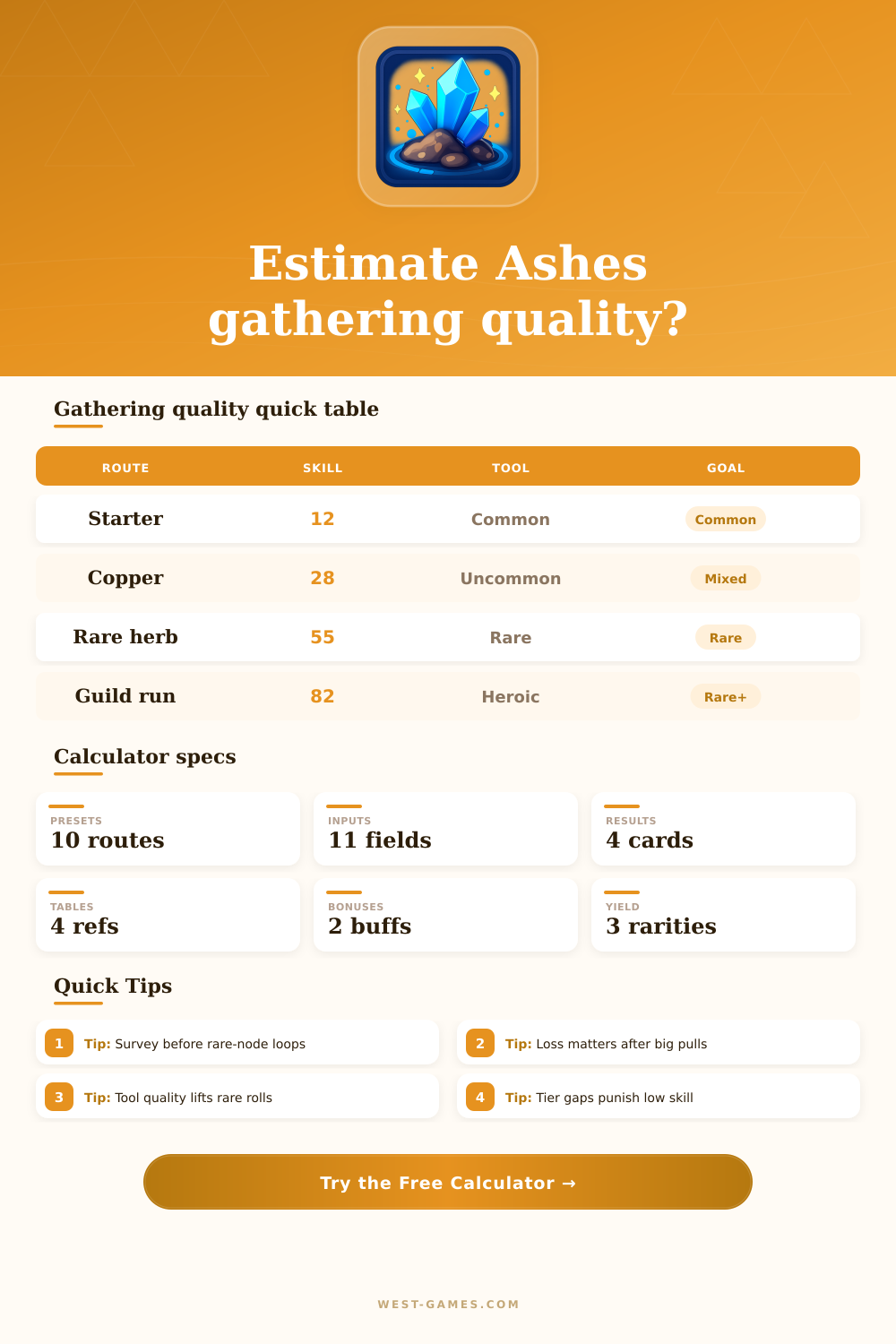
These are broken down neatly in the reference tables found on the page, which detail precisely how much weight every modifier brings to your total result. This explains why a Tier 6 run requires a Legendary tool and why someone who is just starting out should limit themself to what they have available locally until they get up to speed.
If you want to avoid coming away from all that gathering with a stack of worthless common items, it’s all about setting your expectations beforehand. In the end, it’s all about smart gathering. And that isn’t so much grinding as it is figuring out how the odds stack up for you. You need to see which variables you can change and which ones should be seen as an investment. At some point in time you stop seeing the node tiers as simply numbers and instead see them as risk assessments.
And then you gather intentionally instead of impulsively. It’s that change in thinking that makes it so each stroke of the hammer is no longer a coin flip, but instead a well thought-out choice. The numbers are still unyielding, but your approach to them doesn’t have to be. You can adjust on the fly to patch updates and server environments without having to relearn everything. He who knows the odds before he risks them is the one who succeeds.