🚀 Honkai Star Rail Resource Calculator
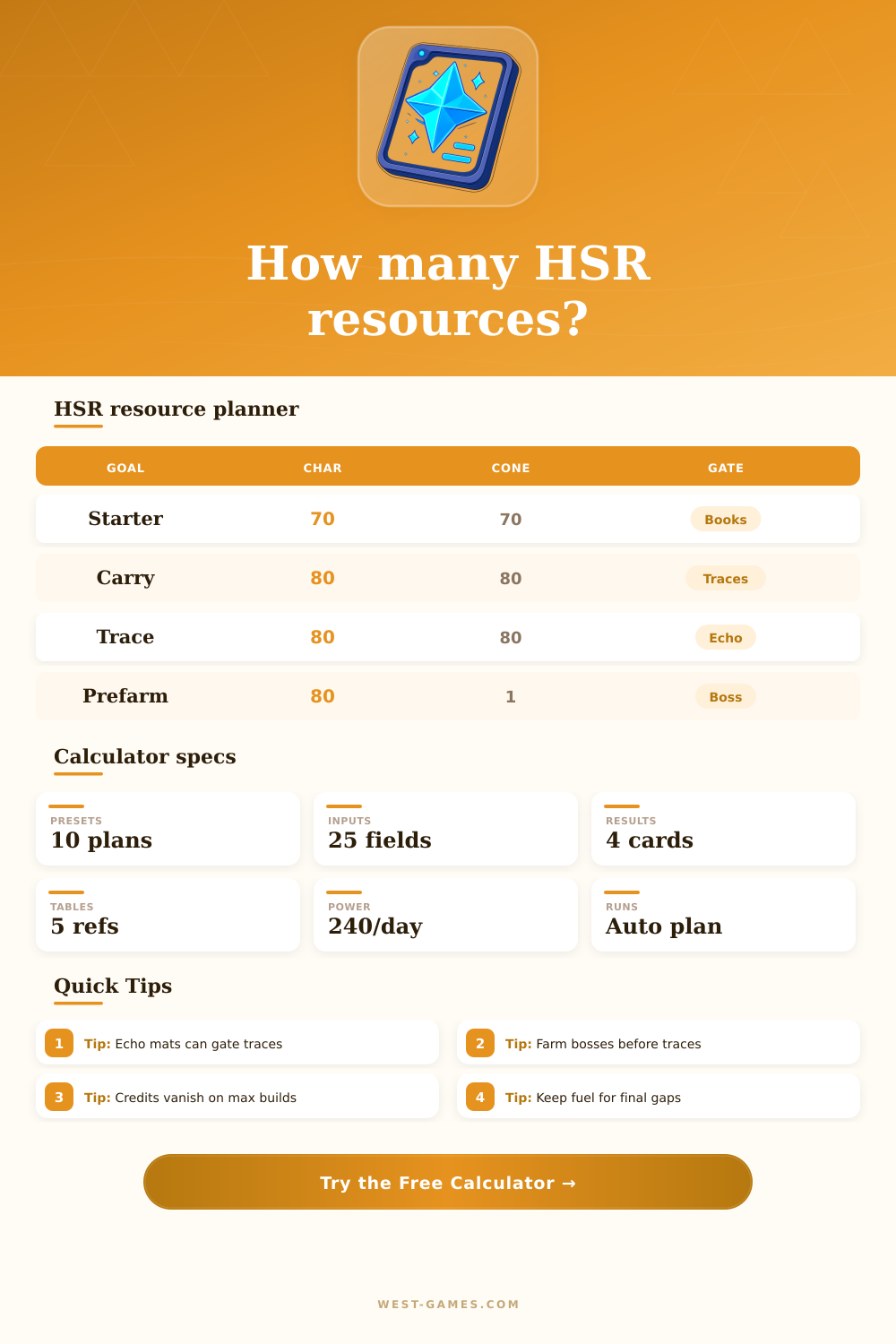
Plan HSR character levels, Light Cone levels, traces, ascension mats, Credits, EXP books, Trailblaze Power, Calyx runs, Stagnant Shadow runs, Echo of War gates, and days to target.
| Target | Typical use | Main resources | Planning risk |
|---|---|---|---|
| Level 60 | Early story and supports | Guides, Credits, ascension | Low trace ceiling |
| Level 70 | Budget MoC or PF support | More boss mats | Survivability check |
| Level 75 | DPS bridge point | EXP and Credits | Still needs final ascension |
| Level 80 | Main DPS or break scaling | Large EXP and Credit spend | Boss mat pressure |
| Two characters | Team pre-farm | All gaps multiply | Weekly traces lag |
The calculator uses milestone curves, then converts missing EXP into Traveler's Guide equivalents and farmable Power.
| Trace target | Best use | Gate | Calculator handling |
|---|---|---|---|
| Trace 6 | Starter builds | Calyx mats | Mostly farmable |
| Trace 8 | Most supports | Credits and mats | Moderate Echo pressure |
| Trace 9 | DPS upgrades | Echo mats | Weekly days checked |
| Trace 10 | Max carry investment | Echo and Tracks | Track gaps shown |
| Bonus nodes | Passives and stats | Enemy drops | Added to trace bundle |
Use exact character pages for final spending. This model is built for comparing farming load, not replacing in-game confirmation.
| Activity | Default cost | Resource planned | Run metric |
|---|---|---|---|
| Golden Calyx EXP | 10 Power per wave | Character EXP books | Waves |
| Golden Calyx Credits | 10 Power per wave | Credits | Waves |
| Crimson Calyx | 10 Power per wave | Trace path mats | Waves |
| Stagnant Shadow | 30 Power per run | Character ascension mats | Runs |
| Echo of War | 30 Power per claim | Weekly trace mats | Claims |
Saved Fuel is entered as total extra Power, then subtracted from the farmable Power requirement before daily days are calculated.
| Resource | Input unit | Used for | Notes |
|---|---|---|---|
| Refined Aether | 6000 EXP value | Light Cone levels | Converted from EXP gap |
| LC ascension mats | High-tier equivalent | Light Cone ascension | Farmed from Crimson Calyx |
| Trace mats | High-tier equivalent | Major trace levels | Path-labeled in plan |
| Enemy drops | High-tier equivalent | Ascension and traces | Usually passive farm help |
| Tracks | Direct count | High trace or key nodes | Not treated as Power farmable |
Material compression keeps the calculator readable. If you track low, mid, and high tiers separately, convert them into the high-tier equivalent you prefer.
| Preset | Main bottleneck | Power pressure | Best adjustment |
|---|---|---|---|
| Limited Carry 80 | EXP, boss mats, traces | Very high | Reserve Fuel for last gaps |
| Support 70/80 | Traces and Credits | Medium-high | Stop non-core traces early |
| Light Cone Only | Aether and LC mats | Medium | Skip character fields |
| Trace 8 to 10 Rush | Echo mats and Tracks | High weekly gate | Check Echo claims first |
| Double Prefarm | Boss mats and books | Very high | Split relic reserve lower |
The route comparison grid recalculates your active plan into farm lanes so you can see whether Calyx, Stagnant Shadow, Echo of War, or Credits are driving the schedule.
Players hit this wall when they finish their initial big story arc. They pulled the five-star character they wanted, dropped some Star Rail Pass currency, and now what? Turns out it’s not even half the battle: It’s also about staring at a list of credits, EXP books, and materials and trying to determine whether or not you has enough resources to optimize the unit before the next banner goes up. And that’s where those accounts stall, usually because players are just farming things equally hard, rather than concentrating on the bottlenecks that truly matter.
Plug in your starting inventory and desired amounts, and the calculator does the rest (above). No more fumbling with conversions and coefficients; it’s done for you. No longer do you have to estimate number of Crimson Calyx runs that will fill an evening, or count every last copy of Traveler’s Guide. It removes the clutter and lets you know if your plan fits your weekly reset and Trailblaze Power window.
How to Manage Your Resources Better
The key is knowing what’s being counted. It isn’t as simple as ‘leveling up’ a character. You are dividing a limited amount of energy each day to cover the rising costs of traces, ascension, and light cones. A common trap that new players fall into is spreading their efforts too thinly. They levels all their supports to 60, throw a bunch of light cone upgrades everywhere, push traces on everybody at once, and so forth. All these things will drain your supply of EXP books and credits but produce zero characters who can clear higher difficulty content such as Memory of Chaos or Pure Fiction well.
The tool illustrates this concentration effect. Set the number of characters to one and increase target level to eighty. The resulting material volume increases a lot. That’s not necessarily bad. In fact, it shows why making a main DPS character first makes sense. You want one spike of damage potential so you can clear out stages fast. This, in turn, frees up resources and time for other team members later.
The planner also takes into account the weekly bottleneck of Echo of War materials. Daily farming won’t fix a shortage of trace materials, which are a special class of material that need weekly boss drops. If your plan involves completing ten levels of a trace that needs weekly boss drops, the calculator will tell you exactly how many weeks it will take to fill that gap. It’ll keep you from being frustrated when you hit a soft cap where you’ve got infinite power and no way to spend it well on your top priority.
The page’s reference tables lay all of this out very clearly: they categorize activities as either daily farmable resources or weekly gated ones. Once you know the difference, you can adjust your expectations. Sure, you might hit level seventy in two days… But those last few trace nodes may take a month of patient weekly claims.
This also has a big impact on inventory management. Players will tend to hoard Refined Aether and Traveler’s Guides in case the meta changes and they’ll need them for something. Now there’s nothing wrong with saving, but if your primary carry is sitting at level sixty while you save up for some future event, that means a serious performance gap that can be difficult to close.
You can view the outputs of all the materials you own to get an idea of just how much work you’ve put into the game already. If you enter a sizeable stockpile of ascension mats, the needed Trailblaze Power drops significantly. Suddenly, instead of worrying about farming, it becomes about spending time. It pushes you to decide between being mat-starved or power-starved, two entirely different issues with completely different answers.
In conclusion, building a powerful team isn’t so much a grind-fest as it is a discipline in how you use resources; namely you’ll want to spend each day’s reset getting the most out of whatever upgrade grants the largest return-on-investment based off your team makeup. That plan becomes the sanity check provided by the calculator. It keeps you from telling yourself “I’m going to have my limited character all maxed out within 3 days” when the numbers say you’re looking at three weeks.
From there, you’re no longer chasing every drop. You’ve synced up your farm routine with the reasonable resource curve. You’re building steadily now. You would of wondered if you’re doing enough anymore. Doing the right thing now means that when the next update comes, your account won’t be catching up; it will be ready to go.