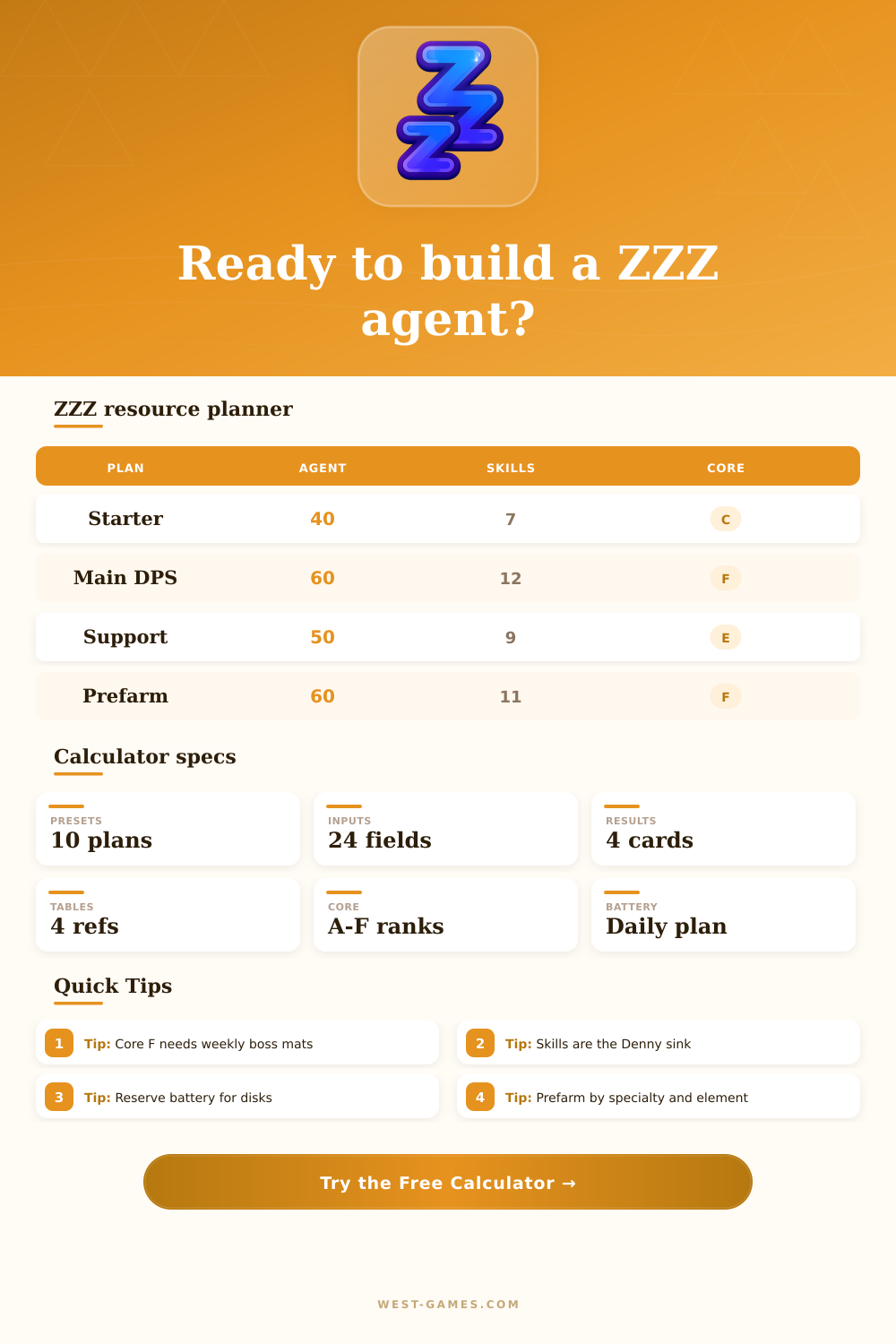
🎮 ZZZ Resource Calculator
Plan Zenless Zone Zero agent levels, W-Engine upgrades, skill chips, core passive ranks, promotion seals, Dennies, Battery Charge, weekly boss mats, Routine Cleanup, and target days.
| Upgrade | Level 1 to 60 total | Main mats | Dennies |
|---|---|---|---|
| Agent promotion | 4 basic, 32 advanced, 30 specialized | Certification Seals | 800,000 |
| Agent EXP | 300 Senior Log equivalents | Investigator Logs | Included in EXP plan |
| W-Engine | 4 basic, 32 advanced, 30 specialized | W-Engine components | 400,000 |
| One skill 1 to 12 | 5 basic, 15 advanced, 50 specialized | Attribute chips and 1 Hamster | 500,000 |
| Core A to F | 60 Higher Dimensional Data, 9 weekly mats | Expert Challenge and Notorious Hunt | 405,000 |
Different agents use different named materials, but the tier pattern is consistent enough for prefarm planning by specialty, attribute, and core boss.
| Category | Examples | Used by | Calculator input |
|---|---|---|---|
| Certification Seals | Attack, Stun, Anomaly, Support, Defense | Agent level caps | Specialty selector |
| Skill Chips | Physical, Fire, Ice, Electric, Ether | Basic, Dodge, Assist, Special, Chain | Attribute selector |
| W-Engine Components | Role component tiers | W-Engine promotion | Component bundle |
| Higher Dimensional Data | Expert Challenge drops | Core passive B to F | HDD owned |
| Weekly Boss Mats | Notorious Hunt drops | Core passive D to F | Weekly mats owned |
Bundle inventory inputs are high-tier equivalents for speed. For exact spending, compare the breakdown rows with your in-game material tiers.
| Farm item | Modeled Battery | Source | Planning note |
|---|---|---|---|
| Promotion seal | 4 / 8 / 12 | Combat Simulation | Basic, Advanced, Specialized |
| W-Engine component | 4 / 8 / 12 | Combat Simulation | Uses bundle input for owned mats |
| Skill chip | 3 / 5 / 8 | Combat Simulation | Specialized chips drive late skills |
| Higher Dimensional Data | 16 each | Expert Challenge | Editable mentally for bonus events |
| Dennies | 1,200 per Battery | VR Denny stage | Only counted when Dennies are short |
Battery assumptions are intentionally conservative. Coffee, events, Inter-Knot rewards, and shop conversions can reduce the actual days.
| Goal | Routine Cleanup share | Best use | Risk |
|---|---|---|---|
| 0% | All Battery to build mats | Fast prefarm finish | Disk progress stalls |
| 20% | About 48 Battery/day at 240 | Balanced weekly build | Needs patience |
| 35% | About 84 Battery/day at 240 | Drive Disc farming | Slower skill mats |
| 50% | About 120 Battery/day at 240 | Disk main-stat hunt | Build mats may miss deadline |
| Weekly gate | Boss mats per week | Core D to F | Cannot be rushed by normal Battery |
The result card uses the slower of normal Battery farming and weekly boss material pacing, then compares it with your target calendar days.
Your bag is always short on what you need. Your new S-Rank agent pulls in. Then you look in your bag, and it’s filled with nothing but…not that. That happens to many people. You’re in love with character art, you picture how they’ll shine in battle…and then you open up your bag. It is empty, or the incorrect items.
There are no resource readily available in Zenless Zone Zero. So if you don’t make a plan for resource gathering before you go after them, grinding becomes tedious, not progress. Because of this, grinding becomes mandatory and not optional.
How to Manage Your Resources Smartly
Upgrade in waves works with previous point. Don’t try to do everything at once. New players thinks “I have five skills to level up, plus a W-Engine to max out, plus six tiers of core passives.” Then they dump their entire stack of Dennies into every single slot before they’re even close to level 60. However, not all upgrades is created equal. In terms of bang-for-your-buck, skills tend to offer the biggest immediate power spike for each Denny spent. Mathematically, it makes sense to prioritize two or three key skill. This allows you to see results quickly while saving your own sanity.
This means gating off some resources vs. You might farm them when you design a build. Combat Simulation modes is a grind for skill chips and promotion seals and use up your battery charge so you can do that one as much as your stamina permits until you run out of the day.
Enter how many of each resource you have, and the calculator does math for you, so you don’t have to do any mental math to convert between materials. It will tell you whether or not you’ve got enough component and logs to reach level 60. More critically though, it points out what can’t be rushed. Levels D-F of core passives need Notorious Hunt materials, which drop only during weekly boss challenges. Spending more time logged into the game won’t help; all you can do is wait for the reset.
That distinction makes all the difference in how you’re spending your day. If mats are your weekly bottleneck, don’t waste your time grinding away on Combat Simulation and drop that battery into Drive Disc farming or Routine Cleanup instead. It’s a little change but it avoids wasted effort. The page has a handy reference table laying out material families clearly so you can see what each of those bosses drops. You don’t want to be grinding for Ice agent materials when your build needs Fire chips. Make sure you match up the attribute and specialty selectors in the tool so everything lines up by name with your real inventory. Anything else is just generic numbers that has no meaning in the game.
The other pain point is Dennies, which vanish fast in promotions. It’s a good idea to have some saved just in case you need to bail yourself out of resource shortages further on down the line. If you’re short, the planner will show you where you come up short with all of the currency at hand. And it’ll handle W-Engines, which can be forgotten about late into the game. That weapon level up consistently over time, giving you solid gains across the board. You would of needed a special boss drop.
It’s like having a budget: Your daily batteries represent your income; your weekly allowance represents your resource limits; each unit you spend should give you most value back. Maxing out cores provides long-term stability, while pushing skills provide quick returns. Balance both by considering your entire week (not individual sessions). Once you’re out of skill mats, move to W-Engine components. When those are gone, focus on core passives. Continue working down the list until no resource is idling while something else reach its limit.
It’s not enough to have a good agent. You also need to be prepared to play that agent when content comes out. The same goes for limited characters; you gather the resources ahead of time to avoid panicking later in the week. Check out some of those build presets, see what other people has found to work well, and tweak from there based off your own available inventory. Defaults don’t count for anything here, either. Plug in your true values. Thirty seals vs. Using ten seals could save you weeks on your schedule. Accurate data in = accurate plans out.
Don’t guess at “ohh I’ll max him out in 5 days.” Figure out your routine day-to-day and set a limit per week. Spend your money wisely, put away what you don’t need to rush, and wait patiently for what you can’t rush. That’s how you fill an empty inventory with a full roster without burning yourself out along the way.