⛵ ATLAS Resource Calculator
Plan ATLAS wood, thatch, fiber, metal, and hide needs for ship parts, crafting quality, biome material variants, crew gathering, weight hauling, and repair reserves.
| Target | Wood | Thatch | Fiber | Metal | Hide |
|---|---|---|---|---|---|
| Raft starter kit | 420 | 260 | 180 | 30 | 35 |
| Sloop build kit | 1,850 | 1,050 | 760 | 180 | 160 |
| Medium plank | 340 | 210 | 120 | 40 | 18 |
| Large plank | 560 | 310 | 180 | 65 | 26 |
| Large speed sail | 360 | 220 | 920 | 75 | 320 |
| Biome | Wood | Fiber | Metal | Best use |
|---|---|---|---|---|
| Temperate | 1.00x | 1.00x | 1.00x | Balanced hull work |
| Tropical | 0.95x | 1.15x | 0.95x | Sails and rope |
| Tundra | 0.95x | 0.90x | 1.10x | Hide and metal |
| Desert | 0.90x | 0.95x | 1.05x | Thatch runs |
| Polar | 0.82x | 0.82x | 1.25x | Metal staging |
| Quality | Material scale | Typical target | Reserve note |
|---|---|---|---|
| Common | 1.00x | Starter ships | 10% reserve |
| Journeyman | 1.35x | Trade ships | 15% reserve |
| Masterwork | 1.65x | Company hulls | 20% reserve |
| Legendary | 2.00x | War parts | 25% reserve |
| Mythical | 2.50x | Flagship parts | 30% reserve |
| Family | Weight/unit | Common bottleneck | Trip note |
|---|---|---|---|
| Wood | 0.50 | Hull planks | Cart or ship box |
| Thatch | 0.30 | Planks and decks | Fast bulk run |
| Fiber | 0.10 | Sails | Low weight, high count |
| Metal | 0.40 | Cannons and gunports | Route bottleneck |
| Hide | 0.25 | Sails and repairs | Hunt timing |
| Preset | Target | Quality | Crew | Reserve | Use case |
|---|---|---|---|---|---|
| Freeport raft | Raft kit | Common | 1 | 5% | Fast starter escape |
| Starter sloop | Sloop kit | Common | 2 | 10% | Solo or duo launch |
| Schooner hull | Medium planks | Fine | 3 | 15% | Trade hull frame |
| Brig trade ship | Large planks | Journeyman | 5 | 18% | Company cargo ship |
| Galleon war refit | Gunports | Masterwork | 8 | 25% | Combat rebuild |
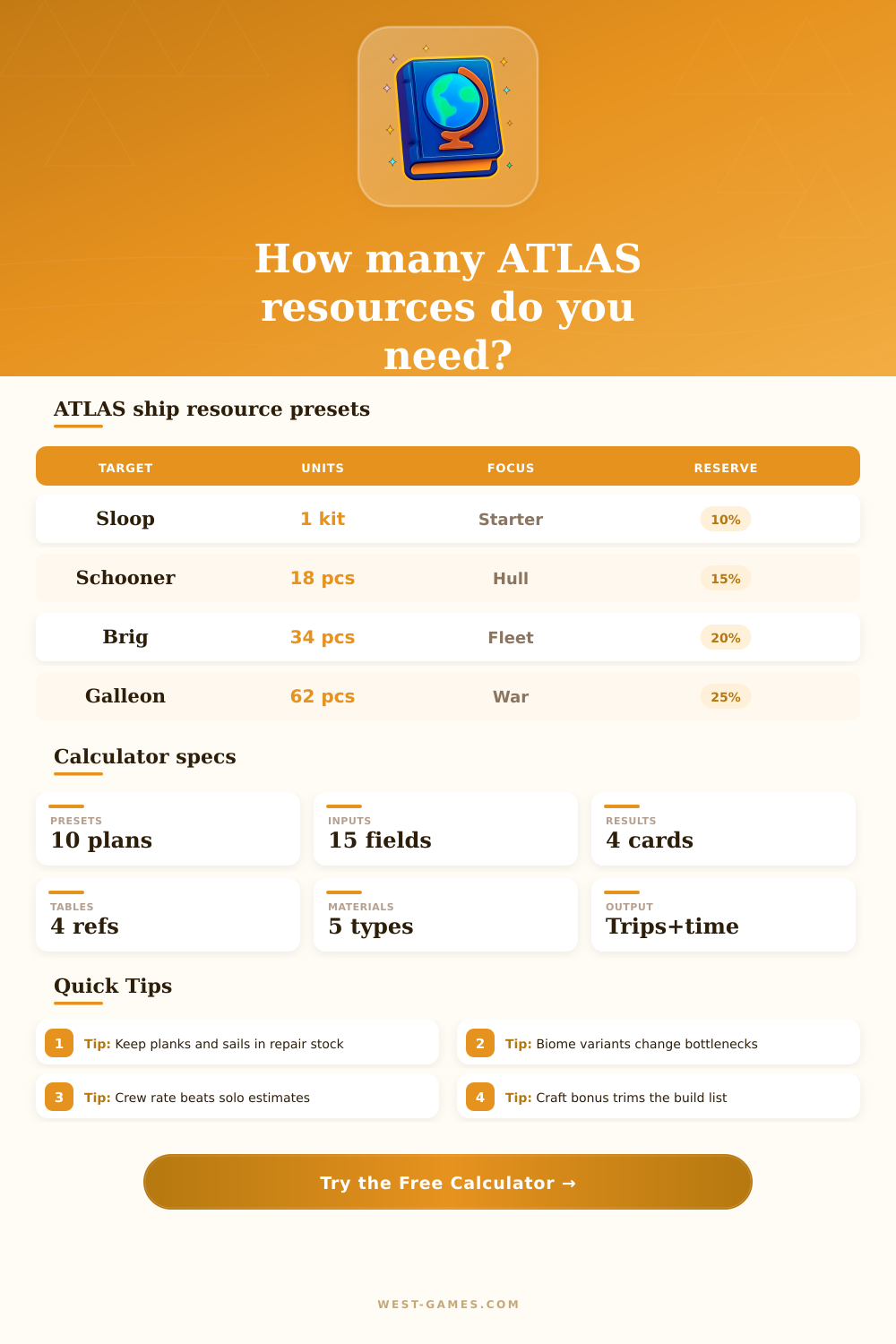
Instead of standing on a virtual shore staring at a crafting menu requesting resources you could never gather in a lifetime, you type in the time and effort needed to get those resources. This turns that abstraction into gameplay time. Want to craft a war ready galleon? A sturdy sloop? The resource requirements seem abstract until they represent actual hours of gameplay. That’s where the calculator kicks in. Type in what you’re trying to make and your gathering conditions. It spits out a number: the number of trips across the ocean floor. It saves you from estimating how long all that realy amounts to.
AT Atlas’ primary challenge isn’t merely learning which ship to construct. You’ll need to understand how quickly higher building quality increase the resources you need. While a beginner may be able to handle a lower-tier raft kit alone, attempting to reach Masterwork or Mythical levels will multiply your requirements for materials like metal, fiber and wood by up to two and a half times. Many players stall at this point, underestimating the amount of high-quality raw material required to produce high-end ships. By adjusting recipes to match your chosen quality level, the tool helps ensure your plan is based off actual crafting requirements rather than more optimistic starting assumptions.
Planning Your Ship Build
The one tiny reprieve to this price increase is crafting skill. Crafting serves as an efficiency discount which cuts away at the end material list. While buffer isn’t huge, it’s something when you’re lugging thousands of items through treacherous waters. Also factor in what’s in your storage. Owning stock counts toward your goal so you don’t have to worry about gathering right now. You don’t need to collect if you own the materials. Often players don’t think about their own stockpile until they slam into a wall.
Where you are can change what materials is available to you. For example, on a tropical island, you may find an abundance of fiber for sails but lack any metal. On a polar region, you might find it easy to get ore but struggle for wood and thatch. For example, on a tropical island, you may find an abundance of fiber for sails but lack any metal. On a polar region, you might find it easy to get ore but struggle for wood and thatch. You’ll see from the reference table above that the variant pressure determines where your bottlenecks will emerge. If you’re gathering in a desert, anticipate that runs for metal to slow down your progress while thatch runs will be efficient. Knowing this beforehand stops the frustration when you arrive at a crafting station missing that critical component.
Perhaps the least considered aspect of ship construction is repair reserves. Combat, monsters and waves will cause damage to ships. In other words, the material with which you started isn’t sufficient. To avoid being put back hours worth of gathering time after one bad storm or battle, keep some sails, deck and plank parts in storage away from the main build queue. Fifteen to twenty percent is not overly pessimistic. It’s a practical survival plan for anyone venturing out past shallow water.
Logistics turn those resource numbers into time commitments by gathering them together. How many people can you get on a crew? What’s an average gather rate for your tools and travel time? How efficient are they? This turns those fixed resource numbers into pieces of game time. The big crew with super high gather rates will see the total hours drop off like a rock. Meanwhile that solo guy out humping heavy metal around at low carry weights could be taking days worth of resources to collect. The trip count output lets you visualize that physical work. This serves as a reminder that each unit of material carry a distance and a weight behind it.
Building ships isn’t so much about building the ship but about navigating your way towards it. It’s a process, an exercise in both planning and patience. Knowing your surroundings dictates your pace. The ocean doesn’t seem quite as intimidating when you realize it’s not just an inventory list but a logistics puzzle. Running stops being about chasing numbers; it’s about organizing expeditions. Missions becomes calculated runs that produce actual yields.