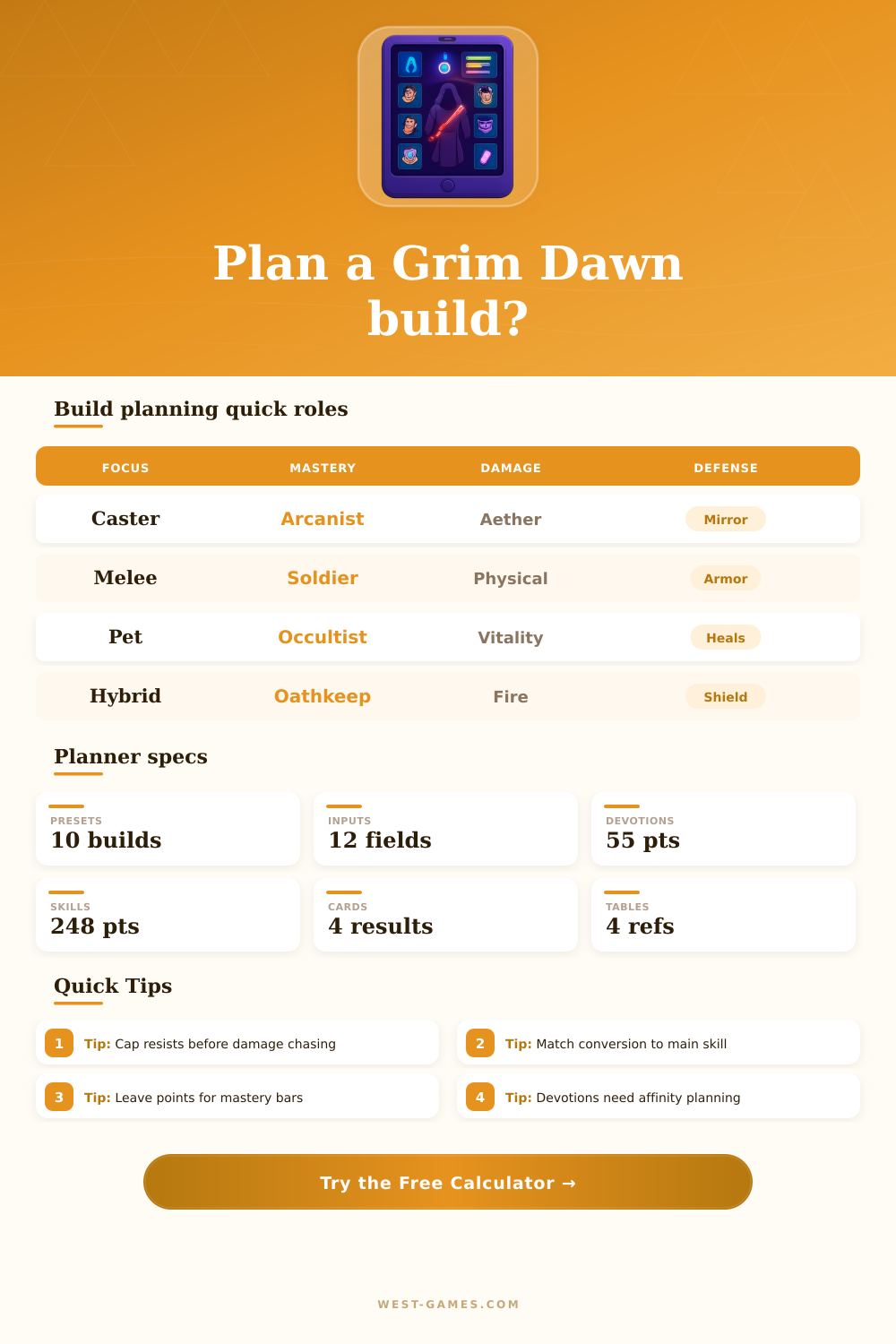
Grim Dawn Character Planner
Plan a complete build route across mastery pair, attributes, skill points, devotion affinities, resistance caps, conversion, and gear priorities.
| Pair | Best fit | Key defense | Point load |
|---|---|---|---|
| Paladin | Fire shield caster | Seal + shield | Medium |
| Vindicator | Lightning attacker | Totem + Seal | High |
| Conjurer | Vitality or pets | Blood of Dreeg | High |
| Spellbinder | Aether caster | Mirror + Mark | Very high |
| Warlord | Physical tank | Armor + shield | Medium |
| Stage | Base cap | Overcap | Priority |
|---|---|---|---|
| Campaign | 60-80 | 0-15 | Elemental |
| Elite | 80 | 15-25 | Chaos + pierce |
| Ultimate | 80 | 25-40 | All main resists |
| Celestial | 80 | 40-60 | Fight-specific |
| Damage | Conversion goal | RR sources | Gear stat |
|---|---|---|---|
| Fire | Physical to fire | Thermite, Aura | Burn + fire |
| Aether | Elemental to aether | Devotion, class | Cooldown + OA |
| Vitality | Acid or chaos to vitality | Curse, Rattosh | Leech + decay |
| Acid | Physical to acid | Guardian, Manticore | Poison + DA |
| Physical | Elemental away | Assassin, Break Morale | Trauma + armor |
| Level | Skill plan | Devotion plan | Gear check |
|---|---|---|---|
| 1-35 | Rush main skill | First RR path | Resists on rares |
| 36-65 | Second mastery | Core sustain | Armor absorption |
| 66-93 | Exclusive skill | Tier 3 damage | Faction augments |
| 94-107 | Polish softcaps | Final 55 points | Set + components |
| Slot group | First priority | Second priority | Planner note |
|---|---|---|---|
| Weapon | Main skill modifier | Conversion or attack speed | Do not split damage types without a reason. |
| Jewelry | Resistance reduction support | Offensive ability | Great place to patch damage and OA together. |
| Armor | Resistance and armor | Health and DA | Chest, legs, and boots carry most survival patches. |
| Medal and relic | Skill bonuses | Cooldown or proc utility | Use these to reach efficient softcaps. |
| Components | Missing resistances | Armor absorption | Seal, scale, and powder choices stabilize Ultimate. |
Reference values are planning targets, not item recommendations. Adjust for your actual monster infrequent rolls, set bonuses, and faction augment access.
Planning a character require decisions about many element of the game. These include your mastery class, skill points, devotion constellation, and gear. Gear has a significant bearing on how you will fare in the game.
If any of the character element dont work well together, the character will fall apart the moment the game’s difficulty increase. This planning tool will allow you to visualize your character before you spend your skill point. This tool will convert your mastery classes, your damage type, your attribute bias, and your devotion route into a point and priority distribution for your character.
How to Plan Your Game Character
This tool wont eliminate the need for your judgment, but it will help you visualize where the pressure point will be for your character upon reaching Ultimate or when chasing celestial content in the game. Your mastery classes will indicate where the focus of your character will be. Some classes are geared towards defense while others focuses on dealing heavy damage with burst spells or skill that enhance your pet.
This will help indicate if your mastery classes will require your point to be distributed into the mastery bar or if you will have exclusive skill point left over from your total number of skill points. Knowing the pressure that your mastery class will create will allow you to decide whether to take on that pressure or change the direction of your character. Your attribute will determine what gear you will be able to wear.
If you opt for a physique-heavy split of attribute, you will have a better chance of staying alive in the early content of the game and will have more flexibility in choosing armor or health affix later on. If you shift your attribute point towards cunning or spirit, you will have more flexibility in the weapons and weapon that you can use. However, you will have a much harder time surviving game content if your gear dont work with your character.
When planning your devotion route, you should ensure that your character does not fail at this stage. Devotion constellations offer damage spell, defense node, and resistance reduction. They also have specific affinity that need to be combined to activate their power.
Choosing a devotion route that matches both your damage type and your defensive route will ensure that you do not waste devotion point on star that will not help your build. This calculator will show how you can distribute your 55 devotion point between offense, defense, and sustain spell so that you can see if your chosen route allows for the constellation that you desire for your character. Resistance management will be required once you pass Normal difficulty.
Your resistance will protect you from the resistance reduction that your enemy will use against you. Additionally, having an overcap of resistance will protect you and allow you to use your gear as you will not drop your resistance under 80% as the game will reduce your resistance when you are under that percentage. This planner will ask for the overcap that you want to reach and the stage of the game that you would like it to reach so that you can see what the resistance should be and how much of it you can trade for damage or utility spell.
Conversion allow your gear and your skill to funnel your damage into a specific type. Your resistance reduction and devotion constellations will be much more efficient if you funnel most of your damage into a specific type. By selecting a percentage into the conversion function of this planner, you can see if your gear and skill will allow you to reach your goal or if you will be forced to funnel your damage into several type in your games.
Your gear will change as you play the game. In the beginning of the game, resistance patch and armor absorption will be important for your survivability. However, later in the game, set bonus and infrequent monster roll will be important for your defense and damage output.
This gear survival planner accounts for gear strength because if your gear is strong in one area, you should not invest many attribute point into bolstering that area because your gear will take care of it for you. The value of this planner go beyond the numbers that it will present for your character. You should always ensure that your mastery class, damage type, devotion route, and gear all work well together before you invest much into the game into building your character.
By making small change at the start of the game, you can save yourself and your character from frustration down the road that you could of otherwise avoided with a few small adjustment at the start. A character that feels good together at level 60 may fall apart once you reach the challenge of Ultimate difficulty. It is important, therefore, to return to this planner to ensure that your original design for the character is still visible to you.
By returning to this tool, you can ensure that the upgrade that you make to your character will not work against your original design for the character. The goal is not to build the perfect character the first time you build it, but to get to the endgame of Grim Dawn with a well-design and well-cohesive character.