🥊 Frame Advantage Calculator
Calculate fighting-game advantage from startup, active frames, recovery, blockstun, hitstun, cancel windows, FPS timing, meaty contact, and the opponent's fastest punish.
You give up the turn, but the defender needs range and a fast button.
Plus frames are enough for a jab, throw threat, or tight stagger.
The defender's listed punish is not guaranteed after spacing.
No active cancel is reducing recovery for this move state.
| Result | Label | What it means |
|---|---|---|
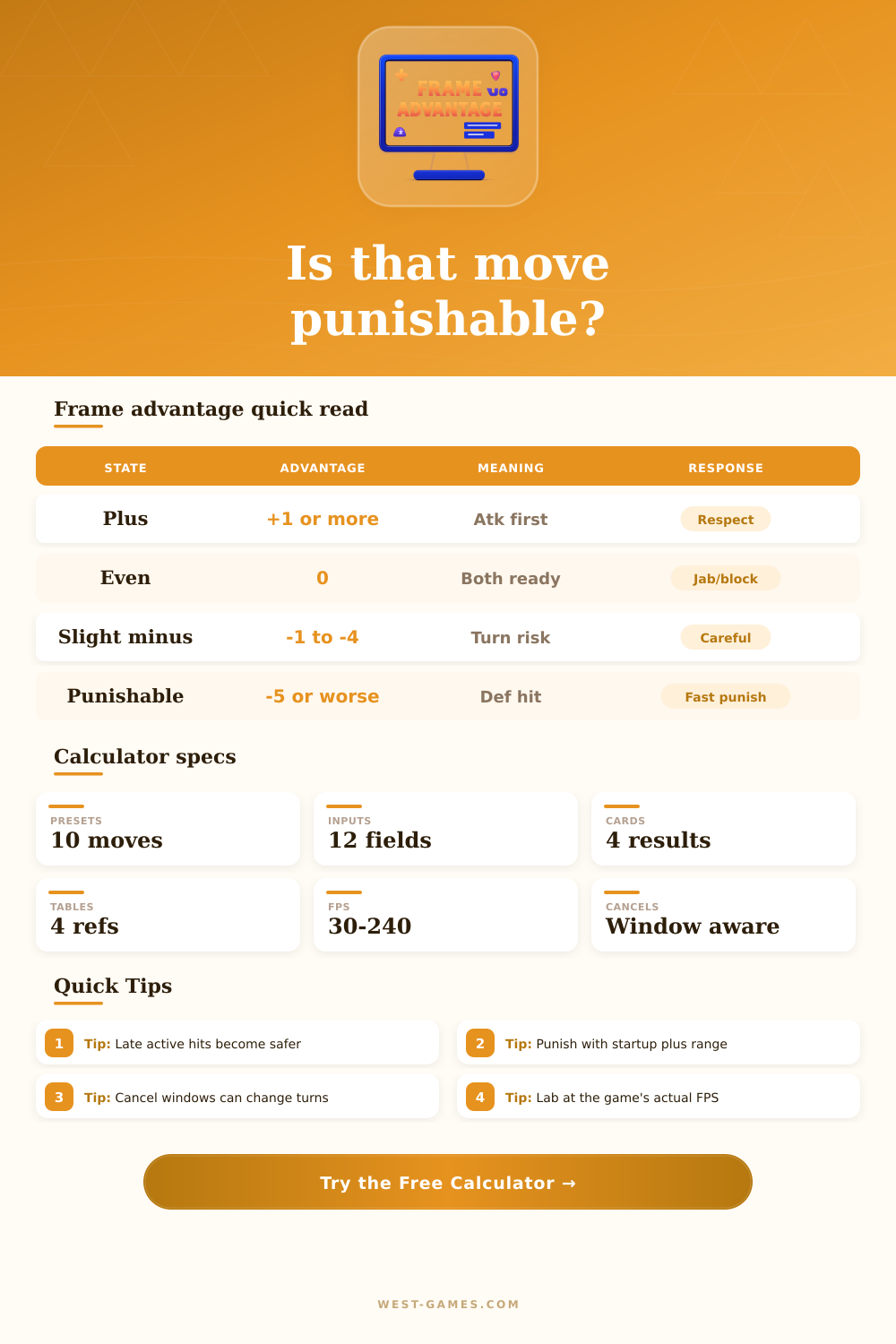
| +5 or more | Strong plus | Attacker can enforce strike, throw, or many links. |
| +1 to +4 | Plus | Attacker acts first, but invincible or armored options may matter. |
| 0 | Even | Both players recover together; fastest startup usually wins. |
| -1 to -4 | Slight minus | Attacker loses turn but is often not punishable. |
| -5 or worse | Punishable | Defender can punish if range, hurtbox, and input timing allow it. |
| Move type | Typical startup | Use |
|---|---|---|
| Fast jab | 3-5f | Interrupts gaps and punishes small minus moves. |
| Throw | 4-7f | Beats blocking when in range, often loses to jump or backdash. |
| Medium poke | 6-9f | Controls neutral and checks walk-ins. |
| Heavy starter | 10-16f | Bigger damage but easier to interrupt or whiff punish. |
| Super / reversal | 1-10f | May ignore normal turn rules if invincible. |
| FPS | 1 frame | 5 frames | 10 frames |
|---|---|---|---|
| 30 | 33.33 ms | 166.67 ms | 333.33 ms |
| 60 | 16.67 ms | 83.33 ms | 166.67 ms |
| 120 | 8.33 ms | 41.67 ms | 83.33 ms |
| 144 | 6.94 ms | 34.72 ms | 69.44 ms |
| 240 | 4.17 ms | 20.83 ms | 41.67 ms |
| Mechanic | Frame effect | Lab note |
|---|---|---|
| Late active hit | Improves advantage | Each later active contact usually adds one frame of safety. |
| Special cancel | Skips recovery | May be safe only if canceled into a safe follow-up. |
| Hit-confirm cancel | Hit only | Great for combos, not a block safety guarantee. |
| Pushback | Changes punishability | A move can be minus enough but still out of range. |
| Whiff recovery | No defender stun | Use total frames and spacing to estimate whiff punish timing. |
| Preset | Startup | Active | Recovery | Block | Hit | Cancel |
|---|---|---|---|---|---|---|
| 3F Jab Check | 3 | 2 | 7 | 8 | 12 | Hit chain |
| Plus Poke | 9 | 3 | 13 | 17 | 22 | None |
| Classic Sweep | 8 | 4 | 24 | 16 | 36 | None |
| Dragon Punch | 5 | 5 | 33 | 16 | 38 | None |
| Safe Special | 14 | 4 | 18 | 20 | 27 | Block cancel |
Have you ever been in a match where you feel as though you traded blows with them but failed to control the tempo? You make your move, they block it, and suddenly they press their button before you. You are reminded that fighting games exist within discrete chunks of time called frames. In most titles, each frame last only one sixtieth of a second (barely long enough to even blink). But those tiny fractions can add up to huge difference throughout a round. The difference between guessing at what’s happening and controlling the neutral game is knowing how many frames you have, or owe.
So we’ll let the calculator do all the math for you (above). Just plug in the raw frame data, like recovery and startup active frames, and add stun values. It will then spit out who go next. Most folks learn their character’s hitstun and blockstun by rote, but then they fail to realize that the math shift if the actual point of contact is one or two frames earlier or later. A well-timed attack might land on its last active frame instead of its first, giving you an important additional frame of safety. This is what most folks miss.
How Frames Change Your Game
A move isn’t some fixed thing; it has a range of possible values that are based off both on spacing and timing. For example: a medium poke with seven frames of startup and three active frames. That sounds like a slow poke on paper, but maybe that short window where your opponent have their feet up off the ground as they start to rise could mean you have just enough time to land it and catch them off guard, forcing a panic block or even a guard break.
The tool also allows you to change cancel windows and contact frames, which reflects how these games actualy work better than static charts do. Special moves that are cancelled into often don’t skip any of their recovery frames, allowing an otherwise punishable mistake to become a safe one. It’s an important mechanic to understand, as it makes clear why certain moves is only safe when chained into other inputs.
The enemy’s toolset is another big factor in punishability. Six frames to start up sounds awful until you find out that their quickest button require them to walk in towards you first. That one frame will be the difference between life and death if they have to close distance first. Spacing modifiers are also taken into account by the calculator so you know whether something is actualy punishable or not versus merely worth less points. If they aren’t going to get anywhere near your character’s hitbox then it doesn’t really matter if you’ll get punished. This is why checking range in training mode is just as important as reading the numbers. Maybe a move is sorta-minus on block, but it forces the enemy back enough that they can’t use their strongest counter so you still maintain the lead.
Damage is only half the story for debating good fighting game moves; people often incorrectly ignore the frame cost entirely. A lot of damage won’t matter when it leaves you ten frames behind after a miss and puts you in danger of losing control of the screen. Smart players understand that tempo and consistency trump brute strength. Quick jabs cuts off your opponent’s attempts. Safe pokes apply pressure without fear. The included reference tables from the calculator will help you sort them into those familiar tiers based on how they actualy affect the fight rather than how much hype they have.
Frames plus enable you to set the pace. Frames minus compel you to play defense against their counter. Even trades depend on who can press first. Frame data is ultimately just a guide, not a rulebook. Throw ranges, invincibility animations, and armor properties all add variables we can’t encapsulate in pure math. But knowing where those frames come from provides a mental map for every interaction. You no longer react by habit; now you play with intent.
The next time someone blocks your attack or lands one on you, consider where those frames go. Did they give you time to respond? Or did you gift them time? Knowing how to use frame advantage transforms chaotic exchanges into calculated decisions. You’ll see the invisible grid governing every duel and learn to step on the squares that put you ahead.