🎲 DnD Experience Calculator
Build a session XP ledger for 5e-style games: share creature awards, add story XP, rate the encounter band, and compare XP advancement with milestone pacing.
| CR | XP | Use case | Party note |
|---|---|---|---|
| 1/8 | 25 | Minion | Level 1 fodder |
| 1/2 | 100 | Scout | Early threat |
| 1 | 200 | Boss | Tier 1 anchor |
| 3 | 700 | Elite | Low-tier spike |
| 5 | 1,800 | Brute | Mid-tier foe |
| 8 | 3,900 | Major | Hard solo base |
| 12 | 8,400 | Nemesis | Needs support |
| 17 | 18,000 | Legend | Epic danger |
| 24 | 62,000 | Mythic | Campaign cap |
Use printed creature XP for awards, then apply encounter multipliers only to judge danger.
| Enemies | Normal | Tiny party | Large party |
|---|---|---|---|
| 1 | 1x | 1.5x | 0.5x |
| 2 | 1.5x | 2x | 1x |
| 3-6 | 2x | 2.5x | 1.5x |
| 7-10 | 2.5x | 3x | 2x |
| 11-14 | 3x | 4x | 2.5x |
| 15+ | 4x | 5x | 3x |
The calculator auto-shifts one step up for fewer than three heroes and one step down for six or more heroes.
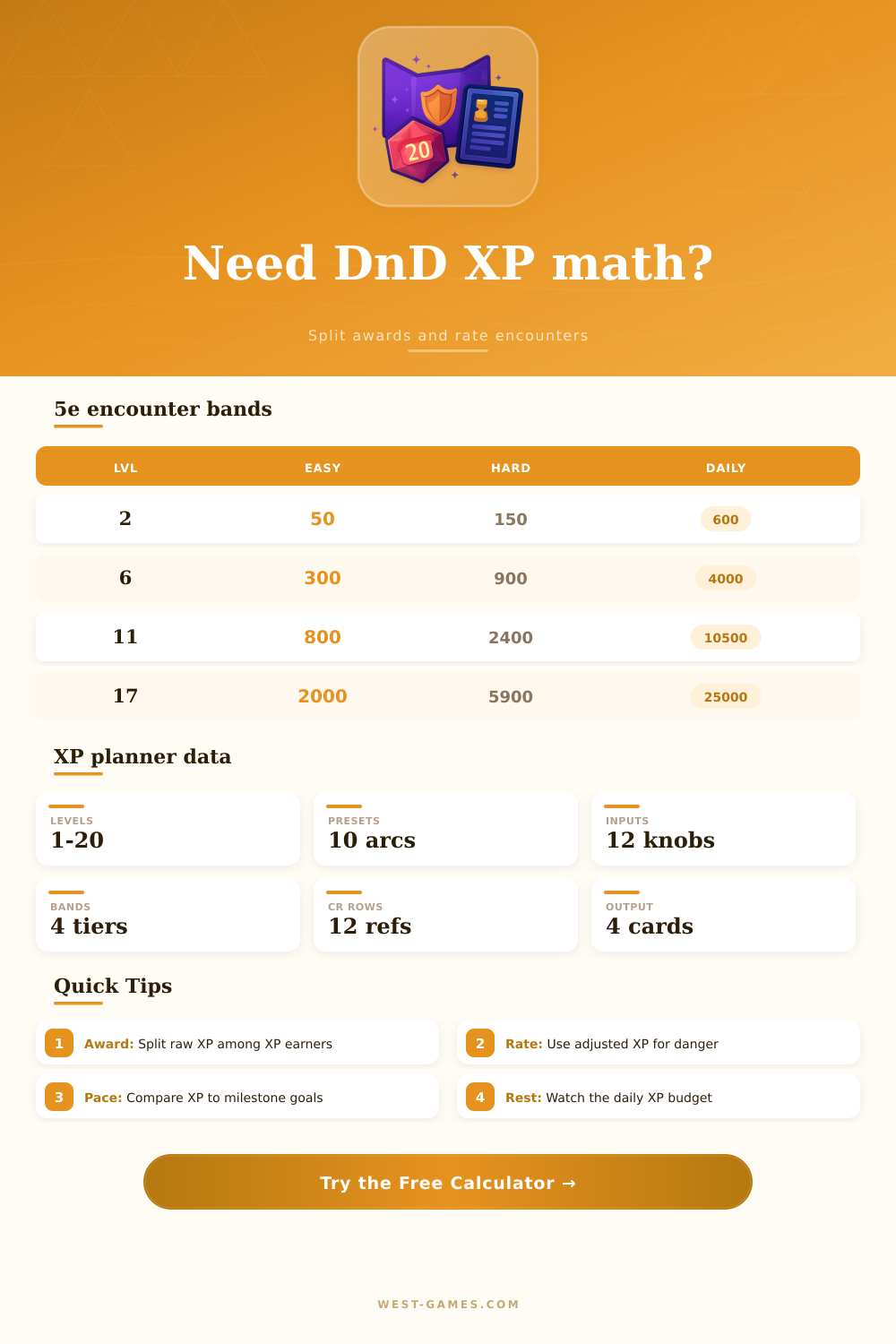
| Level | Easy | Medium | Hard | Deadly |
|---|---|---|---|---|
| 2 | 50 | 100 | 150 | 200 |
| 4 | 125 | 250 | 375 | 500 |
| 6 | 300 | 600 | 900 | 1,400 |
| 8 | 450 | 900 | 1,400 | 2,100 |
| 10 | 600 | 1,200 | 1,900 | 2,800 |
| 14 | 1,250 | 2,500 | 3,800 | 5,700 |
| 18 | 2,100 | 4,200 | 6,300 | 9,500 |
Multiply the row by the number of active heroes to get party thresholds.
| Level | Total XP | Next gap | Daily each |
|---|---|---|---|
| 1 | 0 | 300 | 300 |
| 3 | 900 | 1,800 | 1,200 |
| 5 | 6,500 | 7,500 | 3,500 |
| 7 | 23,000 | 11,000 | 5,000 |
| 11 | 85,000 | 15,000 | 10,500 |
| 15 | 165,000 | 30,000 | 18,000 |
| 19 | 305,000 | 50,000 | 30,000 |
Daily XP is a planning pressure gauge, not a required number of encounters.
Experience tracking is the process that many groups use to determine the growth of there characters and the amount of reward that each of there characters will receive. Experience tracking is important because experience tracking will tell a player when their character is growing, as well as tell the dungeon master when the challenge in the story are appropriate for the characters. If the table uses a calculator for experience tracking, the calculator will handle the math for the group so that the table can focus upon whether or not the numbers provided to each character are appropriate for the character table.
Three of the main inputs that should be used in experience tracking are the number of characters in the party and the number of creature that were killed during the fight. The number of characters that are fighting will impact the amount of experience that each character receives; the more characters in the party, the less experience that each character will receive. For instance, a four-person group will receive more experience than a six-person group.
How to Track Experience and Rewards
In addition to the number of characters in the party, the number of creatures that are killed will impact the experience for the characters; the more creatures that are killed, the more difficult the fight is for the characters. Thus, the experience total will be increased to reflect the difficulty in killing that many creature. In addition to combat experience, another experience that can be awarded to the characters is story experience.
Story experience is provided when the characters take actions in the campaign that are not related to combat, such as bypassing a trap or securing an alliance with another group of adventurers. This story experience can also be entered into the experience calculator along with the other numbers for the campaign, and the setting for the sessions that were completed during that campaign. This information will allow the table to determine whether or not the experience that is provided to the characters is even across each session of the campaign.
In addition to the experience that is calculated for the characters, there are three main outputs of the experience calculator. The first output is the per-character gain in experience; the experience value that is written on each character sheet. The second output is the danger band, which compares the total experience that the party earned to the experience levels that the characters have.
The third output is the comparison of the daily budget for adventuring; this comparison indicates how much of an adventuring day’s pressure that the fight had for the characters. These three values help to indicate the table and players whether or not the experience is appropriate for the characters. Many groups has issues if they use combat as the only method of determining experience for the players.
If combat is the only determining factor for experience, the players who use clever methods to beat challenges may be undervalued compared to those who kill many enemies. Additionally, the players may experience significant increases in experience after completing only a few combats, yet feel no increase after other sessions. This daily budget output for adventuring can help to avoid these issues prior to there emergence.
Milestone pacing is another method that some DMs use in addition to experience tracking. Milestone pacing involves awarding experience to the characters when the narrative of the campaign reaches certain points. These percentages can be compared to experience using the experience calculator; this will allow the table to determine whether or not the experience awarded to the players indicates that the campaign is on schedule with its milestones.
The tables provided on this webpage can aid the table in answering various questions regarding experience and experience calculation. These tables can show the value of a challenge rating for the monsters that were killed, how many experience points each level has, and the per-character experience thresholds for each level. After calculating the experience for the campaign, it may be necesary to adjust the numbers that were calculated.
For example, if the party took significant effort to avoid combat, the total experience that is awarded for the campaign may need to be reduced to reflect that the challenge was not dangerous. Alternatively, if the characters experienced a difficult fight, the experience may need to be increased to reflect that the party experienced challenges that were significant to the campaign. This information will help the table to plan the next few sessions for the players.
The daily budget for adventuring is another output that can be used to aid the table in planning the campaign. For example, if each fight utilizes thirty or forty percent of the daily budget for adventuring, then three or four fights will use up the entire adventuring day of the players. Thus, the table can decide whether or not they will take a short rest or reduce the challenges in the next portion of the campaign.
Experience tracking can help the players and table to make decisions regarding the challenges of the campaign. For example, if players know that the experience numbers are even and appropriate for the characters, they will attempt to use creative solutions to any challenge to gain the experience. If experience tracking is perceived as arbitrary, however, the players will default to combat in order to gain experience.
Thus, by removing the math for the players, experience tracking allows for the players to focus upon the experience numbers to determine their actions in the campaign. The goal of experience tracking is to make the experience earned by the players (and displayed on their character sheets) a transparent measure of the players performance during the campaign. Because the table can determine how many experience points each player earned based off the experience levels of the monsters that were slain, the story experience earned from specific actions, the experience levels of the players, and the daily budget for adventuring, the table and players can discuss the campaign and the type of campaign that they would like to play together.