World of Tanks Effective Armor Calculator Mod
Build a mod-style armor overlay with nominal armor, plate slope, camera impact angle, shell caliber, normalization, overmatch, spaced armor, live effective armor, and penetration margin.
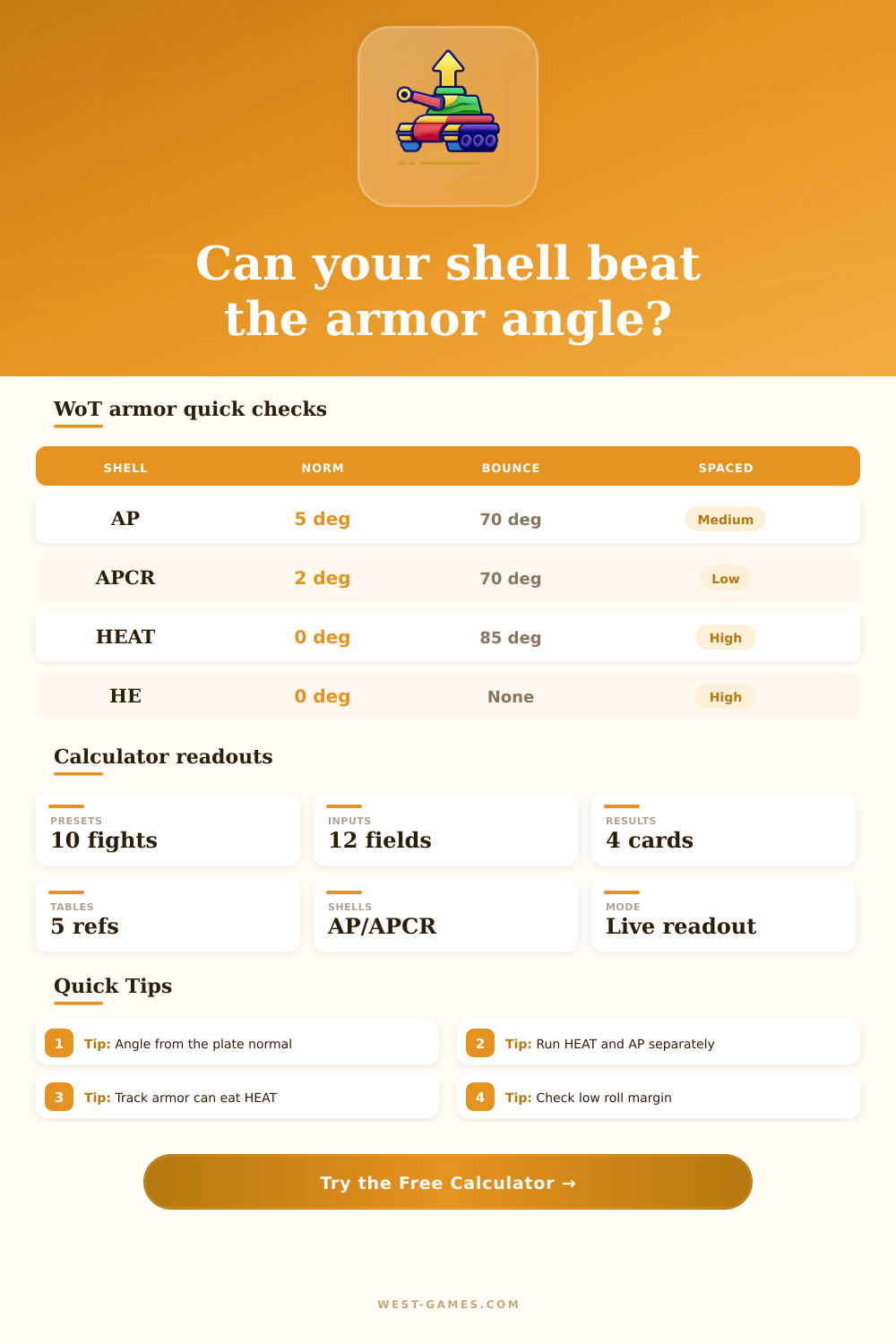
| Shell | Normalization | Ricochet gate | Spaced behavior |
|---|---|---|---|
| AP | 5° baseline | 70° unless 3x overmatch | Moderate track and skirt penalty |
| APCR | 2° baseline | 70° unless 3x overmatch | Lower normalization makes angle matter more |
| HEAT | 0° | 85° planning gate | Very sensitive to tracks, screens, and spaced layers |
| HE | 0° | No classic AP-style bounce | Direct penetration is hard through layered armor |
| Readout | What it means | Typical feel | Watch point |
|---|---|---|---|
| 0-25° | Mostly flat impact | Pen value matters most | Weak spots can be reliable |
| 26-50° | Sloped or offset plate | Effective armor climbs fast | Normalization changes the result |
| 51-69° | Sharp armor presentation | Low rolls start failing | Compare AP and APCR separately |
| 70°+ | Ricochet danger zone | AP may bounce before pen check | 3x overmatch can remove the bounce gate |
| Ratio | Calculator treatment | Practical read | Example |
|---|---|---|---|
| Under 2x | Normal shell rules only | Angle remains punishing | 90 mm shell into 60 mm plate |
| 2x-2.99x | Small angle pressure bonus | Thin plates are less safe | 122 mm shell into 50 mm side |
| 3x or more | AP/APCR ricochet gate disabled | Still needs enough penetration | 152 mm shell into 50 mm armor |
| HEAT | No overmatch credit | Spaced armor is still dangerous | HEAT into tracks or screens |
| Layer | Typical entry | Best use | Risk |
|---|---|---|---|
| Tracks | 20-40 mm | Side bait and wheel shots | HEAT may vanish before main armor |
| Side skirts | 5-60 mm | Side-scrape and reverse angles | AP can still normalize through |
| Mantlet | 40-180 mm | Turret front layering | Local holes can vary heavily |
| Screens | 5-25 mm | HEAT protection | Weak if the main plate is flat |
| Scenario | Main readout to watch | Useful inputs | Shot planning note |
|---|---|---|---|
| Hull-down turret cheek | Adjusted angle and weak spot factor | High nominal armor, curved profile, small yaw | Compare cheek and cupola as separate readouts. |
| Side-scrape corner trade | Ricochet gate and spaced equivalent | High impact yaw, side skirt thickness, AP vs HEAT | HEAT can lose despite higher listed penetration. |
| Pike nose face-off | Combined angle | Plate slope plus camera yaw offset | One pike side often becomes much weaker than the other. |
| Light tank side shot | Overmatch state | Low nominal armor and large caliber | Large AP/APCR shells can ignore the bounce gate. |
| Long range sniper | Adjusted pen average and low roll | Distance, shell type, penetration value | Garage pen can look safe while low roll fails. |
| Track wheel bait | Spaced layer total | Track thickness, track angle, HEAT selected | Shoot past the wheel if the main plate is hidden. |
This calculator is a planning model for angle literacy and mod-style readouts. Exact live game outcomes can vary by hidden collision model, shell path, armor group, and patch-specific mechanics.
In the game World of Tanks, each shell either penetrate the armor of the enemy tank or the shell ricochets off of the enemy tank’s armor. The angles at which the shells hits the enemy tank’s armor are often angles that players dont have the ability to view while they are playing the game. Enemy tanks has armor plates that are not flat to the view of the player’s gun.
An effective armor calculator allow players to account for those invisible angles in the game. Effective armor is not the same as the armor thickness of the enemy’s tanks. Instead, effective armor is the distance that the shell must travel through the armor plate of the enemy tank.
How an Armor Calculator Helps You in World of Tanks
For instance, a 200 millimeter plate that is angled at 60 degrees can have the same effect as 400 millimeter of armor. An effective armor calculator can calculate this value for the player if the player enters the thickness of the armor plate, the built-in slope of the armor plate, and the angle of the armor horizontal to the player. The effective armor calculator also accounts for shell normalization, a small amount that armor-piercing bullets straighten when they make contact with armor.
The degree of shell normalization differ between different types of shells; this can impact whether a shell ricochet or penetrates armor. Overmatch rules add to the complexity of the calculation of effective armor. If the caliber of the player’s shell is three times the thickness of the armor of the enemy tank that the player is targeting, a shell will ignore ricochet rules and will definitely make contact with the armor.
The effective armor calculator consider this factor automatically. This factor is important in particular in the face of light enemy tanks and side armor; the large gun of an enemy tank will ignore angles that would stop a smaller shell. If a player does not use the effective armor calculator’s features related to overmatch rules, the player may waste premium game rounds to fire at enemies whose armor can be penetrated.
Spaced armor add further complexity to the calculation of effective armor. The spaced armor can include armor tracks, side skirts, or mantlets in front of the main armor plate. These spaced armor plating design will eat into the power of the shell before it arrives at the main armor of the enemy tank.
HEAT shells suffer the most from spaced armor, but armor piercing shells can also be impacted if the outer layer of the spaced armor is angled relative to the player’s gun. An effective armor calculator allow the player to enter both the thickness of the spaced armor and the angle of that spaced armor; the armor calculator calculates the thickness and angle of the main armor plate to remain accurate in its calculations. If a player does not separate the spaced armor from the main armor in their calculations, they may not accurately calculate how much penetration is required to hit their target enemy tank.
The reference tables included on the page relate to these calculations. The reference tables include information about the angles at which shells will ricochet, the normalization of armor piercing shells, and how spaced armor work. If a player takes the time to read these tables, they can form an understanding of these calculations that can be utilized in the game.
Many players learn about these mechanics only by firing shells at angles that appear weak to them. The benefit of using an effective armor calculator is that it can help a player to learn which situations is safe to take risks in versus which situations will punish them for their lack of patience. For instance, a player might find that a turret cheek may appear safe to target but may have an angle that makes it unsafe to fire at it with certain types of shells.
Similarly, side-scrapes may work once but not another time due to differences in thickness of armor skirts or because the enemy tank use HEAT shells. The effective armor calculator allow players to test this same angle for AP, APCR, and HEAT shells in under a minute. Distance is another factor that may influence whether a shell penetrates the armor of the enemy tank.
Armor piercing shells and APCR shells lose strength with distance, but HEAT shells does not. The effective armor calculator allow for a distance curve to show the player how accurate the penetration value will be at 400 meters. This feature prevents players from making the mistake of assuming that penetration values at which they can hit the armor in they’re own garage will have the same results at range during the game.
The final component of the effective armor calculator include the hit quality of the tank’s armor. Fields in the armor calculation model weak spots, reinforced spots, and curved surfaces in the enemy tank without having to change any other factors in the calculation. For instance, a cupola might be 30% thinner than the remainder of the enemy tank’s armor.
If the armor calculator models both the thinner cupola and a thick mantlet, a player can compare the two to determine which is a better target. The armor calculator does not replace the player’s experience in the game but it can shorten the learning curve for players to master these calculations. Once players understands how to calculate the armor of an enemy tank and how the various elements impact that calculation, players will be able to read the angles on the map and take their shots with confidence.
Actualy, players should of known this sooner. Youll find that the moddern math is more complex than it looks.