♟ USCF Elo Calculator
Estimate a post-event US Chess rating from current rating, prior games, opponent ratings, game results, expected score, K factor, bonus threshold, and rating floor.
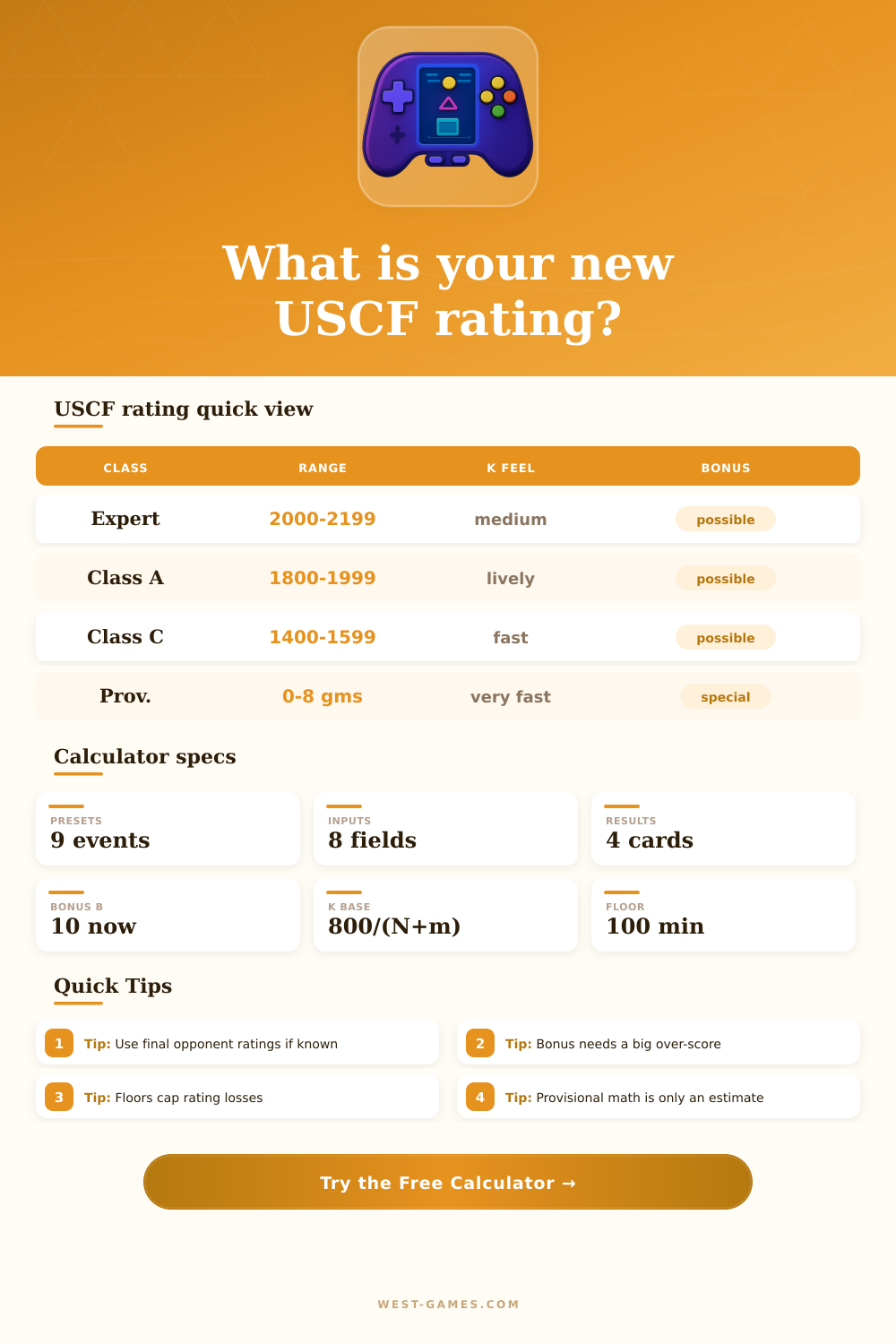
| Band | Rating | Practical read |
|---|---|---|
| National Master | 2200-2399 | Small K, tough bonus threshold |
| Expert | 2000-2199 | Strong events still move rating |
| Class A/B | 1600-1999 | K often remains active |
| Class C/D | 1200-1599 | Upsets can swing quickly |
| Class E and below | Under 1200 | Opponent mix matters a lot |
| Effective games | Event games | K |
|---|---|---|
| 6 | 4 | 80.00 |
| 6 | 6 | 66.67 |
| 20 | 4 | 33.33 |
| 20 | 6 | 30.77 |
| 50 | 6 | 14.29 |
| Entry | Score | Use case |
|---|---|---|
| W or 1 | 1.0 | Win, forfeit win if rated |
| D or 0.5 | 0.5 | Draw, agreed or played |
| L or 0 | 0.0 | Loss, rated forfeit loss |
| Skip blank | Ignored | Unplayed or no-move game |
| Rule item | Calculator treatment | Why it matters |
|---|---|---|
| 2025 bonus | B=10 by default | Lower threshold means more bonus chances |
| Three-round events | Uses m0=max(m,4) | Short events still use four-game threshold |
| Repeat pairings | Blocks bonus when flagged | Official formula limits repeat-heavy events |
| Rating floor | Applies entered minimum | Prevents displayed estimate below floor |
| Comparison | Meaning | Best use | Warning |
|---|---|---|---|
| Actual line | Your entered score and pairings | Post-event estimate | Official crosstable may use final ratings |
| Half-point less | One draw changed to a loss, or win to draw | See sensitivity near section cutoffs | Not a withdrawal tool |
| Half-point more | One loss changed to draw, or draw to win | See rating upside from one result | Bonus can make jump uneven |
| Bonus target | Score needed to beat B x sqrt(m0) | Check breakout events | Special/provisional ratings differ |
All rows use the same entered opponent list; the dynamic comparison cards above update with your event.
Chess ratings is a numerical estimate of the strength of a given chess player. A players chess rating change after they play one or more rated games. Chess ratings are important to the chess player because their ratings determine the tournament in which they can enter, and which tournaments may send invitations to the chess player.
While many players feel uncertain about how their rating will change after the completion of a tournament, it is actualy calculated on the basis of a few different factor. The calculation of a player’s current chess rating use a few different factors: the player’s current rating, the number of rated games the player has completed, the ratings of their opponents, bonus point, and rating floors. The player’s current games and the number of games they have played will determine how much the outcome of their next games will affect their current rating.
How Chess Ratings Change
For players with few completed games, small deviations in the outcome of their games will lead to significant change in their current chess rating. For players with many completed games, changes in their rating will be less pronouncedly. The other factor that the system considers in the calculation of a player’s rating is their opponent ratings.
By comparing the strength of their opponents to their own, the system calculates the difference between the games they won against strong opponents compared to weak opponents. This difference in rating is used to calculate the change in their own rating. The higher the difference in rating between opponents and themselves, the more points the system will add to their chess rating.
Another factor in the calculation of their rating is bonus point. The system awards these to players whose current score reach a threshold that is based off the number of games played in a specific tournament. Not all chess tournaments allow bonus points for their participant, as the system calculates that many chess tournaments has many repeated games between the same opponents.
Therefore, to avoid inflation of the ratings of those who frequent play against the same opponents, the system does not award bonus points in those cases. Another way in which the system calculate a player’s rating is through the consideration of their rating floor. Each player has a floor to their rating that their rating cannot go below.
In most cases, players’ ratings remain above their floors, so they are not observed in the majority of games. However, should a player experience a drop in their performance, the rating floor will act as a protection for that rating. A player can distinguish between provisional and established ratings through the use of different calculation mode.
Provisional ratings use the performance rating for the current event and their history, while established ratings use only the standard rating formula. As a result, changes to the player’s rating will be larger with the use of provisional ratings. To test these two option, a player can use a calculator to compare the changes that each mode will create in their rating.
Finally, there are a few factors that the system does not account for. Most notably, it does not account for the human factor that can impact a chess player’s performance in their games, or the fact that their rating is always a small delayed measurement of their actual improvement in strength. Instead, the system treats each player’s games equally, and a single tournament may not always reflect their true strength.
However, a player can treat their chess rating as an estimate of their true strength, the more games they play and the more consistent their performance within those games. To efficient use the system to manage their chess games, a player must enter their opponent ratings correct, and have an understanding of the difference between provisional and established ratings.